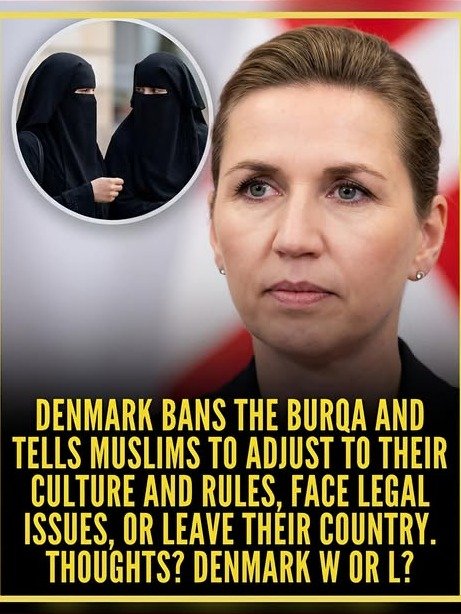
Imagine a world where what you wear in public could land you a fine, or even a jail sentence. For years, Denmark has been at the center of a heated global debate over just such a policy: its controversial ban on certain face coverings. This isn’t just about fashion; it’s a profound discussion about religious freedom, cultural integration, and the very definition of a liberal society.
First introduced in 2018, this legislation, often referred to as the ‘burqa ban,’ has once again seized international headlines. As nations grapple with complex questions of identity and belonging, Denmark’s stance serves as a stark reminder of the delicate balance between individual rights and perceived societal norms. But what exactly does the law entail, and why is it drawing such intense scrutiny now?
The Genesis of the Ban: A Look Back at 2018
The Danish ban on face coverings came into effect on August 1, 2018, following a parliamentary vote that saw broad support from across the political spectrum. The law prohibits individuals from wearing garments that obscure the face in public spaces, explicitly targeting items like the niqab and burqa, which are full-face veils worn by some Muslim women. While the law technically applies to all face coverings, including false beards or masks, its primary focus and impact have undeniably been on Muslim women.
At the time of its implementation, the Danish government asserted that the ban was not directed at any specific religion. Instead, they framed it as a measure to promote integration and uphold Danish values, arguing that full-face coverings hinder communication and social cohesion. This narrative quickly became a cornerstone of the policy’s defense, positioning it as a tool for fostering a more open and integrated society.
Arguments For: Integration, Communication, and Public Order
Proponents of the ban often emphasize several key arguments. One of the most frequently cited is the importance of facial recognition for effective communication and social interaction. They argue that seeing a person’s face is fundamental to understanding emotions and building trust, which are crucial elements for successful integration into Danish society.
Another significant point raised by supporters revolves around public order and safety. While acknowledging that the risk might be small, some argue that face coverings could potentially be used to conceal identity, posing a challenge for law enforcement and security. This perspective often aligns with broader concerns about anonymity in public spaces.
“The burqa and niqab are not symbols of religious belief but rather symbols of oppression,” stated a prominent Danish politician during the initial debate, reflecting a common sentiment among those who view the garments as contrary to principles of gender equality and individual freedom within a secular state.
Furthermore, some argue that the ban is a reflection of Danish secular values, which prioritize the separation of religion and state and advocate for a public sphere free from overt religious symbols that might be perceived as exclusionary. From this viewpoint, the law is seen as an affirmation of a shared cultural identity.
Arguments Against: Religious Freedom, Discrimination, and Human Rights
Conversely, critics of the ban have voiced profound concerns, primarily centered on issues of religious freedom and discrimination. They argue that the law disproportionately targets Muslim women and infringes upon their fundamental right to practice their religion freely. For many women who choose to wear the niqab or burqa, it is a deeply personal expression of their faith and identity, not a symbol of oppression.
Human rights organizations and international bodies have widely condemned the ban, highlighting its potential to marginalize and isolate an already vulnerable minority group. They contend that rather than promoting integration, such policies can lead to increased discrimination and a sense of alienation among those affected, pushing them further away from mainstream society.
- Violation of Religious Freedom: Denies individuals the right to express their faith through clothing.
- Discrimination: Primarily targets and impacts Muslim women, raising concerns about indirect discrimination.
- Lack of Evidence: Critics argue there’s little evidence that face coverings genuinely hinder integration or pose a significant security threat.
- Counterproductive: May lead to further isolation rather than integration, forcing women to stay home.
Moreover, opponents question the effectiveness of the ban in achieving its stated goals. They argue that forcing women to remove their veils does not necessarily lead to greater integration or empowerment; instead, it may limit their participation in public life and restrict their freedom of movement. The notion that the state should dictate what individuals wear, particularly for religious reasons, is seen by many as an overreach of governmental power.
The Global Spotlight: Why Now?
The renewed global attention on Denmark’s face-covering ban isn’t happening in a vacuum. It coincides with ongoing debates across Europe and beyond regarding multiculturalism, national identity, and the boundaries of religious expression in public spaces. As societies grapple with increasing diversity, the Danish case serves as a poignant example of the tensions that can arise.
Recent legal challenges and discussions within international human rights forums have brought the issue back into focus. Activists and legal scholars continue to scrutinize the ban’s human rights implications, prompting renewed media coverage and public discourse. Furthermore, the broader political climate, marked by rising nationalism in some regions, often re-ignites these debates.
The Real-World Impact: Lives Affected
Beyond the legal and political rhetoric, the ban has had a tangible impact on the lives of women in Denmark. While the number of women wearing full-face veils in Denmark is relatively small, estimated to be in the low hundreds, the legislation has created a climate of fear and uncertainty for them.
Reports suggest that some women have opted to stay home more often to avoid potential fines or confrontations, effectively limiting their participation in public life, education, and employment. This outcome directly contradicts the stated goal of integration, instead fostering a sense of exclusion and marginalization within their own country.
“I feel like a second-class citizen. My choice, which is deeply personal, has been criminalized,” shared one woman anonymously in a recent report, encapsulating the profound emotional toll the ban has taken on those it targets.
The ban has also led to instances of public harassment and stigmatization, as the visible nature of the law makes individuals wearing face coverings targets for unwanted attention. This creates a challenging environment where personal choices are under constant public scrutiny and judgment.
A Broader European Context: Denmark is Not Alone
It’s important to note that Denmark is not an isolated case in Europe. Several other European countries have implemented similar bans or restrictions on face coverings. France was the first European nation to ban full-face veils in public spaces in 2010, followed by Belgium in 2011, Austria in 2017, and parts of Switzerland through local referendums.
These policies often share similar rationales, citing secularism, integration, and public order. However, they also face comparable criticisms regarding religious freedom and discrimination. The cumulative effect of these bans across the continent highlights a broader European struggle to define the parameters of religious expression in increasingly diverse societies.
Each country’s approach reflects its unique historical, cultural, and political context, but the underlying tensions between individual rights and state interests remain a consistent theme. The ongoing debates, therefore, transcend national borders, becoming a critical part of a larger European and global conversation about identity and human rights.
The Path Forward: Navigating Complex Freedoms
The debate surrounding Denmark’s face-covering ban is far from over. It continues to be a focal point for discussions on human rights, religious freedom, and the challenges of cultural integration in modern liberal democracies. As societies become more diverse, finding ways to balance individual liberties with collective societal norms will remain a crucial task for policymakers and citizens alike.
Ultimately, the renewed global attention on Denmark’s policy serves as a powerful reminder that seemingly local debates can have far-reaching implications. It forces us to confront fundamental questions about what it means to live in a free society, how we define integration, and whether legislation aimed at promoting certain values inadvertently undermines the very freedoms it purports to protect. The unseen battle for personal expression and religious liberty continues.
About the Author




