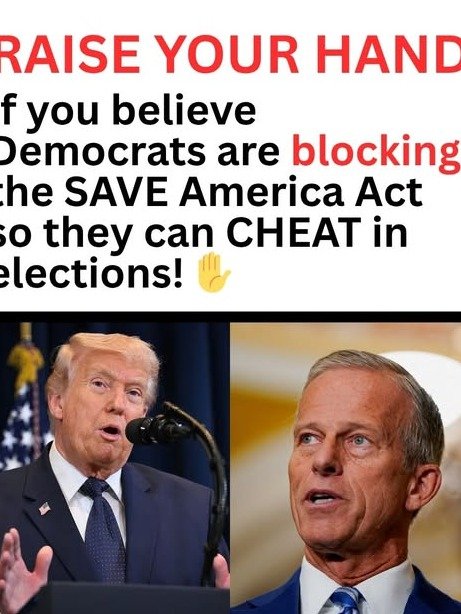
Imagine a future where every vote cast is undeniably secure, where election integrity is beyond question, and public trust in our democratic process is absolute. This vision is precisely what proponents of the SAVE America Act claim to offer. Yet, this pivotal piece of legislation, designed to fortify our nation’s voting systems, finds itself ensnared in a fierce political battle, stalled indefinitely in the United States Senate.
The legislative landscape is often a minefield of differing ideologies, but few issues ignite such passionate debate as the very mechanics of our elections. At the heart of this current deadlock lies a bill that many view as a fundamental, common-sense step towards a more robust democracy, while others fear it could erect unnecessary barriers to the ballot box. The stakes couldn’t be higher as the nation grapples with questions of access versus security.
The SAVE America Act: A Blueprint for Election Integrity?
The Secure American Votes and Elections (SAVE) America Act was introduced with the explicit goal of enhancing the security and transparency of federal elections across the United States. Its architects argue that a unified, national standard for election security is not just desirable, but absolutely essential in an era of heightened scrutiny and skepticism surrounding election outcomes. They contend that existing state-by-state variations create vulnerabilities that undermine confidence in the entire system.
This comprehensive bill proposes several key measures that its supporters champion as vital safeguards. These provisions aim to address various aspects of the voting process, from voter registration to ballot counting, with the overarching objective of making it harder to commit fraud and easier to verify legitimate results. The proposed changes are significant and touch upon nearly every stage of an election.
- Universal Photo Identification: The Act mandates that all voters present a valid, government-issued photo ID at the polls for in-person voting. Proponents argue this is a basic security measure, akin to boarding an airplane or cashing a check, ensuring that only eligible individuals cast a ballot.
- Enhanced Absentee Ballot Security: It calls for stricter chain-of-custody protocols for absentee ballots, including mandatory signature verification against state databases, secure drop-off locations, and limitations on who can collect and submit ballots on behalf of others, commonly known as ballot harvesting.
- Mandatory Post-Election Audits: The bill would require all states to conduct risk-limiting audits after federal elections, utilizing statistically sound methods to ensure the accuracy of vote counts and identify potential discrepancies.
- Regular Voter Roll Maintenance: States would be required to regularly and systematically update their voter registration lists, removing deceased voters, those who have moved out of state, or duplicate registrations, thereby ensuring cleaner and more accurate rolls.
- Increased Penalties for Election Fraud: The SAVE America Act proposes significantly stiffer penalties, including higher fines and longer prison sentences, for individuals convicted of election-related offenses, aiming to deter fraudulent activities.
Supporters of the SAVE America Act believe these provisions are not only reasonable but urgently needed. They point to public opinion polls that often show strong support for measures like voter ID, arguing that these are common-sense reforms that most Americans can agree on. Their core argument centers on restoring and maintaining public faith in the electoral process, which they see as foundational to a functioning democracy.
“The integrity of our elections is not a partisan issue; it’s an American imperative,” stated a prominent advocate for the SAVE America Act. “This bill offers a clear, actionable path to secure our votes, rebuild trust, and ensure that every legal ballot counts, and only legal ballots count. To block such a measure is to implicitly accept the very vulnerabilities we should be striving to eliminate.”
The Unyielding Wall: Senate Gridlock and Partisan Divide
Despite the strong advocacy and the perceived common-sense nature of its proposals by some, the SAVE America Act remains firmly stuck in the Senate. The primary reason for this legislative paralysis, as the original prompt highlights, lies in the staunch opposition from Democratic lawmakers. This isn’t just a minor disagreement; it’s a fundamental clash of philosophies regarding voting rights and election administration.
Democrats have largely united against the bill, viewing its provisions not as safeguards, but as potential instruments of voter suppression. Their concerns are deeply rooted in the belief that certain measures, particularly strict photo ID requirements and limitations on absentee ballot access, disproportionately affect minority voters, the elderly, students, and low-income individuals who may face challenges obtaining required identification or accessing traditional polling places.
From their perspective, the SAVE America Act represents an attempt to solve a problem that either doesn’t exist on a widespread scale or is being exaggerated for political purposes. They often cite studies and expert analyses suggesting that instances of in-person voter fraud are exceedingly rare, and that the focus should instead be on expanding access to the ballot box, not restricting it.
“We must protect the sacred right to vote for all eligible Americans, not erect new barriers that disenfranchise our citizens,” argued a Democratic Senator during a recent floor debate. “The SAVE America Act is a wolf in sheep’s clothing, cloaking voter suppression tactics under the guise of security. Our democracy thrives when more people participate, not fewer.”
The opposition also raises concerns about potential federal overreach. Many Democrats argue that election administration has traditionally been a state responsibility, and a comprehensive federal mandate like the SAVE America Act could infringe upon states’ rights to manage their own electoral processes. This perspective emphasizes localized control and tailored solutions rather than a one-size-fits-all federal approach.
The Broader Battle for America’s Electoral Future
The gridlock over the SAVE America Act is not an isolated incident; it’s a microcosm of a much larger, ongoing national debate about the future of American elections. For years, the country has been sharply divided over how to balance election security with voter access. One side prioritizes preventing fraud and ensuring the integrity of results, often advocating for stricter rules. The other prioritizes making it easier for every eligible citizen to vote, often cautioning against measures that could suppress turnout.
This partisan divide has profound implications for public trust. When bills like the SAVE America Act are stalled, it can exacerbate existing anxieties about the fairness and accuracy of elections. Supporters of the bill may feel their concerns about security are being ignored, while opponents may feel their warnings about voter suppression are being dismissed. This creates a cycle of distrust that can be difficult to break.
Furthermore, the legislative stalemate highlights the deep ideological chasm that defines much of contemporary American politics. Both sides genuinely believe they are fighting for the preservation of democracy, yet their approaches are diametrically opposed. This makes compromise incredibly difficult, leading to the kind of protracted gridlock we see with the SAVE America Act.
What Does This Mean for You, the Voter?
For the average American voter, this legislative standoff means continued uncertainty. If you believe strongly in the need for enhanced election security, the stalled SAVE America Act represents a missed opportunity to implement what you consider vital safeguards. If you prioritize easy access to the ballot box, the bill’s inability to advance might be a relief, but the underlying push for such measures remains a concern.
The ongoing debate also means that election laws will likely remain a patchwork of state-level regulations, rather than a uniform national standard. This can lead to confusion, as voting rules vary significantly from one state—or even one county—to another. Understanding your local election laws becomes even more crucial in this environment.
Ultimately, the fate of the SAVE America Act, and other similar legislation, will shape the landscape of American democracy for years to come. Whether the Senate can find a path forward, whether through compromise or a shift in political dynamics, remains to be seen. What is clear is that the conversation around election integrity and voter access is far from over, and its outcome will directly impact how every American participates in our foundational democratic process.
The Path Forward: A Call for Dialogue or Continued Stalemate?
Looking ahead, the prospects for the SAVE America Act appear dim without significant bipartisan negotiation or a dramatic shift in the political calculus. The current Senate rules, particularly the filibuster, empower the minority party to block legislation, making it exceptionally difficult for controversial bills to pass without broad consensus.
Some analysts suggest that the only way forward is through incremental reforms, focusing on smaller, less contentious aspects of election administration that might garner bipartisan support. However, proponents of the SAVE America Act argue that piecemeal solutions are insufficient to address what they perceive as systemic vulnerabilities.
The debate over election security isn’t just about legislative text; it’s about the very soul of our democracy. As the SAVE America Act languishes, the nation watches, waiting to see if its leaders can bridge the divide and forge a path that secures our elections while upholding the fundamental right to vote for every eligible citizen. The gridlock isn’t just about a bill; it’s about the future of American trust and participation.
Protecting the Ballot: A Never-Ending Quest
The quest for perfectly secure and accessible elections is a continuous journey, not a destination. Throughout American history, debates over voting rights and election administration have been central to our national identity. From the expansion of suffrage to women and minorities, to the Civil Rights Act, and ongoing discussions about electoral college reform, the mechanisms of our democracy are constantly evolving.
The SAVE America Act is merely the latest chapter in this long-standing narrative. Its current predicament in the Senate underscores the enduring challenge of balancing competing values: the imperative to prevent fraud and the equally vital commitment to ensuring universal access to the ballot. Until a consensus emerges, or a political shift breaks the deadlock, the future of election security in America will remain a fiercely contested battleground.
About the Author




