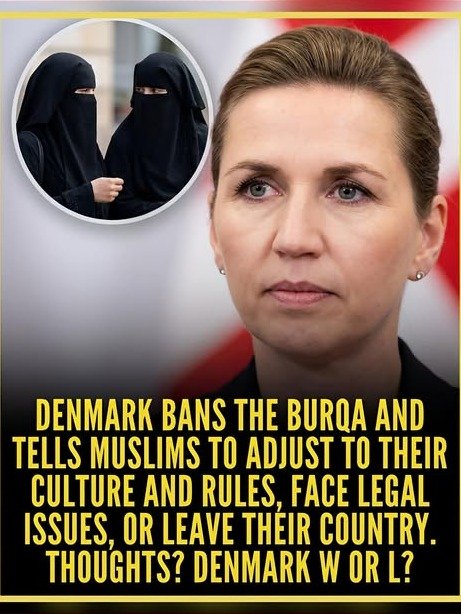
What if the very fabric of your personal freedom—the right to dress as you choose—was challenged by the state? This isn’t a hypothetical question for many in Denmark, where a contentious 2018 law restricting certain face coverings in public spaces has resurfaced as a flashpoint in a simmering global debate. Get ready to dive deep into a policy that touches on everything from national identity to human rights, igniting conversations across continents.
A seemingly simple legislative act, often colloquially dubbed the ‘burqa ban,’ has drawn renewed global attention, prompting observers to question the balance between individual liberties and societal norms. While the law specifically targets items like the niqab and burqa, its implications extend much further, touching on secularism, integration, and the very definition of a free society. Understanding this Danish policy means exploring a complex web of cultural, political, and human rights considerations.
The Genesis of the Ban: A 2018 Landmark
The controversial Danish law, officially titled ‘Act on a ban on the wearing of garments that cover the face in public places,’ came into effect on August 1, 2018. It was a legislative move that had been debated intensely for years, reflecting a growing sentiment in certain political circles within Denmark and across Europe regarding public order and integration.
The government at the time justified the ban on grounds of public safety, arguing that full face coverings impede identification and communication in public spaces. Furthermore, proponents cited concerns about the integration of immigrants into Danish society, suggesting that such coverings were a barrier to assimilation and a symbol of oppression, particularly for women.
Unpacking the Law: What Exactly Is Forbidden?
The Danish law is quite broad in its scope, prohibiting any garment that covers the face in such a way as to make identification difficult. This explicitly includes items like the Islamic niqab and burqa, which cover the entire face except for the eyes, or the entire body respectively. However, it also extends to other items such as balaclavas, masks, and even fake beards worn in a way that obscures identity.
There are, of course, exceptions. The law does not apply to face coverings worn for legitimate purposes, such as protective gear in certain professions, cold weather clothing, or costumes for specific events like carnivals, provided they do not unduly obstruct identification. Violators face a fine of 1,000 Danish kroner (approximately $150 USD) for a first offense, with increasing penalties for repeat offenses, potentially reaching 10,000 kroner.
Arguments for the Ban: Upholding Danish Values and Security
Supporters of the ban often articulate their position through several key arguments, deeply rooted in concepts of national identity, public order, and gender equality. One primary justification centers on the idea of public safety and security. They argue that the ability to identify individuals in public spaces is crucial for maintaining law and order, and that face coverings undermine this principle, making it harder to prevent and investigate crimes.
Another significant pillar of support for the ban is the concept of integration. Proponents believe that open communication and visible integration are essential for a cohesive society. They contend that full face coverings act as a barrier to social interaction and cultural exchange, hindering the successful assimilation of minority groups into Danish society. From this perspective, the ban is seen as a tool to encourage greater participation and transparency.
About the Author




