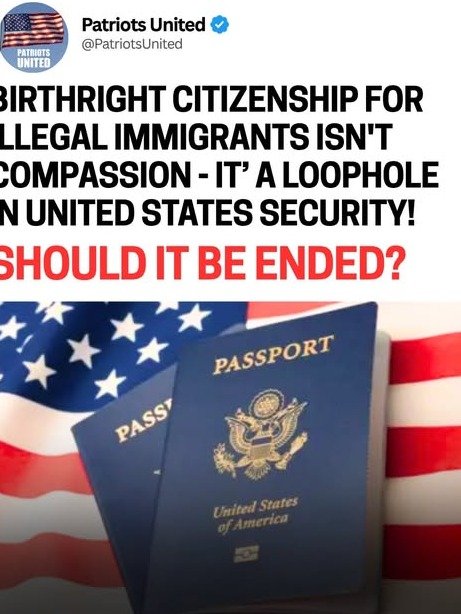
Imagine a world where being born on American soil no longer guarantees U.S. citizenship. Sound impossible? Think again. A seismic legal and political battle is erupting, threatening to redefine one of the most fundamental tenets of American identity: birthright citizenship. This isn’t just a policy debate; it’s a high-stakes clash over constitutional interpretation, national sovereignty, and the very fabric of who gets to be called an American.
The controversy, reignited by former President Trump’s administration and still simmering on the political frontlines, centers on a bold executive order seeking to deny automatic citizenship to children born in the U.S. to undocumented parents. This move challenges over a century of legal precedent and deeply entrenched understanding of the 14th Amendment, pushing the nation into uncharted constitutional waters. The implications are profound, touching on everything from immigration policy to the rights of individuals and the future of America’s legal landscape.
The Core of the Debate: What is Birthright Citizenship?
At the heart of this impassioned discussion lies the 14th Amendment to the U.S. Constitution, ratified in 1868 in the aftermath of the Civil War. Its opening sentence famously declares:
“All persons born or naturalized in the United States, and subject to the jurisdiction thereof, are citizens of the United States and of the State wherein they reside.”
This clause was primarily intended to grant citizenship to formerly enslaved people, ensuring their rights and status within the nation.
For over 150 years, this phrase has been widely interpreted to mean that nearly anyone born on U.S. soil is automatically a U.S. citizen, regardless of their parents’ immigration status. This principle, known as jus soli (right of the soil), is a cornerstone of American law and differs significantly from jus sanguinis (right of blood), where citizenship is derived from one’s parents.
The simplicity and clarity of this interpretation have, for generations, avoided the complex and often discriminatory systems of determining citizenship based on ancestry or parental status. It has been seen as a mechanism for integration, ensuring that children born and raised within American society are fully part of it, preventing the creation of a permanent underclass of stateless individuals.
Historical Context and Modern Challenges
While the 14th Amendment’s primary aim was clear, its application to children of non-citizens was solidified by the Supreme Court in the 1898 case of United States v. Wong Kim Ark. The court ruled that a child born in the U.S. to Chinese immigrants, who were not eligible for naturalization at the time, was indeed a U.S. citizen. This landmark decision has served as the bedrock for modern birthright citizenship, affirming that the phrase “subject to the jurisdiction thereof” applies to virtually everyone born within U.S. borders, with very limited exceptions like children of foreign diplomats.
However, in recent decades, this interpretation has faced increasing scrutiny, particularly from conservatives and those advocating for stricter immigration enforcement. Critics argue that the original intent of the 14th Amendment did not foresee or intend to grant citizenship to children of undocumented immigrants, viewing it as a loophole that encourages illegal immigration.
They contend that the phrase “subject to the jurisdiction thereof” should be interpreted more narrowly, applying only to those whose parents owe full allegiance to the United States, which, they argue, undocumented immigrants do not. This reinterpretation forms the legal basis for the push to change or challenge birthright citizenship.
Trump’s Executive Order: A Constitutional Showdown
The debate escalated dramatically when former President Trump announced his intention to issue an executive order to end birthright citizenship for children of undocumented immigrants. This declaration sent shockwaves through the legal and political communities, sparking a fierce debate over the limits of presidential power and the immutability of the Constitution.
The proposed executive order aimed to circumvent the traditional legislative process, which would require a constitutional amendment – an exceedingly difficult endeavor. Proponents of the executive order argued that the President has the authority to interpret the 14th Amendment differently, asserting that the current understanding is flawed and can be corrected by executive action.
Opponents, however, vehemently countered that a constitutional amendment cannot be overridden by presidential decree. They stressed that the executive branch’s role is to enforce laws, not rewrite the Constitution, and that such an order would be immediately challenged in court and almost certainly struck down as unconstitutional.
Legal Hurdles and Supreme Court Precedent
The idea of ending birthright citizenship via executive order faces monumental legal obstacles. Legal scholars across the political spectrum largely agree that a constitutional amendment is the only way to alter the plain text and established interpretation of the 14th Amendment. This requires a two-thirds vote in both the House and Senate, followed by ratification by three-fourths of the states – a threshold that has proven almost impossible to meet for contentious issues.
“To overturn 150 years of settled law and a Supreme Court precedent like Wong Kim Ark would require a constitutional amendment, not just an executive order or a simple act of Congress,” explains constitutional law expert Professor Jane Doe. “The idea that a president can unilaterally redefine citizenship is a dangerous precedent that undermines the very foundation of our legal system.”
Any executive action on this matter would undoubtedly trigger a swift and prolonged legal battle, likely heading all the way to the Supreme Court. While the current conservative majority on the Court might be perceived as sympathetic to a narrower interpretation, overturning such long-standing precedent would be an extraordinary move with far-reaching implications, potentially destabilizing constitutional law.
The “Anchor Baby” Argument and its Impact
A significant, and often controversial, part of the argument against birthright citizenship is the concept of “anchor babies.” This term, considered pejorative by many, refers to children born in the U.S. to undocumented parents, who critics claim are used to secure legal status for their families, acting as an “anchor” to prevent deportation or facilitate future immigration. Those who use this term argue that it incentivizes illegal immigration and creates a strain on public resources.
However, research indicates that the direct path to legal status for parents through their U.S.-citizen children is far more complex and limited than often portrayed. While U.S.-citizen children can petition for their parents, this can only happen once the child turns 21, and the parents must still meet numerous eligibility requirements, often requiring them to leave the country and apply from abroad, which can trigger lengthy re-entry bars.
Furthermore, denying birthright citizenship would not necessarily deter illegal immigration but could instead create a large, permanent underclass of residents without full rights, complicating social integration and potentially leading to significant humanitarian issues within the country. It would create a class of people who are born and live in the U.S., but have no legal claim to the nation they call home.
Global Perspectives on Citizenship
The U.S. is not alone in its approach to birthright citizenship, but it is part of a shrinking minority of developed nations that fully embrace jus soli. Countries like Canada and Mexico also grant birthright citizenship, reflecting a similar historical emphasis on integrating new populations.
However, many European and Asian countries primarily follow jus sanguinis, where citizenship is determined by the nationality of one’s parents. Even among countries that historically followed jus soli, some have tightened their laws. For example, Australia and the UK have added requirements that at least one parent must be a citizen or permanent resident for a child to gain birthright citizenship.
These international comparisons often fuel the debate in the U.S., with proponents of changing the law pointing to other nations’ stricter policies as models. However, critics counter that the unique historical context and founding principles of the United States make such comparisons less relevant, emphasizing America’s identity as a nation of immigrants.
The Enduring Battle for America’s Soul
The clash over birthright citizenship is more than just a legal or political squabble; it’s a fundamental debate about American identity, the interpretation of its founding documents, and its future as a nation. The stakes are incredibly high, affecting millions of individuals and shaping the very definition of who belongs.
While an executive order to unilaterally end birthright citizenship faces immense legal hurdles and is widely considered unconstitutional, the very discussion keeps the issue alive. It highlights deep ideological divisions within the country regarding immigration, national sovereignty, and the role of the Constitution in a modern, diverse society.
As this debate continues to unfold, expect intense legal challenges, passionate political rhetoric, and a profound examination of what it truly means to be born in America. The outcome will not only redefine citizenship but could also set a precedent for how future constitutional questions are approached, marking this as one of the most critical fights of our time.
What Happens Next?
The path forward for those seeking to alter birthright citizenship is fraught with challenges. While an executive order remains a highly contentious and likely unconstitutional route, the push for legislative changes or constitutional amendments will persist. This ongoing battle underscores the deep ideological chasm in American society regarding immigration and national identity.
For now, the 14th Amendment and its established interpretation of birthright citizenship remain the law of the land. However, the intensity of the debate signals that this issue is far from settled. Its resolution will require not just legal arguments but also a broader societal consensus on what kind of nation America strives to be in the 21st century.
Stay informed, because the implications of this constitutional clash could impact generations to come, redefining what it means to be an American citizen.
About the Author




