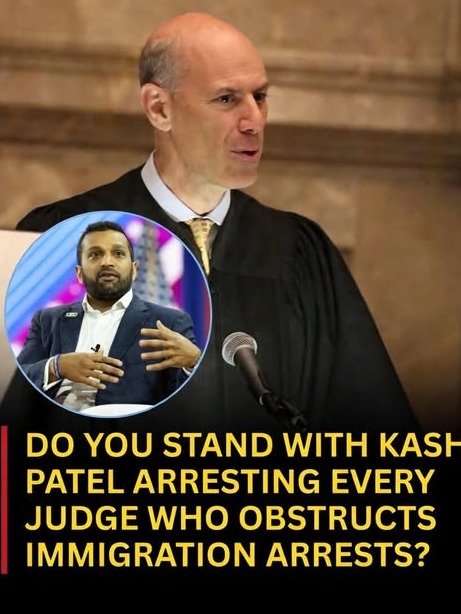
Imagine a world where the very decisions made by judges, traditionally shielded by judicial independence, could land them in criminal court. This isn’t a hypothetical thought experiment for some, but a serious proposition gaining traction. At the heart of this intensifying debate is Kash Patel, a figure known for his impactful roles in national security and government, who is spearheading an initiative to hold what he terms ‘activist judges’ criminally accountable for actions perceived to impede immigration arrests.
This isn’t merely about policy disagreements; it delves into the fundamental structure of our legal system and the separation of powers. Patel’s call for criminal accountability represents a significant escalation, challenging long-held doctrines of judicial immunity and asking profound questions about where the line between judicial interpretation and obstruction of law truly lies. It’s a conversation that has the potential to reshape the future of immigration enforcement and judicial oversight in America.
The Core of Kash Patel’s Initiative: A Radical Shift in Judicial Accountability
Kash Patel, a former chief of staff to the Acting United States Secretary of Defense, senior counsel for the House Permanent Select Committee on Intelligence, and a former federal prosecutor, has put forth a provocative plan. His initiative targets judges whose rulings, in his view, actively hinder the ability of immigration authorities to carry out arrests and deportations, thereby undermining border security and national sovereignty.
The central thrust of Patel’s proposal is to move beyond the traditional avenues of appeal or impeachment for judicial misconduct. Instead, he advocates for a mechanism that would allow for criminal charges to be brought against judges who are deemed to be overstepping their authority and deliberately obstructing immigration enforcement efforts. This represents a seismic shift from the conventional understanding of judicial protection.
Defining ‘Activist Judges’ and ‘Impeding Immigration Arrests’
The term ‘activist judge’ itself is often a point of contention, frequently used by critics to describe judges whose decisions are perceived to be based more on personal or political ideologies rather than strict adherence to legal text and precedent. In the context of immigration, this often refers to judges who issue injunctions, stay deportation orders, or create loopholes that prevent or delay the apprehension and removal of individuals deemed to be in the country unlawfully.
What constitutes ‘impeding immigration arrests’ can manifest in various ways. It might involve rulings that:
- Block federal agencies: Preventing Immigration and Customs Enforcement (ICE) or Border Patrol from carrying out arrests in specific jurisdictions or under certain circumstances.
- Issue broad injunctions: Halting nationwide enforcement actions or specific immigration policies.
- Grant asylum or protection: In ways that are seen as overly broad or inconsistent with existing law, thereby preventing removal.
- Mandate specific procedures: Imposing requirements on immigration authorities that are perceived to make their work impossible or impractical.
Patel’s initiative suggests that when such judicial actions move beyond legitimate legal interpretation and into deliberate obstruction, they should be met with severe consequences, including criminal prosecution.
Judicial Immunity: A Cornerstone Under Scrutiny
For centuries, the concept of judicial immunity has been a bedrock principle of legal systems worldwide, including in the United States. This doctrine generally protects judges from liability for actions taken in their official capacity, even if those actions are later found to be erroneous or malicious. The rationale is to ensure judges can make decisions independently, without fear of reprisal or harassment, thereby preserving the integrity and impartiality of the judiciary.
“Judicial immunity is not for the protection or benefit of a malicious or corrupt judge, but for the benefit of the public, whose interest it is that judges should be at liberty to exercise their functions with independence and without fear of consequences.” – Justice Stephen J. Field, Bradley v. Fisher (1871)
However, Patel’s initiative directly challenges the scope and limits of this immunity. He argues that if a judge’s actions constitute a deliberate obstruction of justice or a violation of federal law, the shield of immunity should be lifted, just as it can be for other public officials who engage in criminal behavior. This raises critical questions about the balance between judicial independence and accountability.
Arguments For Patel’s Initiative: Restoring Order and Accountability
Proponents of Kash Patel’s initiative articulate several compelling reasons why such a radical step is necessary. They often point to what they perceive as a systemic breakdown in immigration enforcement, exacerbated by judicial interventions.
- Rule of Law: They argue that judges who consistently issue rulings that contradict or undermine existing immigration laws are effectively legislating from the bench, usurping the role of Congress and the executive branch. Holding them accountable would, therefore, uphold the constitutional separation of powers.
- National Security and Border Control: With ongoing concerns about border integrity and national security, advocates believe that judicial actions impeding arrests directly compromise the nation’s ability to control its borders and protect its citizens. Criminal accountability would serve as a deterrent.
- Public Safety: Some argue that preventing the arrest and deportation of individuals who may pose a threat to public safety, even if only by delaying their removal, puts communities at risk. Accountability for judges, in this view, reinforces public safety.
- Deterrence: The threat of criminal charges could act as a powerful deterrent, encouraging judges to exercise greater restraint and ensure their rulings are strictly within the bounds of established law, rather than driven by personal or political agendas.
- Restoring Public Trust: For many, there’s a growing sentiment that some judges are out of touch with the will of the people or are actively working against it. This initiative could be seen as a way to restore public trust in the judiciary by demonstrating that no one is above the law.
“The idea that a judge can actively work to prevent federal agents from doing their job, directly impacting our national security, and face no consequences beyond an appeal, is fundamentally broken,” a supporter might contend. “We need mechanisms to ensure accountability when the rule of law is deliberately subverted.”
Concerns and Counterarguments: A Dangerous Precedent?
While the arguments for increased judicial accountability resonate with many, Patel’s initiative also faces significant opposition and raises profound concerns among legal scholars, civil liberties advocates, and segments of the judiciary itself. The primary fear is that such a move could set a dangerous precedent, undermining the very foundation of an independent judiciary.
- Threat to Judicial Independence: Critics argue that criminalizing judicial decisions, even those perceived as ‘activist,’ would create a chilling effect. Judges might become hesitant to make unpopular but legally sound rulings, fearing political retaliation or criminal charges, thereby compromising their ability to act as a check on executive and legislative power.
- Political Weaponization: There is a significant concern that such a mechanism could be easily weaponized for political purposes. A judge’s decision could be deemed ‘criminal’ simply because it conflicts with the agenda of the party in power, leading to politically motivated prosecutions.
- Separation of Powers: The initiative is seen by some as an encroachment by the executive or legislative branches into the judicial sphere, blurring the lines of the separation of powers and potentially leading to a constitutional crisis.
- Defining ‘Criminal Intent’: Proving criminal intent in a judicial decision would be incredibly difficult. Judges often interpret complex laws, and disagreements over interpretation are inherent to the legal process. Distinguishing between a controversial legal interpretation and a deliberate criminal act of obstruction is a monumental challenge.
- Sufficient Safeguards Exist: Opponents contend that existing mechanisms like appeals, impeachment, and professional ethics boards are sufficient to address judicial misconduct without resorting to criminal charges that could cripple the judiciary.
“To criminalize a judge’s legal ruling, however unpopular, is to fundamentally misunderstand the role of the judiciary,” a constitutional law expert might argue. “It opens the door to tyranny, where judges become afraid to rule against the powerful, and that is a threat to every citizen’s rights.”
Historical Context and Precedent (or Lack Thereof)
Historically, holding judges criminally accountable for their judicial decisions is extremely rare in the United States. While judges can be impeached for high crimes and misdemeanors, which is a political process, and can face civil lawsuits for actions outside their judicial capacity, criminal prosecution for judicial rulings themselves is virtually unheard of. This rarity underscores the deep-seated respect for judicial independence that has characterized American jurisprudence.
There have been instances where judges have faced criminal charges, but these typically involve actions like bribery, corruption, or other offenses committed outside the scope of their legitimate judicial duties, or where their actions were clearly administrative and not judicial in nature (e.g., embezzling court funds). Patel’s initiative seeks to push the boundary directly into the realm of judicial decision-making, a largely uncharted legal territory for criminal accountability.
The Broader Immigration Debate and its Impact
This initiative doesn’t exist in a vacuum; it’s deeply intertwined with the highly charged and often contentious national debate over immigration policy. The current political climate, marked by significant disagreements over border security, enforcement, and the treatment of undocumented immigrants, provides fertile ground for such a bold proposal.
The frustration among some segments of the population regarding what they perceive as a lack of effective immigration enforcement fuels support for drastic measures. For them, judicial rulings that appear to thwart efforts to control the border or deport individuals are seen as direct impediments to national sovereignty and safety. This initiative, therefore, taps into a powerful vein of public sentiment that demands greater accountability across all branches of government on this critical issue.
Potential Ramifications and Future Outlook
Should Kash Patel’s initiative gain significant traction and lead to legislative or executive action, the ramifications for the American legal system would be profound. It could fundamentally alter the relationship between the judiciary and the other two branches of government, potentially shifting the balance of power in unprecedented ways.
The discussion around this initiative forces a critical examination of the limits of judicial power, the meaning of accountability, and the very definition of justice in a democratic society. It asks us to consider where the line between legitimate judicial oversight and judicial overreach truly lies, and what measures, if any, are appropriate when that line is perceived to be crossed. The debate is far from settled, and its outcome could have lasting effects on the fabric of American governance.
Your Voice in the Debate
Kash Patel’s initiative to hold judges criminally accountable for impeding immigration arrests is more than just a legal concept; it’s a call to action that challenges the very foundations of our government. It forces us to confront difficult questions about power, accountability, and the future of our borders.
Do you believe this is a necessary step to ensure the rule of law and secure our nation, or does it represent a dangerous overreach that threatens judicial independence? The implications are vast, touching upon constitutional law, national security, and the future of immigration policy. Your perspective is crucial in this vital national conversation.
About the Author




