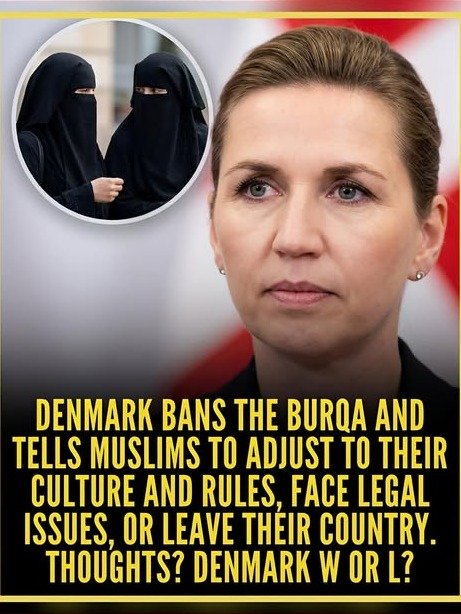
Imagine a country where choosing what to wear in public could lead to a fine, sparking a fierce global debate about freedom, integration, and identity. This isn’t a dystopian novel; it’s the reality in Denmark, where a contentious policy on certain face coverings has been in effect since 2018. Now, this very law is once again drawing intense international scrutiny, forcing us to ask profound questions about societal values and individual liberties.
What began as a domestic policy discussion has blossomed into a full-blown international talking point, highlighting deep divisions and complex cultural sensitivities. The Danish government’s stance, often dubbed the ‘burqa ban,’ has been both staunchly defended and fiercely condemned, positioning Denmark at the heart of a broader European conversation on immigration, integration, and religious freedom.
The Law That Divided a Nation
The law, officially known as the ‘Ban on covering the face in public,’ came into force on August 1, 2018. It explicitly prohibits wearing garments that cover the face in public spaces, making it illegal to obscure one’s face to the extent that it’s unrecognisable. While often referred to as a ‘burqa ban’ or ‘niqab ban,’ its scope is broader, encompassing items like balaclavas, masks, and even fake beards if they conceal the face significantly.
The legislation was not drafted to target a specific religious group on paper, but its practical application undeniably affects Muslim women who choose to wear a niqab (a veil covering the entire face except the eyes) or a burqa (a veil covering the entire face and body, with a mesh screen for the eyes). Violators face a fine of 1,000 Danish kroner (approximately $145 USD) for a first offense, escalating to 10,000 kroner for repeat offenses.
Why the Ban? The Arguments from the Danish Government
Proponents of the ban, including the Danish government and several political parties, argue that it is crucial for integration and public safety. They maintain that facial recognition is fundamental to communication and social interaction, which are vital for successful integration into Danish society.
“It is incompatible with the values of Danish society and disrespectful to the community to keep your face hidden when interacting with others in public spaces,” stated a government spokesperson upon the law’s implementation. This sentiment underscores the belief that visible facial expressions are a cornerstone of Danish cultural norms.
Beyond integration, public order and security are frequently cited reasons. The ability to identify individuals in public spaces is presented as a necessary measure for law enforcement and general safety. Furthermore, some arguments touch upon gender equality, suggesting that certain face coverings are symbols of oppression and that the ban liberates women from patriarchal expectations.
A Storm of Criticism: Human Rights and Religious Freedom
Despite the government’s justifications, the law has faced a torrent of criticism from international human rights organizations, legal experts, and minority groups. Critics argue that the ban is a direct infringement on religious freedom and personal liberty, disproportionately affecting a small number of Muslim women and effectively discriminating against them.
Amnesty International, for instance, condemned the law as a ‘discriminatory violation of women’s rights.’ They, along with others, argue that forcing women to choose between their religious beliefs and participating in public life is coercive and undermines fundamental human rights. Rather than fostering integration, opponents suggest the ban alienates and marginalizes an already vulnerable minority.
- Religious Freedom: The right to manifest one’s religion or belief in worship, observance, practice, and teaching.
- Personal Autonomy: The freedom to make choices about one’s own body and dress.
- Discrimination: Singling out a specific religious minority, even if the law is phrased neutrally.
- Effectiveness: Doubts about whether the ban truly aids integration or simply pushes women further into isolation.
The Broader European Landscape: A Trend or an Anomaly?
Denmark is not alone in implementing such restrictions. The debate around face coverings is part of a larger, ongoing conversation across Europe concerning secularism, national identity, and the place of religious symbols in public life. France was the first European country to implement a full ban on face coverings in public in 2011, followed by Belgium in 2011 and Austria in 2017. The Netherlands also has a partial ban on face coverings in public buildings and on public transport.
Each country’s legislation has its own nuances, but the underlying tensions are strikingly similar: a clash between state-mandated secularism or integration policies and individual religious freedoms. These laws often emerge amidst heightened debates about immigration and national identity, reflecting complex societal anxieties rather than purely practical concerns.
In Switzerland, a similar ban was recently approved in a national referendum, further illustrating the deep-seated nature of this issue across the continent. These debates often highlight a struggle to balance the rights of individuals to express their identity and beliefs with the perceived need for social cohesion and security within a multicultural society.
The Human Cost: Impact on Affected Communities
While the number of women in Denmark who wear a niqab or burqa is relatively small – estimated to be around 150-200 individuals – the impact of the law on their lives is profound. Many have reported feeling targeted, isolated, and unable to participate fully in public life without fear of fines or confrontation.
For some, the choice is stark: either abandon a deeply held religious practice or face social exclusion and legal penalties. This can lead to increased feelings of marginalization and a sense of not belonging, paradoxically hindering the very integration the law purports to promote. It also raises questions about the role of the state in dictating personal dress choices.
Renewed Global Attention: Why Now?
The recent resurgence of global attention on Denmark’s face-covering ban isn’t necessarily due to a singular new event, but rather the cyclical nature of such contentious policies. Ongoing discussions about human rights in Europe, heightened political rhetoric surrounding immigration, and anniversary markers for the law itself often bring these debates back to the forefront.
Furthermore, international bodies and human rights advocates consistently monitor and report on such legislation, ensuring that these policies remain under global scrutiny. Every time a new report is released, or a similar law is proposed elsewhere, the spotlight inevitably swings back to countries like Denmark, reigniting the discussion.
The current political climate, both within Denmark and across Europe, continues to grapple with questions of identity, diversity, and the balance between individual freedoms and societal expectations. These are not static issues; they are dynamic forces constantly shaping policy and public discourse.
The Road Ahead: An Unresolved Debate
As Denmark continues to uphold its ban on face coverings, the policy remains a symbol of a broader, unresolved debate gripping modern societies. It forces us to confront difficult questions: Where do we draw the line between individual freedom and collective norms? How do we foster integration without infringing on fundamental rights?
The Danish ban, much like its counterparts in other European nations, serves as a powerful reminder of the complex challenges inherent in building inclusive societies while navigating diverse cultural and religious landscapes. For now, the silent storm surrounding Denmark’s controversial law continues to rage, with no clear resolution in sight, leaving its mark on the fabric of both national identity and global human rights discourse.
`,
About the Author




