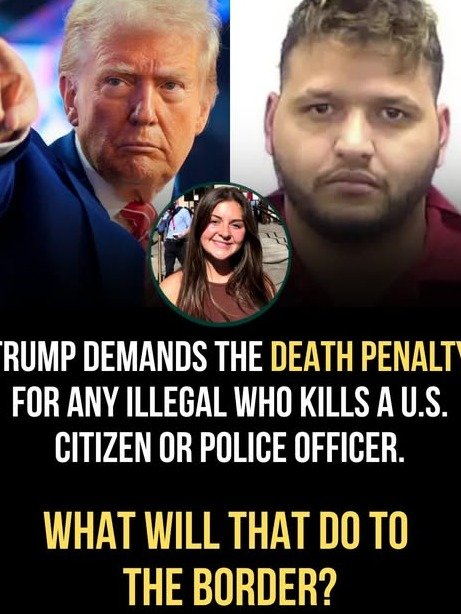
Imagine a crime so heinous, so utterly devastating, that it sparks a national conversation about the ultimate punishment. A bold and controversial proposal has just rocked the political landscape, promising to redefine justice and national security in America. Former President Donald Trump has recently intensified his call for a radical measure: implementing the death penalty for migrants convicted of killing American citizens or law enforcement officers.
This declaration isn’t just a fleeting comment; it’s a powerful statement embedded within a broader vision to reassert national sovereignty and enforce what he terms ‘zero mercy’ for those who commit violent crimes on U.S. soil. The implications of such a policy are vast, touching upon intricate legal frameworks, international human rights debates, and the very fabric of American justice. This isn’t merely about punishment; it’s about a fundamental shift in how the nation addresses crime committed by non-citizens.
The Core of the Controversial Proposal
At its heart, Trump’s proposition aims to draw a clear, unyielding line in the sand. He argues that any migrant, regardless of their legal status, who commits murder against an American citizen or a police officer, should face the ultimate penalty: execution. This stance is presented not just as a punitive measure, but as a critical component of restoring law and order, deterring future crimes, and sending an unequivocal message about the sanctity of American lives and the authority of its law enforcement.
The former president’s rhetoric often frames this as a matter of national security and a necessary defense against what he perceives as a breakdown of border control and a rise in crime linked to undocumented immigration. He emphasizes that the current system is too lenient, allowing dangerous individuals to exploit loopholes, and that only the most severe penalties can truly protect the homeland.
A Broader Push for ‘Zero Mercy’
This specific call for the death penalty is not an isolated idea but rather a key element in Trump’s overarching strategy to redefine justice and immigration policy. His ‘zero mercy’ philosophy extends beyond this single issue, encompassing stricter border enforcement, expedited deportations, and a general crackdown on criminal activity, particularly when involving non-citizens. The underlying message is one of uncompromising resolve: America will protect its own, and those who threaten that safety will face the harshest possible consequences.
This broader push seeks to restore a sense of absolute justice, where severe crimes meet equally severe punishments, leaving no room for leniency or perceived weaknesses in the legal system. It’s a vision that resonates deeply with a significant portion of the electorate who feel that the current system is failing to adequately protect citizens and uphold the rule of law.
Legal Labyrinths: Applying the Death Penalty to Non-Citizens
Implementing such a policy would undoubtedly plunge the legal system into uncharted and complex territory. The application of the death penalty to non-citizens, particularly those who may have entered the country illegally, raises a myriad of constitutional and international law questions. Would due process rights apply equally? How would international treaties regarding human rights and the treatment of foreign nationals factor in?
Legal scholars and human rights organizations would likely challenge such a policy on multiple fronts. Issues concerning jurisdiction, the definition of ‘migrant,’ and the potential for perceived discrimination would all come under intense scrutiny. The U.S. Constitution guarantees due process and equal protection under the law, and any attempt to apply a different standard to non-citizens could face significant legal hurdles, potentially leading to prolonged court battles.
The Debate on Deterrence and Justice
Proponents of Trump’s proposal often argue that the death penalty serves as the ultimate deterrent, preventing others from committing similar heinous acts. The idea is that the fear of such an irreversible consequence would significantly reduce violent crime rates among the migrant population. Furthermore, for many, it represents the purest form of justice for victims and their families, ensuring that those who take a life pay the ultimate price.
The emotional appeal of ‘an eye for an eye’ is powerful, especially in cases involving the murder of innocent citizens or dedicated police officers. Supporters believe it’s a moral imperative to ensure that the punishment fits the crime, particularly when the victims are those sworn to protect the community or ordinary individuals going about their lives.
Ethical and Humanitarian Concerns
Conversely, opponents of the death penalty, both domestically and internationally, raise profound ethical and humanitarian concerns. Many argue that capital punishment is inherently cruel and unusual, violating fundamental human rights. The risk of executing an innocent person, even with the most rigorous legal processes, is a constant and terrifying specter that fuels abolitionist movements worldwide.
International bodies and many allied nations have abolished the death penalty, and its application to non-citizens could strain diplomatic relations and invite criticism from global human rights advocates. There are also concerns about potential racial or ethnic biases in the application of capital punishment, leading to disproportionate impacts on certain groups. Critics also question the effectiveness of the death penalty as a deterrent, citing studies that often show no significant difference in crime rates between jurisdictions with and without capital punishment.
The Political Landscape and Public Opinion
This proposal is not just a legal or ethical debate; it’s a highly charged political issue that resonates deeply with Trump’s base and beyond. For many of his supporters, it symbolizes strength, decisiveness, and a commitment to protecting American lives above all else. It taps into anxieties about border security, national identity, and the perception of rising crime.
Public opinion on the death penalty in general remains divided in the U.S., with support often fluctuating based on specific circumstances and political climate. However, proposals targeting specific groups or types of crime, especially those involving vulnerable victims or law enforcement, can often garner significant support from those seeking tougher crime measures. This proposal is likely to further polarize the debate, with passionate arguments on both sides.
Implications for International Relations and Sovereignty
Should such a policy be enacted, it would undoubtedly have significant implications for U.S. international relations. Many countries, particularly in Europe and Latin America, are staunchly opposed to the death penalty and might view its application to their citizens (even those residing illegally in the U.S.) as a breach of international norms or human rights principles. This could lead to diplomatic protests, challenges in extradition proceedings, and potentially impact bilateral relations.
However, proponents would counter that it is a matter of national sovereignty: the right of a nation to enforce its own laws within its borders and protect its citizens. They would argue that the U.S. should not be dictated to by international bodies on matters of domestic criminal justice, especially when dealing with egregious crimes committed against its people.
The Path Forward: A Divisive National Conversation
Donald Trump’s call for the death penalty for migrants who commit murder is a truly unprecedented and highly provocative proposal. It forces a national conversation not only about criminal justice and immigration but also about the fundamental values and priorities of the United States. As the political discourse heats up, this issue will undoubtedly remain a central point of contention, sparking intense debate across legal, ethical, and humanitarian landscapes.
Whether such a policy could ever be legally implemented, or how it would reshape America’s standing on the global stage, remains to be seen. What is clear, however, is that this proposition has ignited a crucial discussion about justice, deterrence, and the unwavering commitment to the safety and security of American citizens and those who serve to protect them. The stakes are incredibly high, and the implications are monumental for the future of American law and order.
About the Author




