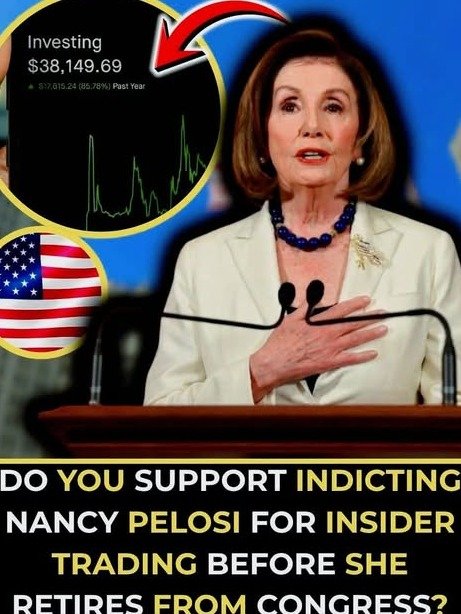
Imagine having access to privileged information that could make you millions in the stock market. Now imagine that power resting in the hands of the very people elected to serve you. This isn’t a hypothetical scenario from a financial thriller; it’s the heart of a rapidly intensifying national debate surrounding stock trading by members of Congress.
From high-profile figures like former Speaker Nancy Pelosi to countless other representatives and senators, the financial activities of our lawmakers have come under intense scrutiny. Concerns about ethics, transparency, and potential conflicts of interest are fueling a growing firestorm, leaving many Americans wondering if the system is truly fair.
The Alarming Rise of Congressional Fortunes
For years, whispers have circulated about how some politicians seem to accumulate significant wealth during their time in public service. While some of this can be attributed to legitimate means, the timing and success of certain stock trades by elected officials and their immediate families have raised serious red flags.
The core issue is simple: members of Congress are privy to an extraordinary amount of non-public information. They vote on legislation affecting entire industries, receive briefings on economic trends, national security, and global events, and shape policies that can directly impact corporate profits. This access creates an undeniable, inherent advantage in the stock market.
When lawmakers or their spouses make timely trades in industries poised to benefit (or suffer) from upcoming legislation or government actions, it creates an undeniable appearance of impropriety. It suggests that personal financial gain might be influencing policy decisions, rather than the public good.
The STOCK Act: A Flawed Attempt at Transparency?
In response to earlier scandals and public pressure, Congress passed the Stop Trading on Congressional Knowledge (STOCK) Act in 2012. This bipartisan law aimed to combat insider trading by members of Congress and their staff, making it explicitly illegal for them to profit from non-public information gained through their official positions.
The Act also mandated greater transparency, requiring members to publicly disclose their stock trades within 45 days of the transaction. The intention was clear: shed light on financial activities to deter unethical behavior and allow the public to monitor potential conflicts of interest. However, over a decade later, many argue the STOCK Act hasn’t gone far enough.
Critics point to several weaknesses. The 45-day disclosure window is often too long, allowing significant market movements to occur before the public is aware of a trade. Furthermore, enforcement has been inconsistent, and penalties for violations have often been minor, failing to act as a true deterrent. The law, while a step forward, appears to have significant loopholes.
High-Profile Cases: When Politics Meets Profit
Perhaps no figure has drawn more attention to this issue than Nancy Pelosi. While she herself does not trade stocks, her husband, Paul Pelosi, has made numerous high-value trades over the years, often in major tech companies and other sectors directly impacted by legislative decisions or government contracts.
One notable instance involved Paul Pelosi’s purchase of millions of dollars in NVIDIA shares shortly before Congress was set to vote on a bill that would provide significant subsidies to the domestic semiconductor industry. While the Pelosis maintain all trades are legitimate and made without insider information, the optics are undeniably problematic, fueling public cynicism.
“The perception is that members of Congress are using their positions to enrich themselves, and that erodes public trust in our institutions,” says Craig Holman, a government affairs lobbyist for Public Citizen.
This isn’t an isolated incident. During the early days of the COVID-19 pandemic, several senators were investigated for selling off significant stock holdings after receiving closed-door briefings on the looming health crisis, but before the public fully understood its severity. While many of these investigations did not result in criminal charges, the damage to public trust was undeniable.
The Erosion of Public Trust
The continuous stream of news stories about congressional stock trading, coupled with the apparent lack of robust consequences, has a corrosive effect on public confidence. When ordinary citizens struggle financially, seeing their elected representatives seemingly profit from their positions can breed deep resentment and a feeling of betrayal.
This issue feeds into a broader narrative that Washington operates by a different set of rules, where the elite are shielded from the consequences faced by everyday Americans. It undermines the very foundation of democratic governance, which relies on the public’s belief in the integrity and impartiality of its leaders.
A 2022 poll by the University of Maryland and The Washington Post found that a staggering 86% of Americans believe members of Congress and their immediate family members should be prohibited from trading individual stocks. This overwhelming consensus transcends political divides, indicating a deep-seated desire for reform.
The Arguments Against a Full Ban
Despite widespread public support for stricter rules, a complete ban on stock trading by members of Congress and their families faces opposition from some quarters. Proponents of the current system or less restrictive alternatives often raise several points:
- Right to Invest: Some argue that banning stock trading infringes on a politician’s fundamental right to manage their personal finances and invest their own money, just like any other citizen.
- Attracting Talent: There’s a concern that overly restrictive rules might deter qualified individuals with financial acumen from seeking public office, as they would be forced to divest their assets or forgo potential earnings.
- Complexity of Enforcement: Implementing and enforcing a full ban, especially for family members, could be logistically challenging and difficult to monitor effectively without invasive measures.
- Blind Trusts as an Alternative: Many suggest that mandatory blind trusts – where a third party manages a politician’s assets without their knowledge – are a sufficient safeguard against conflicts of interest.
However, critics of the blind trust argument point out that even with a blind trust, a politician still knows the general composition of their assets and might still be influenced by policies affecting those sectors. Furthermore, setting up and maintaining truly “blind” trusts can be complex and expensive.
Proposed Solutions: Restoring Integrity to Washington
The public outcry has spurred a renewed push for more comprehensive reform. Several legislative proposals have been introduced, aiming to strengthen the rules and rebuild trust. Key solutions being discussed include:
- Outright Ban on Individual Stock Trading: This is the most popular proposal, advocating for a complete prohibition on members of Congress and their immediate families from buying or selling individual stocks. They would instead be limited to diversified mutual funds, ETFs, or blind trusts.
- Mandatory Blind Trusts: Requiring all members of Congress to place their assets, and those of their spouses and dependent children, into qualified blind trusts managed by an independent third party. This would eliminate direct control over investment decisions.
- Increased Penalties and Enforcement: Stiffening financial penalties for violations of disclosure rules and insider trading laws, alongside more rigorous oversight and enforcement by ethics committees and regulatory bodies.
- Expanded Scope of “Insider Information”: Clarifying and broadening the definition of what constitutes non-public, material information derived from official duties to cover a wider range of scenarios.
- Divestment Requirements: Requiring members to divest from certain holdings that present clear conflicts of interest upon entering office.
These proposals aim to create a clear firewall between public service and private profit, ensuring that lawmakers’ decisions are driven solely by the interests of their constituents, not their personal portfolios.
Why This Matters to Every American
This isn’t just a debate about political ethics; it’s about the very integrity of our democratic system and the fairness of our economic markets. When politicians are perceived to be enriching themselves through their positions, it erodes the public’s faith in government’s ability to act impartially.
It also raises fundamental questions about market fairness. If those with legislative power can leverage non-public information for financial gain, it creates an uneven playing field for everyday investors. This undermines the principles of a free and fair market, where success should be based on merit and open access to information, not privileged access.
Ultimately, the call for reform is a call for accountability. It’s about ensuring that those entrusted with immense power adhere to the highest ethical standards, putting the welfare of the nation above personal financial gain. The current system, with its apparent loopholes and perceived abuses, is simply unsustainable for a healthy democracy.
The Path Forward: A Demand for Accountability
The national debate surrounding congressional stock trading is not merely a passing controversy; it represents a fundamental challenge to the integrity of American governance. The overwhelming public demand for stricter rules signals a clear message to Washington: the status quo is no longer acceptable.
Moving forward, true reform will require political will and a commitment to prioritizing public trust over personal financial interests. Whether through a complete ban, mandatory blind trusts, or a combination of robust measures, the goal must be to eliminate even the appearance of impropriety and restore faith in the impartiality of our elected officials.
The time for incremental changes and weak enforcement is over. Americans deserve a government where leaders are focused on serving the people, not their stock portfolios. The future of our democracy and the fairness of our markets depend on it.
About the Author




