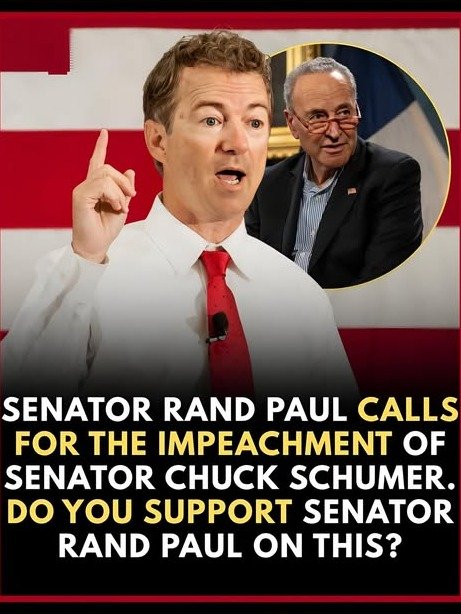
Imagine a world where political accountability was truly blind, where leaders from both sides of the aisle faced the exact same level of scrutiny, regardless of their party affiliation. This isn’t just a philosophical ideal; it’s the core of a recent, explosive demand from Senator Rand Paul, who publicly called for Senate Majority Leader Chuck Schumer to undergo the same intense examination that has hounded former President Donald Trump.
This isn’t merely political rhetoric; it’s a direct challenge to the perceived double standards prevalent in Washington D.C. Senator Paul’s call has ignited a fierce debate about fairness, impartiality, and the very foundation of justice in America’s political landscape. It forces us to confront uncomfortable questions about who gets investigated, why, and whether the scales of justice are truly balanced for everyone in power.
The Weight of Scrutiny: A Look at Donald Trump’s Experience
To understand the gravity of Senator Paul’s demand, one must first grasp the unprecedented level of scrutiny that has been directed at former President Donald Trump. From the moment he announced his candidacy, through his presidency, and even after leaving office, Trump has been the subject of relentless investigations, legal challenges, and media examinations.
His tenure was marked by two impeachment trials in the House of Representatives, both leading to acquittal in the Senate. Beyond impeachment, numerous federal and state investigations have probed various aspects of his business dealings, campaign finance, and actions while in office. These inquiries have spanned everything from alleged Russian collusion to the January 6th Capitol events, and beyond.
The sheer volume and intensity of these investigations are nearly unparalleled in modern American political history. They have involved extensive document reviews, witness testimonies, and significant legal battles, consuming vast resources and public attention. This constant spotlight has fundamentally shaped public perception of Trump and his administration, often overshadowing policy achievements or other narratives.
Rand Paul’s Bold Challenge: Equal Standards for Schumer?
Against this backdrop of intense scrutiny faced by Donald Trump, Senator Rand Paul’s call for Chuck Schumer to undergo a similar level of examination resonates deeply with those who feel there’s a significant imbalance in how political figures are held accountable. Paul’s argument isn’t about Schumer specifically being guilty of any particular crime, but rather about the principle of applying consistent standards of investigation across the political spectrum.
The Kentucky Senator’s demand implies that if the bar for investigation and public questioning is set so high for one political figure, it should be equally high for others, especially those in positions of immense power like the Senate Majority Leader. This isn’t a call for frivolous inquiries, but for a systemic re-evaluation of how oversight and accountability are applied in Washington.
“If we are to maintain any semblance of fairness and public trust, then the principle of equal scrutiny must apply to all. We cannot have a justice system that appears to selectively target individuals based on their political affiliation or perceived adversaries.” – A paraphrased sentiment reflecting Senator Paul’s stance.
Paul’s perspective suggests that the political establishment, and perhaps even segments of the media, have a tendency to focus their investigative energies disproportionately. He is essentially asking: where is the balance? If every action, every statement, and every past association of one leader is meticulously dissected, shouldn’t the same be true for others who wield significant power and influence?
The Argument for Impartiality: Why it Matters for Democracy
At the heart of Senator Paul’s demand lies a foundational principle of democratic governance: impartiality. For a justice system, or even the broader system of political accountability, to be credible, it must be seen as fair and unbiased. When the public perceives that certain individuals or parties are treated differently, faith in institutions erodes rapidly.
The concept of ‘equal justice under law’ is not merely a slogan; it is a cornerstone of a healthy republic. If citizens begin to believe that investigations are politically motivated, or that some leaders are ‘above the law’ while others are relentlessly pursued, the very legitimacy of government comes into question. This perception of a ‘two-tiered’ system of justice can lead to widespread cynicism and distrust.
- Erosion of Public Trust: When accountability appears selective, public confidence in legal and political institutions diminishes.
- Weaponization of Justice: The fear that investigations can be used as political tools rather than genuine searches for truth.
- Undermining Democratic Principles: A system where fairness is absent weakens the democratic process itself.
- Increased Polarization: Perceived double standards often exacerbate partisan divides, making compromise and cooperation even more difficult.
Senator Paul’s call serves as a powerful reminder that the integrity of our political system hinges on the consistent application of rules and the unwavering pursuit of truth, regardless of who is in power or which party they represent.
What Kind of Scrutiny Could Schumer Face?
While Senator Paul did not specify particular alleged misdeeds by Chuck Schumer, his call for ‘Trump-level scrutiny’ would imply an examination of a broad range of areas typically associated with powerful political figures. This could include, but not be limited to, the following:
Firstly, an intense look at Schumer’s legislative leadership and decision-making. As Senate Majority Leader, Schumer holds immense power over the legislative agenda, committee assignments, and the direction of policy. A thorough investigation might examine how these powers have been exercised, looking for any potential conflicts of interest, undue influence, or breaches of ethical conduct in the pursuit of legislative goals.
Secondly, scrutiny could extend to campaign finance and political donations. All politicians receive campaign contributions, but ‘Trump-level’ examination would delve into the minutiae of who donated, what influence they might have sought, and whether any donations crossed legal or ethical lines. This includes super PACs, dark money groups, and other entities associated with his political machine.
Furthermore, an investigation might explore personal finances and business dealings, similar to the extensive probes into Trump’s financial empire. While Schumer’s financial holdings are likely different in nature, the principle of transparency and potential conflicts of interest would be paramount. Any alleged use of his position for personal or family gain would be thoroughly scrutinized.
Finally, there could be a focus on interactions with lobbyists, special interest groups, and foreign entities. Powerful leaders are constantly engaging with these groups. An intense review would seek to uncover any instances where these interactions might have improperly influenced policy, or where there were undisclosed dealings that could compromise national interest or ethical standards.
The Challenges of Achieving Impartiality in a Partisan Era
While the call for equal scrutiny is principled, the reality of achieving it in today’s hyper-partisan political climate is fraught with challenges. Washington D.C. is a deeply divided city, where political battles are often fought with intense fervor, and perceived slights are rarely forgotten.
One major hurdle is the inherent partisanship of oversight bodies. Congressional committees, often tasked with investigations, are typically led by members of the majority party, with minority members playing an oppositional role. This structure can make truly impartial investigations difficult, as inquiries can easily be viewed as politically motivated attacks rather than genuine searches for truth.
Moreover, the media plays a significant role in shaping public perception of investigations. Depending on the outlet’s political leanings, an investigation into a figure like Schumer could be framed as a legitimate pursuit of justice or a baseless political witch hunt. This further complicates the ability of the public to discern facts from political narratives, adding layers of cynicism to the process.
The Ripple Effect: What This Means for American Politics
Senator Paul’s demand, whether or not it leads to formal investigations, has already had a significant ripple effect on the political discourse. It forces a public conversation about accountability, fairness, and the perceived biases within the American justice and political systems.
If such a standard of scrutiny were genuinely applied across the board, it could fundamentally alter the way politicians operate. It might encourage greater transparency, more meticulous adherence to ethical guidelines, and a heightened awareness of public perception. Conversely, it could also lead to an endless cycle of retaliatory investigations, paralyzing legislative action and further deepening partisan divides.
The debate sparked by Senator Paul is not just about Chuck Schumer or Donald Trump; it’s about the kind of political system Americans want to live in. Do we demand truly equal justice, even if it means uncomfortable truths are revealed about leaders on both sides? Or do we accept a system where scrutiny is selectively applied, potentially undermining the very trust essential for a functioning democracy?
Conclusion: The Unending Quest for Fair Accountability
Senator Rand Paul’s provocative call for Senate Majority Leader Chuck Schumer to face ‘Trump-level scrutiny’ is more than just a headline-grabbing statement. It’s a profound challenge to the status quo, a demand for genuine impartiality, and a mirror held up to the perceived double standards of Washington D.C.
In an era of deep political division and widespread skepticism, the pursuit of fair and consistent accountability for all in power is paramount. Whether or not Senator Paul’s specific demand materializes into formal investigations, the conversation it has ignited is crucial. It reminds us that for democracy to thrive, the principle of equal justice must not only exist in theory but must be visibly and consistently applied in practice, ensuring that no one is truly above the law, regardless of their position or party.
About the Author




