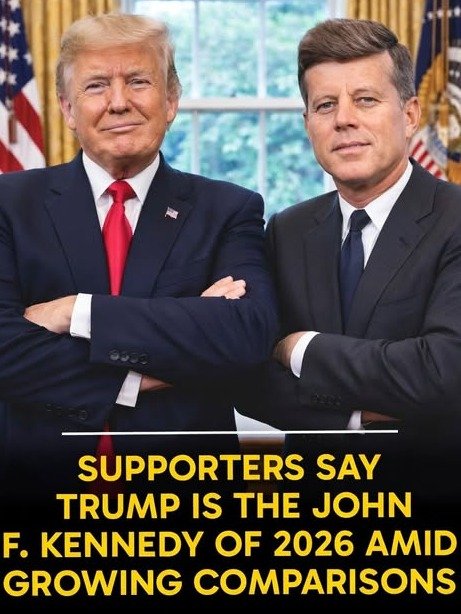
Imagine a political landscape where historical figures are not just remembered, but reborn. A recent claim circulating among Donald Trump’s staunchest supporters suggests precisely that, sparking widespread debate and curiosity. They’re not just comparing him to a past president; they’re explicitly labeling him the ‘John F. Kennedy of 2026,’ a bold assertion that demands a closer look.
This intriguing, and for many, bewildering comparison has ignited conversations across social media and political commentary circles. It’s a statement that goes beyond a mere observation, acting as a powerful piece of political rhetoric designed to frame Trump’s image and legacy in a unique light. But what exactly underpins such an audacious claim, and what does it reveal about the evolving nature of political hero worship in modern America?
The Audacious Comparison: Unpacking the ‘JFK of 2026’ Label
The phrase ‘John F. Kennedy of 2026’ isn’t just a casual remark; it’s a deliberate and loaded declaration. On its surface, it seems to attribute to Donald Trump qualities that supporters admire in the iconic 35th President of the United States. This label aims to elevate Trump’s standing by associating him with a figure often remembered for his charisma, vision, and a certain ‘Camelot’ mystique.
It implies a belief that Trump embodies a similar spirit of leadership, communication prowess, and connection with the American people, albeit updated for the modern era. The ‘2026’ addition isn’t arbitrary; it suggests a forward-looking vision, perhaps anticipating a future political role for Trump or simply a reinterpretation of Kennedy’s enduring appeal in a contemporary context. It’s a claim that forces us to examine the perceived parallels, no matter how disparate the two figures may seem at first glance.
Charisma and Connection: A Shared Appeal?
One of the most frequently cited reasons for the comparison revolves around charisma. John F. Kennedy was undeniably a charismatic figure, captivating audiences with his youthful vigor, eloquent speeches, and a sophisticated charm that projected confidence and optimism. His public appearances were events, drawing massive crowds eager to hear his vision for a ‘New Frontier.’
Donald Trump, despite a vastly different style, also commands immense personal magnetism. His rallies are legendary for their energy, drawing tens of thousands of fervent supporters who feel a deep, personal connection to him. His direct, often unscripted communication style resonates powerfully with his base, who perceive it as authentic and unfiltered, a stark contrast to traditional political discourse.
“Both Kennedy and Trump, in their own unique ways, mastered the art of connecting directly with the populace, bypassing conventional gatekeepers to forge a bond with their supporters that transcended mere political affiliation.”
While JFK’s charisma was often described as refined and intellectual, Trump’s is raw, populist, and confrontational. Yet, both managed to inspire fervent loyalty and an almost cult-like devotion among their followers, demonstrating an innate ability to stir emotions and rally people around a common cause or identity. This shared capacity to forge deep personal connections is a cornerstone of the ‘JFK of 2026’ narrative.
Mastering the Media: Communication Styles Compared
John F. Kennedy was a pioneer in using the burgeoning medium of television to his advantage. His televised press conferences were groundbreaking, allowing him to speak directly to the American people with an air of authority and calm. He understood the visual power of the medium and crafted his image meticulously, projecting an aura of presidential grace and intellectual gravitas.
Fast forward to the 21st century, and Donald Trump has similarly redefined political communication, albeit through different channels. He leveraged social media platforms like Twitter to bypass traditional media outlets, delivering his messages directly to his millions of followers. This direct-to-supporter approach created an unfiltered pipeline for his views, allowing him to control his narrative in an unprecedented way.
- JFK: Mastered the nascent power of television, delivering eloquent speeches and composed press conferences.
- Trump: Dominated social media, using platforms to communicate directly, often controversially, with his base.
- Shared Trait: Both understood and exploited the dominant communication technologies of their respective eras to build a powerful public persona and mobilize support.
Both presidents, therefore, demonstrated an acute understanding of how to utilize the prevailing media landscape to shape public opinion and maintain a direct line of communication with their supporters. This strategic mastery of communication, irrespective of style, forms another pillar of the comparison.
Challenging the Establishment: Mavericks in Their Own Right
Though often viewed through a nostalgic lens, John F. Kennedy’s path to power was not without its challenges from the political establishment. He represented a younger generation, a new guard within the Democratic Party, and his ‘New Frontier’ vision sought to push beyond the conventional thinking of the time. He faced skepticism and resistance from older, more entrenched political figures who questioned his experience and progressive agenda.
Donald Trump, on the other hand, explicitly positioned himself as an anti-establishment outsider, vowing to ‘drain the swamp’ of Washington D.C. His entire political persona was built on defying traditional political norms, challenging both the Republican and Democratic establishments. He openly critiqued career politicians, globalist policies, and what he perceived as a corrupt political system.
This shared perception of being an outsider, of fighting against entrenched power structures, resonates deeply with their respective bases. For JFK, it was about ushering in a new era of American leadership and progress. For Trump, it was about disrupting a perceived stagnant and corrupt system. Both, in their own ways, presented themselves as figures willing to take on the status quo.
Vision and Ambition: Shaping a Nation’s Future
John F. Kennedy’s presidency was defined by ambitious goals and a forward-looking vision. His call to land a man on the moon before the decade was out ignited the nation’s imagination and galvanized scientific and technological innovation. He spoke of a ‘New Frontier’ that challenged Americans to push boundaries in space, civil rights, and global peace, embodying an aspirational spirit.
Donald Trump, too, presented a grand vision for America, albeit one rooted in a different philosophy. His ‘Make America Great Again’ slogan evoked a desire to restore a perceived past glory, focusing on economic nationalism, border security, and a reassertion of American strength on the global stage. While different in their directional focus – one looking forward, the other backward – both offered a compelling narrative of national purpose.
The ability to articulate a clear, albeit distinct, vision for the nation’s future is a powerful leadership trait. Whether it’s reaching for the stars or bringing manufacturing jobs back home, both leaders tapped into a deep-seated desire among the populace for a strong, decisive leader who could articulate and pursue ambitious national goals. This capacity to inspire and direct national energy is a key element in the comparison.
The ‘2026’ Enigma: What Does the Future Hold?
The inclusion of ‘2026’ in the label adds a layer of prophecy and future-gazing. It’s not just a historical comparison but a statement about anticipated political relevance and influence. Why 2026 specifically? It could be a symbolic date, projecting Trump’s enduring presence on the political stage, or even hinting at a potential future election cycle or significant political event.
This temporal specificity suggests that supporters believe Trump’s impact is not just a relic of the past, but a force that will continue to shape American politics for years to come. It positions him not just as a historical echo of JFK, but as the embodiment of a similar leadership archetype for a future generation, a ‘JFK for the modern age.’ The ‘2026’ implies a continuity of influence, a belief that his political narrative is still unfolding and will reach a significant crescendo in the near future.
The Glaring Differences: A Chasm of Ideology and Era
While supporters draw parallels, it’s crucial to acknowledge the profound differences between John F. Kennedy and Donald Trump. Their political ideologies stand in stark contrast: Kennedy was a liberal Democrat, advocating for social programs, civil rights, and international cooperation. Trump is a conservative Republican, championing deregulation, nationalism, and an ‘America First’ foreign policy.
Their backgrounds couldn’t be more different: Kennedy came from a prominent political dynasty, steeped in public service and Ivy League education. Trump emerged from a real estate and entertainment empire, a self-proclaimed outsider to the political establishment. Their temperaments also diverge sharply, with Kennedy often described as measured and intellectual, while Trump is known for his confrontational and often bombastic style.
- Policy: JFK’s progressive ‘New Frontier’ vs. Trump’s conservative ‘America First’.
- Background: Established political family vs. Businessman outsider.
- Temperament: Measured diplomacy vs. Unpredictable bombast.
- Historical Context: Cold War era vs. post-9/11 digital age.
The historical context is also vastly different. Kennedy governed during the height of the Cold War and the burgeoning Civil Rights Movement, an era of relative national unity despite deep societal divisions. Trump’s presidency unfolded in an age of hyper-partisanship, digital disinformation, and profound cultural polarization. To ignore these fundamental distinctions is to engage in a selective and arguably superficial comparison.
Why Make Such a Comparison? The Psychology Behind the Label
So, why would supporters consciously make such a seemingly incongruous comparison? The motivations are likely multifaceted. Firstly, it serves to elevate Donald Trump by associating him with one of America’s most revered and mythologized presidents. It’s a rhetorical strategy to imbue Trump with a sense of historical gravitas and legitimacy that his detractors often deny him.
Secondly, it taps into a deep-seated nostalgia for a perceived ‘golden age’ of American leadership, where presidents were seen as strong, charismatic figures who united the nation, even if that perception is often romanticized. By aligning Trump with JFK, supporters might be trying to appeal to a broader audience, perhaps even those who admire Kennedy’s legacy but are wary of Trump’s image.
“Political comparisons are rarely purely factual; they are often aspirational, designed to project desired qualities onto a leader and reshape public perception.”
Finally, the comparison is undoubtedly a provocative one, designed to spark debate and garner media attention. In the highly charged landscape of modern politics, such a bold claim is guaranteed to generate discussion, allowing supporters to control a part of the narrative and keep their chosen leader at the center of attention. It’s an act of political myth-making, attempting to define a leader’s legacy even as it unfolds.
Legacy and Political Mythology: A Continuous Reinvention
The ‘JFK of 2026’ label is a testament to the enduring power of political mythology and the continuous reinvention of historical figures to serve contemporary narratives. Political leaders are not just defined by their actions, but by the stories we tell about them, and how those stories are adapted to fit current political needs. JFK himself has been subject to various interpretations over the decades, his legacy shifting with changing societal values.
This comparison highlights how political figures can become symbols, their names invoked to represent ideals, even when those ideals might seem contradictory across different eras and personalities. It underscores the idea that in the realm of political discourse, perception often trumps reality, and the crafting of a compelling narrative can be as crucial as policy achievements. The ‘JFK of 2026’ is less about historical accuracy and more about crafting a powerful, aspirational political identity for Donald Trump in the minds of his supporters.
Conclusion: A Complex Tapestry of Comparison
The assertion that Donald Trump is the ‘John F. Kennedy of 2026’ is far more than a simple comparison; it’s a complex piece of political rhetoric that warrants careful examination. It draws on perceived parallels in charisma, communication, and anti-establishment sentiment, while strategically overlooking vast differences in ideology, temperament, and historical context. The ‘2026’ aspect adds a layer of prophetic ambition, suggesting a belief in Trump’s enduring and future-shaping influence.
Ultimately, this label reveals much about the desires and strategies of Trump’s support base. It speaks to a longing for strong, charismatic leadership and a willingness to reinterpret history to fit a contemporary political agenda. Whether you find the comparison insightful or absurd, it undeniably serves as a potent reminder of how historical figures are continually recontextualized in the ever-evolving theater of American politics, sparking debate and shaping perceptions in ways that continue to resonate into the future.
About the Author




