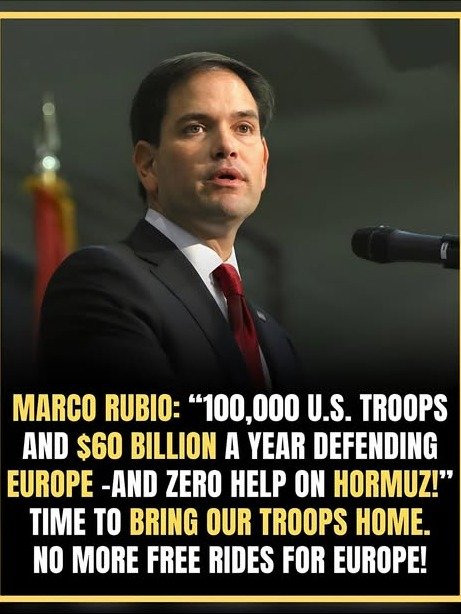
Did you know that the United States maintains a massive military footprint across the globe, with tens of thousands of troops stationed in countries far from its borders? This extensive presence comes with an astronomical price tag, sparking a vital debate that every American needs to understand. Senator Marco Rubio recently ignited a crucial conversation, raising serious questions about the sustainability and strategic wisdom of America’s current defense spending and troop deployments.
Specifically, the U.S. stations between 80,000 to 100,000 troops in Europe alone, a commitment that costs taxpayers billions of dollars annually. But what are the true implications of this monumental investment? Are we getting the best return on our security dollar, or are these resources being diverted from pressing domestic needs and evolving global threats? This isn’t just about numbers; it’s about the future of American power, prosperity, and national security.
The Astronomical Cost of Global Vigilance
The United States’ defense budget is colossal, dwarfing that of any other nation on Earth. While exact figures fluctuate, annual defense spending often hovers around the $800 billion mark, a sum that includes everything from personnel salaries and equipment procurement to research and development. A significant portion of this budget is dedicated to maintaining a global military presence, including the operational costs of bases, infrastructure, and the deployment of personnel overseas.
Consider the sheer logistics involved: providing housing, healthcare, education for families, and all the necessary support systems for tens of thousands of service members and their dependents stationed abroad. These are not merely temporary deployments; many represent decades-long commitments. The financial burden extends beyond salaries, encompassing everything from fuel for jets and ships to the maintenance of complex weaponry and the upkeep of sprawling military installations.
Europe’s Enduring Garrison: A Post-Cold War Paradox?
The presence of 80,000 to 100,000 U.S. troops in Europe is a legacy of the Cold War, a testament to America’s commitment to deterring Soviet aggression. For decades, this robust forward deployment was seen as essential for collective defense through NATO. However, the geopolitical landscape has drastically changed since the fall of the Berlin Wall, leading many to question whether such a large and costly presence is still optimally aligned with current strategic realities.
While Russia’s recent aggression in Ukraine has undeniably revitalized NATO’s purpose and reaffirmed the need for a strong deterrent, the scale and nature of the U.S. contribution remain a point of contention. Critics argue that European nations, with their robust economies, should be shouldering a greater share of their own defense, particularly given the direct threat they face on their continent. This debate isn’t about abandoning allies, but rather about ensuring equitable burden-sharing and efficient resource allocation.
Senator Rubio’s Clarion Call for Strategic Re-evaluation
Senator Marco Rubio’s concerns stem from a desire to ensure America’s defense posture is both effective and fiscally responsible. He has consistently highlighted the need to scrutinize long-standing commitments and adapt to a rapidly evolving global threat environment. Rubio’s argument often centers on the idea that resources tied up in traditional, large-scale deployments might be better utilized addressing emergent threats or reinforcing critical capabilities at home.
“We have to ask tough questions about why we have so many troops in certain regions when new threats are emerging elsewhere,” Rubio has stated, emphasizing the need for a dynamic and adaptable defense strategy. “Our defense spending must align with today’s challenges, not just yesterday’s.”
His perspective is not an isolationist one, but rather a call for strategic clarity and a more efficient allocation of America’s finite resources. He urges policymakers to consider whether the current distribution of forces effectively addresses the rise of China, the complexities of cyber warfare, and other non-traditional security challenges that demand different types of investments and deployments.
Shifting Global Threats: Are We Fighting Yesterday’s Wars?
The world stage is dramatically different from the one that shaped many of America’s current military deployments. While Cold War-era strategies focused heavily on conventional land warfare in Europe, today’s challenges are multi-faceted. The rise of China as a near-peer competitor, particularly in the Indo-Pacific, demands significant attention and resources. Cyber warfare, space-based threats, and the proliferation of advanced technologies require different defensive and offensive capabilities.
Maintaining a large traditional military presence in one region might inadvertently divert resources and strategic focus from these critical, emerging domains. The question isn’t whether America should be globally engaged, but how that engagement can be optimized to counter the most pressing threats to its national interests and those of its allies, without overextending its capabilities or its budget.
The NATO Alliance: A Partnership Under Scrutiny
The North Atlantic Treaty Organization (NATO) stands as the most successful military alliance in history, a cornerstone of transatlantic security. However, the question of burden-sharing within NATO has been a persistent point of contention, especially for American policymakers. While all NATO members commit to collective defense under Article 5, the U.S. has historically borne the lion’s share of the financial and military burden.
Despite the alliance’s agreed-upon target for members to spend 2% of their GDP on defense, many European nations consistently fall short. This disparity fuels arguments, like Rubio’s, that U.S. troop presence in Europe enables allies to underinvest in their own defense, creating a dependency that is both costly for American taxpayers and potentially detrimental to the alliance’s long-term health. A truly robust alliance requires all members to contribute meaningfully and proportionately.
Economic Impact and Competing Domestic Priorities
Every dollar spent on overseas military deployments is a dollar that cannot be invested elsewhere. This concept, known as opportunity cost, is central to the debate over defense spending. Critics argue that the billions allocated to maintaining a vast global footprint could instead be directed towards vital domestic needs, such as:
- Infrastructure development: repairing roads, bridges, and modernizing public transportation.
- Education: investing in schools, teacher salaries, and STEM programs.
- Healthcare: expanding access, lowering costs, and funding medical research.
- Technological innovation: bolstering America’s competitive edge in critical future industries.
- Addressing climate change: funding renewable energy and resilience initiatives.
The debate is not about choosing between national security and domestic well-being, but about finding the optimal balance. A strong nation requires both robust defense and a thriving society at home. Over-committing resources abroad could, paradoxically, weaken the very foundations of American power.
The Strategic Dilemma: Presence vs. Flexibility
Advocates for a strong forward presence argue that it is crucial for deterrence, rapid response, and maintaining stability in key regions. Having troops and equipment already in place allows for quicker reactions to crises, reassures allies, and signals commitment to adversaries. This ‘boots on the ground’ approach provides invaluable intelligence gathering and fosters interoperability with partner nations.
However, an alternative perspective champions greater strategic flexibility. This approach suggests that technological advancements allow for rapid deployment from the continental U.S., negating the need for such extensive permanent overseas bases. It also posits that a smaller, more agile footprint could free up resources for high-tech capabilities, special operations forces, and cyber defenses, which are increasingly vital in modern conflict. The challenge lies in finding the sweet spot between these two strategic philosophies.
Looking Ahead: Re-evaluating America’s Global Footprint
The conversation initiated by Senator Rubio and others is not a call for isolationism, but rather an urgent plea for a sober and comprehensive re-evaluation of America’s global defense strategy. As the world becomes more complex and multi-polar, the U.S. must adapt its approach to national security to ensure it remains effective, sustainable, and aligned with its core interests.
This re-evaluation will likely involve difficult choices: Which alliances are most critical? Where are permanent deployments truly indispensable? How can we encourage greater burden-sharing from allies? And how can we best invest in the capabilities needed to deter future threats, rather than continuing to prepare for past ones? These are the questions that demand answers as America navigates the challenges of the 21st century.
The Path Forward: A Balanced Approach
Ultimately, the goal is to forge a defense strategy that is both robust and responsible. It means ensuring that America’s military is lean, agile, and equipped to meet the full spectrum of modern threats, from conventional warfare to cyberattacks and geopolitical competition. It also means fostering strong alliances where all partners contribute equitably, and where U.S. resources are deployed strategically, not just out of historical inertia.
The debate over defense spending and troop deployments is far from over. It is a critical dialogue that impacts every American, shaping our economic future, our global standing, and our national security. Understanding these complexities is the first step toward advocating for a defense policy that truly serves the nation’s best interests in a rapidly changing world.
About the Author




