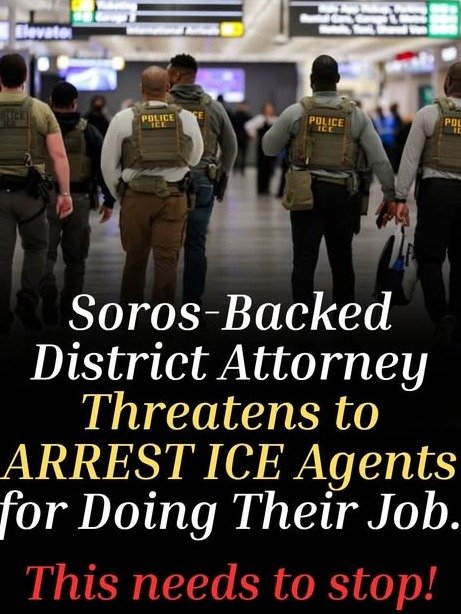
Imagine a city’s top prosecutor publicly clashing with federal immigration agents, warning them against operations within his jurisdiction. This isn’t a scene from a political thriller; it’s the reality unfolding in Philadelphia, where District Attorney Larry Krasner has ignited a firestorm of debate. His controversial directives regarding U.S. Immigration and Customs Enforcement (ICE) agents are not just local news; they’re a flashpoint in a national conversation about criminal justice reform, federal authority, and the very definition of a prosecutor’s role.
At the heart of this intense scrutiny is Krasner himself, a figure widely known for his backing from George Soros-linked funding. This financial support has fueled a new breed of ‘progressive prosecutors’ across the country, aiming to redefine justice from the ground up. But with these radical shifts come equally fervent opposition, especially when local policies appear to directly challenge federal law enforcement, as seen in the ongoing saga with ICE.
The Architect of Reform: Who is Larry Krasner?
Larry Krasner’s journey to becoming Philadelphia’s District Attorney is anything but conventional. Before his 2017 election, he spent three decades as a civil rights attorney, often suing the police department and defending activists, a background that sharply contrasts with the traditional prosecutor’s path. His career was marked by a tenacious advocacy for individuals against state power, setting the stage for a dramatic shift in how justice would be administered in one of America’s largest cities.
His campaign platform was revolutionary: end mass incarceration, reduce cash bail, and hold police accountable. These promises resonated with a significant portion of the electorate, weary of punitive ‘tough on crime’ policies that disproportionately affected minority communities. His victory wasn’t just a win for him; it was seen as a mandate for sweeping criminal justice reform, signaling a new era for Philadelphia’s legal system.
The Soros Connection: Fueling a Movement
A crucial element in understanding Krasner’s rise, and indeed the broader progressive prosecutor movement, is the significant financial backing from political action committees (PACs) linked to billionaire philanthropist George Soros. These funds, often channeled through organizations like the Open Society Foundations, have supported candidates nationwide who advocate for reforms aligned with Soros’s vision of a less punitive and more equitable justice system.
For Krasner, this support was instrumental. It provided the resources necessary to run a highly competitive campaign, amplifying his message of systemic change. Critics, however, view this funding as an attempt by an outside influence to reshape local judicial systems, arguing that it introduces a political agenda that may not always align with public safety priorities or the will of local taxpayers.
The ICE Standoff: A Line in the Sand
The latest controversy surrounding District Attorney Krasner centers on his outspoken stance against U.S. Immigration and Customs Enforcement (ICE) operations. Krasner has issued warnings and directives that effectively push back against ICE’s presence and activities within Philadelphia’s jurisdiction, particularly regarding arrests and deportations of undocumented immigrants who may have minor offenses or no criminal record.
This isn’t merely a suggestion; it’s a deliberate policy choice reflecting his administration’s broader philosophy. Krasner’s office has reportedly advised ICE agents on protocols for operating within the city, and in some instances, has been perceived as actively discouraging cooperation between local law enforcement and federal immigration authorities. Such actions are a direct challenge to the federal government’s mandate to enforce immigration laws, creating a complex legal and political battleground.
“Our office will not be complicit in actions that undermine community trust or target vulnerable populations. We are here to uphold justice for all Philadelphians, and that includes ensuring due process and fair treatment, regardless of immigration status.”
Backlash and Blame: The Critics Weigh In
Krasner’s progressive policies, especially his stance on ICE, have drawn fierce criticism from various quarters. Federal authorities, including ICE officials, have publicly condemned his actions, arguing that they impede essential immigration enforcement and potentially endanger public safety by creating ‘sanctuary’ environments for individuals who should be deported. They assert that local jurisdictions should not interfere with federal mandates.
Law enforcement unions and some members of the Philadelphia Police Department have also expressed concerns, citing potential difficulties in inter-agency cooperation and the perception that Krasner’s policies are overly lenient. Critics argue that such directives send a message that Philadelphia is unwilling to cooperate with federal partners, potentially making the city a magnet for those seeking to avoid immigration enforcement.
Law vs. Politics: Where Does the Line Blur?
The core of the debate surrounding Larry Krasner’s tenure, particularly his ICE directives, lies in the fundamental tension between ‘law’ and ‘politics.’ Traditionally, a district attorney’s role is to enforce existing laws without political bias. However, progressive prosecutors like Krasner argue that their role extends beyond mere enforcement to actively shaping justice through policy, discretion, and advocacy for systemic change.
This approach transforms the DA’s office from a purely legal institution into a powerful political instrument, capable of influencing social policy on a grand scale. When a DA decides not to prosecute certain offenses, to drastically reduce bail, or to limit cooperation with federal agencies, these are not just legal decisions; they are deeply political statements that reflect a particular ideological vision for society.
Impact on Philadelphia: A City Divided
The effects of Krasner’s progressive policies are keenly felt within Philadelphia. Supporters point to reductions in the city’s jail population, fewer individuals held on cash bail for minor offenses, and a renewed focus on addressing the root causes of crime rather than simply punishing its symptoms. They argue that these reforms are creating a more equitable justice system and fostering greater trust between communities and law enforcement.
However, critics often highlight rising crime rates, particularly homicides, which some attribute at least partially to Krasner’s leniency. While the causes of crime are complex and multi-faceted, the narrative of a ‘soft on crime’ DA gains traction when violent crime statistics spike. This creates a deeply polarized environment, where every policy decision is scrutinized through the lens of its perceived impact on public safety and community well-being.
The National Ripple Effect: Sanctuary Cities and Federal Power
Philadelphia’s standoff with ICE under Krasner is not an isolated incident; it’s a microcosm of a larger national conflict. Cities across the United States have adopted ‘sanctuary’ policies, limiting their cooperation with federal immigration authorities. These policies are often rooted in a desire to build trust within immigrant communities, encouraging reporting of crimes without fear of deportation, and reflecting humanitarian concerns.
However, these local initiatives frequently clash with the federal government’s authority to enforce immigration laws. The resulting legal battles and political rhetoric underscore a fundamental disagreement over sovereignty, local control, and the scope of federal power. The Philadelphia situation serves as a high-profile example of how these tensions play out on the ground, with significant implications for both local residents and national policy.
The Future of Justice: A Shifting Landscape
Larry Krasner’s tenure as Philadelphia’s District Attorney represents a bold experiment in criminal justice reform, one that challenges long-held assumptions about the role of a prosecutor. His approach, bolstered by progressive funding, has undeniably sparked vital conversations about equity, incarceration, and the balance of power between local and federal authorities. Yet, it has also ignited fierce opposition, raising questions about public safety and the rule of law.
The ongoing struggle between Krasner’s office and federal agencies like ICE is more than just a local dispute; it’s a bellwether for the future of justice in America. As more progressive prosecutors emerge and push for systemic change, the lines between legal enforcement and political advocacy will continue to blur, forcing communities nationwide to grapple with complex questions about how they define justice, safety, and accountability in an evolving society. Your city, too, may soon face these critical decisions.
About the Author




