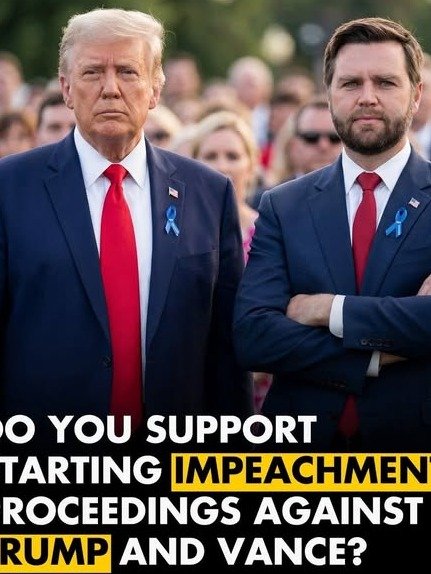
In the tumultuous world of American politics, few words ignite more controversy or confusion than ‘impeachment.’ Yet, despite the swirling rumors and intense public debate, a critical fact often gets lost: there are currently no active impeachment proceedings targeting Donald Trump or JD Vance as of early 2026. This might come as a surprise given the constant political noise, but understanding the precise legal and political landscape is paramount.
This article will delve into the constitutional framework of impeachment, examine the historical context, and explore why these two prominent figures frequently find their names linked to such discussions, even in the absence of formal action. We’ll unpack the reality behind the headlines and clarify what ‘active proceedings’ truly entails.
Understanding the Impeachment Process
Before we dissect the current political climate, it’s essential to grasp the fundamental mechanics of impeachment in the United States. The Constitution grants Congress the power to remove federal officials, including the President, Vice President, and other civil officers, for ‘Treason, Bribery, or other high Crimes and Misdemeanors.’ This is a two-stage process, designed to be a grave and exceptional measure.
The journey begins in the House of Representatives, where a simple majority vote is required to impeach an official. This vote effectively acts as an indictment, charging the individual with specific offenses. Once impeached by the House, the process moves to the Senate, which then conducts a trial. For a conviction and removal from office, a two-thirds majority vote in the Senate is necessary. This high bar ensures that impeachment is not a simple partisan tool, but a serious constitutional mechanism.
A Brief History of Impeachment in the U.S.
The history of presidential impeachment is remarkably sparse, underscoring its gravity. Only three U.S. Presidents have ever been impeached by the House of Representatives: Andrew Johnson in 1868, Bill Clinton in 1998, and Donald Trump twice, in 2019 and 2021. None of these presidents were ultimately convicted and removed from office by the Senate.
“Impeachment is not a punishment for a crime; it is a political proceeding, an act of the sovereign people, not a judicial process.” – Gerald Ford (1970)
This historical context is crucial. It highlights that while impeachment is a constitutional power, its actual application, particularly against a president, is rare and fraught with immense political implications. It often reflects deep divisions within the government and the public.
Donald Trump and the Impeachment Record
Former President Donald Trump holds a unique place in American history as the only president to be impeached twice by the House of Representatives. His first impeachment came in December 2019, on charges of abuse of power and obstruction of Congress. These charges stemmed from allegations that he pressured Ukraine to investigate a political rival in exchange for military aid.
The House voted to impeach, but the Senate acquitted him in February 2020. Less than a year later, in January 2021, Trump faced a second impeachment. This time, the charge was ‘incitement of insurrection,’ related to the events of January 6th at the U.S. Capitol. He was again acquitted by the Senate, though a significant number of Republican senators voted to convict.
- First Impeachment (2019): Charges of Abuse of Power, Obstruction of Congress. Acquitted by Senate.
- Second Impeachment (2021): Charge of Incitement of Insurrection. Acquitted by Senate.
The discussions surrounding Trump and impeachment have remained a constant fixture in political discourse, even after he left office. Critics frequently suggest grounds for future proceedings, while supporters vehemently defend his actions. However, as of early 2026, there are no new, active proceedings being considered or initiated against him in either chamber of Congress.
The JD Vance Factor: Why His Name Comes Up
Senator JD Vance, a prominent Republican figure from Ohio, has also found his name entangled in the broader impeachment discussion, albeit in a different context. Unlike former President Trump, Senator Vance has not faced any formal impeachment proceedings. His inclusion in this public discourse often stems from his high-profile political positions, his vocal criticisms of political opponents, and his potential future roles in government.
Vance has become a significant voice in conservative politics, known for his strong opinions and often controversial statements. In an increasingly polarized political environment, any prominent figure who takes a firm stance can become the subject of intense scrutiny and, by extension, the target of rhetorical calls for impeachment from political adversaries or concerned citizens.
Political Rhetoric vs. Constitutional Reality
It’s crucial to distinguish between political rhetoric and actual constitutional processes. In the heated arena of modern politics, the word ‘impeachment’ is often deployed as a powerful rhetorical weapon. Opposing parties or activist groups might call for an official’s impeachment to express extreme disapproval, generate public pressure, or simply to energize their base.
These calls, while reflecting legitimate public sentiment or political strategy, do not equate to ‘active impeachment proceedings.’ An active proceeding requires concrete steps: formal investigations by House committees, drafting of articles of impeachment, and ultimately, a vote by the full House of Representatives. Without these steps, discussions remain just that – discussions.
The Political Climate of Early 2026
The early months of 2026 find the United States in a politically charged atmosphere, with mid-term elections on the horizon and presidential election speculation already in full swing. In such an environment, the weaponization of political tools, including the threat of impeachment, becomes more common. Both Donald Trump and JD Vance are figures who consistently draw significant media attention and are central to ongoing political debates.
Trump, as a former president and potential future candidate, remains a focal point for both ardent support and fierce opposition. Vance, as an influential senator and a rising star in the Republican party, also attracts considerable scrutiny. It is therefore unsurprising that their names would surface in discussions about accountability and the limits of power, even when formal impeachment mechanisms are not engaged.
Navigating the Information Landscape
In an age of rapid information dissemination and social media-driven narratives, it can be challenging to discern fact from speculation. The mention of ‘impeachment’ in relation to high-profile figures like Donald Trump or JD Vance can quickly gain traction, leading many to believe that formal actions are underway.
However, it is vital for citizens to seek out reliable sources and verify claims. Official government websites, reputable news organizations, and direct statements from congressional leadership are the most accurate places to confirm the status of any potential impeachment proceedings. The absence of such official announcements means that, despite the chatter, no active process has begun.
The True State of Affairs: No Active Proceedings
To reiterate the core message: as of early 2026, there are no active impeachment proceedings involving either Donald Trump or JD Vance. This means that neither the House of Representatives nor the Senate has formally initiated steps to investigate, charge, or try either individual for impeachment. While the topic may be a point of public discussion and political strategizing, it has not translated into constitutional action.
Understanding this distinction is crucial for an informed citizenry. It allows for a clearer view of the actual political landscape, separating hypothetical scenarios and rhetorical skirmishes from the serious, constitutionally mandated process of impeachment. The absence of active proceedings underscores that while political tensions run high, the formal mechanisms of accountability are currently not engaged in this specific context.
About the Author




