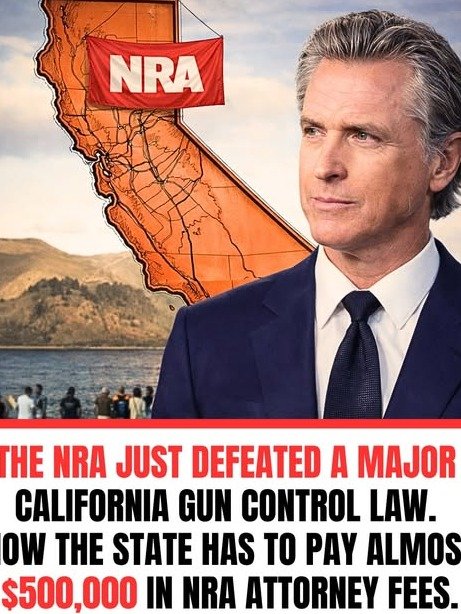
A seismic shift just reverberated through the legal landscape of California, delivering a monumental victory for Second Amendment advocates and free speech proponents alike. In a stunning turn of events, the National Rifle Association (NRA) has successfully challenged and effectively halted the enforcement of California’s controversial Assembly Bill 2571 (AB 2571), a law designed to severely restrict firearm advertising and marketing aimed at minors.
This isn’t just another legal skirmish; it’s a profound declaration that could reshape the ongoing debate surrounding gun control and constitutional rights across the nation. For years, gun owners and industry stakeholders have watched as California enacted increasingly stringent regulations. Now, a crucial piece of that legislative puzzle has been dismantled, raising critical questions about the limits of state power when it comes to fundamental freedoms.
The Genesis of AB 2571: A State’s Stance on Youth and Firearms
California’s AB 2571, signed into law in 2022, represented a bold legislative effort to curb what lawmakers perceived as irresponsible marketing practices within the firearms industry. The intent was clear: to protect minors from what the state deemed predatory advertising that could potentially normalize gun violence or encourage dangerous behaviors among young people.
Specifically, the law prohibited firearm industry members from marketing or advertising any firearm-related product in a manner that “reasonably appears to be attractive to minors.” This broad language encompassed everything from promotional materials and advertisements to product placement and endorsements, aiming to create a significant barrier between the industry and younger audiences.
Proponents of AB 2571 argued that it was a necessary measure to safeguard public health and reduce gun violence, particularly in an era marked by tragic school shootings and rising concerns about youth access to firearms. They contended that certain marketing tactics, often featuring cartoon-like imagery or video game aesthetics, blurred the lines between responsible firearm use and dangerous misuse, thereby endangering children.
The NRA Steps Up: A Dual Challenge on Constitutional Grounds
From the moment AB 2571 was enacted, it faced fierce opposition. The National Rifle Association, a stalwart defender of gun rights, quickly moved to challenge the law in federal court, arguing that it violated fundamental constitutional protections. Their legal strategy was robust, asserting infringements on both the First Amendment (freedom of speech) and the Second Amendment (the right to keep and bear arms).
The NRA, alongside other plaintiffs including gun retailers and advocacy groups, contended that AB 2571’s provisions were overly broad and vague, creating a chilling effect on legitimate commercial speech. They argued that the law effectively banned truthful advertising about legal products, even when such advertising was directed at adults but might incidentally be seen by minors.
“This law was an egregious overreach, attempting to silence vital communication about lawful products and constitutional rights under the guise of child protection. Our First and Second Amendment rights are not subject to a legislative veto based on subjective interpretations of ‘attractive to minors.'”
Furthermore, the lawsuit highlighted the Second Amendment implications, arguing that restricting access to information about firearms could indirectly impede the right to acquire and use them for lawful purposes, including self-defense. The plaintiffs emphasized that responsible firearm education and product awareness are crucial, and AB 2571 stifled these efforts.
The Court’s Decisive Blow: First Amendment Trumps State Control
The legal battle culminated in a federal court decision that sided squarely with the NRA and its co-plaintiffs. The court’s ruling delivered a crushing blow to AB 2571, granting a preliminary injunction that prevents the state from enforcing the controversial law.
The judge’s reasoning focused heavily on First Amendment concerns, particularly the protection of commercial speech. The court found that AB 2571’s prohibitions were not narrowly tailored to achieve the state’s stated interest in protecting minors. Instead, the law was deemed to be an unconstitutional restriction on speech, effectively banning a wide range of lawful advertising simply because it *might* appeal to a minor.
Crucially, the court questioned the state’s premise that any advertisement for a firearm could be deemed inherently harmful or attractive to minors in a way that warranted a blanket ban. The ruling underscored that for commercial speech restrictions to be constitutional, they must directly advance a substantial government interest and be no more extensive than necessary to serve that interest. AB 2571, in the court’s view, failed this critical test.
What This Means: A Resounding Victory for Gun Rights and Free Speech
This federal court ruling is a monumental victory for several reasons:
- Reinforcement of First Amendment Rights: It reaffirms the robust protection of commercial speech, even for products that some find controversial. This sets a precedent against overly broad state censorship.
- Second Amendment Advocacy Boost: While the primary focus was on the First Amendment, the win indirectly supports the Second Amendment by ensuring that information about legal firearms and related products can be disseminated.
- A Check on Legislative Overreach: The decision serves as a powerful reminder that states cannot infringe upon constitutional rights, even when attempting to address valid public safety concerns, without adhering to strict legal standards.
- Impact on the Firearms Industry: Manufacturers, retailers, and advertisers can breathe a sigh of relief, as they are no longer subject to the vague and restrictive provisions of AB 2571. This allows for more open and truthful communication about their products.
For gun rights advocates, this ruling is more than just a legal triumph; it’s a morale booster. It signals that even in states with aggressive gun control agendas, constitutional protections can, and will, be enforced by the judiciary.
The Broader Implications: A Ripple Effect Across the Nation?
The implications of this ruling extend far beyond California’s borders. Other states considering similar restrictions on firearm advertising will now have to contend with this precedent. The decision reinforces the idea that attempts to regulate firearm-related speech must be carefully crafted to avoid constitutional challenges.
This legal victory also highlights the ongoing, often contentious, dance between state legislatures and federal courts when it comes to gun control. While states like California continue to push the boundaries of gun regulation, the judiciary remains a critical check, ensuring that such laws do not erode fundamental rights enshrined in the U.S. Constitution.
The firearms industry, which has often felt targeted by restrictive legislation, can now point to this ruling as evidence that their legitimate commercial activities deserve constitutional protection. This could embolden them to challenge other advertising or marketing restrictions in various jurisdictions.
What’s Next? Appeals and the Enduring Battle
While the preliminary injunction is a significant win, the legal battle may not be entirely over. The State of California could choose to appeal this decision to a higher court, potentially prolonging the legal wrangling. However, the strength of the First Amendment arguments presented by the NRA makes any appeal an uphill battle for the state.
Regardless of future appeals, this ruling stands as a powerful testament to the enduring importance of constitutional safeguards. It underscores the principle that even well-intentioned legislation must respect the fundamental rights of speech and, by extension, the right to keep and bear arms.
This landmark decision in California is a clear message: while the debate over gun control will continue, attempts to restrict constitutional freedoms through overly broad legislation will face rigorous scrutiny and, as seen with AB 2571, can be decisively struck down by the courts. For now, the Second Amendment, and the right to discuss it, stands stronger in the Golden State.
About the Author




