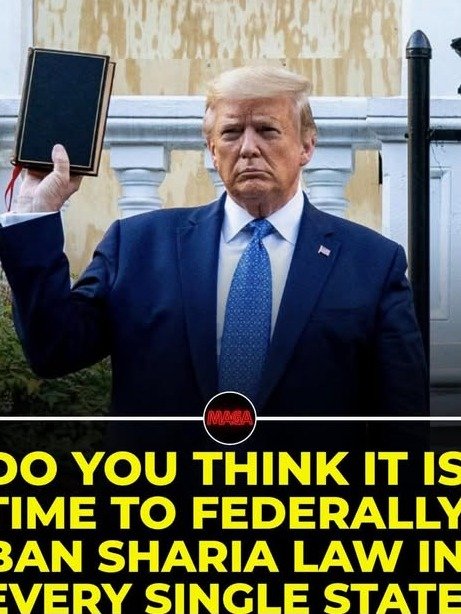
Remember that powerful image? A leader standing firm, holding a symbol of enduring faith against a backdrop of national tension. The moment President Trump held up the Bible wasn’t merely a fleeting photo opportunity; it was a potent visual declaration that resonated deeply with millions, sparking a critical conversation about the very bedrock of American society.
This single, striking photograph became a flashpoint, not just for its immediate political context, but for what it represented: a staunch defense of America’s unique constitutional framework. It underscored a fundamental principle that many believe is increasingly under threat – the absolute supremacy of the United States Constitution over any other legal system, foreign or domestic.
The Enduring Symbolism of the Bible in American Life
For centuries, the Bible has held a significant, albeit complex, place in American public life and historical narrative. From early colonial settlements founded on religious freedom to presidential inaugurations where oaths are sworn on its pages, it symbolizes a moral compass and a connection to Judeo-Christian values that many Americans view as foundational to the nation’s character.
When President Trump displayed the Bible, it was interpreted by many as an affirmation of these deeply rooted values and a symbolic gesture aligning himself with a tradition of American exceptionalism grounded in religious liberty and a particular moral order. It spoke volumes to those who feel these traditional foundations are being eroded or challenged.
This act wasn’t about establishing a state religion, which is explicitly forbidden by the Constitution. Rather, it tapped into a collective consciousness that sees a connection between these historical values and the principles of liberty and justice enshrined in American law. It served as a powerful reminder of the cultural and historical underpinnings that inform the American experiment.
Understanding the American Constitutional Framework
At the heart of the United States lies its Constitution, a revolutionary document that established a government of the people, by the people, and for the people. It is the supreme law of the land, designed to protect individual liberties, ensure due process, and maintain a delicate balance of power among three branches of government.
The Constitution guarantees fundamental rights such as freedom of speech, freedom of religion, and equality before the law, regardless of background or belief. These rights are not granted by any ruler or religious text but are considered inherent and protected by the government itself. This framework is what makes America distinct and enduring.
One of the most critical aspects of the American system is the separation of church and state. This principle ensures that the government does not establish or endorse any religion, and conversely, that religious institutions do not dictate government policy. It safeguards both religious freedom and governmental neutrality, preventing the imposition of any singular religious legal code on all citizens.
Sharia Law: An Overview and Its Diverse Interpretations
To fully grasp the core of this national debate, it’s essential to understand what Sharia Law entails. Sharia, often translated as “the clear, well-trodden path to water,” is a comprehensive Islamic legal and moral code derived from the Quran and the teachings (Sunnah) of the Prophet Muhammad. It encompasses a broad range of human activities, from religious rituals to criminal justice, family law, and commerce.
It’s crucial to acknowledge that Sharia is not a monolithic entity. There are diverse interpretations and schools of thought across the Islamic world, leading to significant variations in its application. Some interpretations are quite liberal, focusing on universal moral principles, while others are highly conservative, advocating for strict adherence to traditional rulings that may differ significantly from Western legal norms.
For many Muslims, Sharia represents a personal guide for living a pious life, a framework for ethical behavior, and a source of spiritual connection. However, when Sharia is proposed or implemented as a state legal system, particularly in a pluralistic society like the United States, questions inevitably arise regarding its compatibility with existing constitutional protections.
Why Sharia Law is Incompatible with the US Constitution
The core argument against the implementation or recognition of Sharia Law in the United States rests on its perceived incompatibility with several fundamental tenets of the US Constitution. This isn’t an attack on Islam as a religion, but a defense of the secular, rights-based legal system that defines America.
Separation of Church and State
The First Amendment of the US Constitution clearly states: “Congress shall make no law respecting an establishment of religion, or prohibiting the free exercise thereof.” This Establishment Clause creates a high wall of separation between church and state. Sharia Law, as a comprehensive religious legal system, inherently blurs this line by seeking to govern both religious and secular affairs.
If Sharia were to be applied in American courts, even in specific cases, it would effectively introduce a religious legal code into a secular judicial system. This would be a direct violation of the Establishment Clause, setting a dangerous precedent that could undermine the very foundation of governmental neutrality in religious matters.
Equality Under the Law and Individual Rights
The US Constitution guarantees equality for all citizens, regardless of gender, religion, or other protected characteristics. The Fourteenth Amendment ensures “equal protection of the laws.” Many interpretations of Sharia Law, particularly more conservative ones, present significant challenges to these principles.
“Our Constitution guarantees freedom of speech, freedom of religion, equality under the law, and due process for all. Any legal system that contradicts these fundamental rights cannot coexist with the American system.” – A common sentiment among constitutionalists.
For example, some Sharia interpretations may afford different legal standing to men and women, or to Muslims and non-Muslims, in areas such as testimony in court, inheritance, or marital rights. Such distinctions are directly at odds with the constitutional guarantees of equal protection and individual rights that are cornerstones of American jurisprudence.
Freedom of Speech and Expression
The First Amendment also protects freedom of speech, a cornerstone of American democracy. While not absolute, this freedom allows for criticism, dissent, and expression of diverse viewpoints. Some interpretations of Sharia Law include prohibitions against blasphemy or apostasy, which can carry severe penalties and restrict freedom of expression in ways that are fundamentally incompatible with American legal standards.
The American legal system protects the right to express even unpopular or offensive ideas, as long as they do not incite violence or directly harm others. Introducing legal concepts that criminalize speech based on religious doctrine would be a profound departure from this core constitutional protection.
Due Process and Judicial Autonomy
The Fifth and Fourteenth Amendments guarantee due process of law, ensuring fair treatment and judicial procedures for all. The American legal system relies on a common law tradition, precedent, and the interpretation of secular statutes by independent courts.
Introducing Sharia-based judgments, particularly from religious courts or councils, could create a parallel legal system or introduce conflicting legal standards that undermine the uniformity and integrity of the American judicial process. This would compromise the principle that all citizens are subject to the same laws and judicial review, regardless of their religious affiliation.
The Supremacy of American Law: A Non-Negotiable Principle
Article VI, Clause 2 of the United States Constitution, known as the Supremacy Clause, unequivocally states that the Constitution and the laws made pursuant to it are “the supreme Law of the Land.” This means that federal law takes precedence over state laws, and crucially, that no foreign or religious legal system can supersede American law.
The debate over Sharia Law isn’t about religious tolerance; it’s about legal sovereignty. America prides itself on being a nation of laws, not of men, and certainly not of foreign religious doctrines. Allowing any external legal system to operate with authority within the US would create a dangerous precedent, eroding the very foundation of its legal and governmental structure.
Upholding the Constitution means ensuring that every person living within the United States, regardless of their background or personal beliefs, is subject to the same set of laws, administered by the same secular judicial system. This is the ultimate guarantor of liberty and justice for all.
Why This Stance Matters for America’s Future
The symbolic act of holding the Bible, in the context of a broader discussion about Sharia Law, serves as a powerful reminder of the continuous vigilance required to protect America’s unique constitutional experiment. It’s a call to reaffirm the principles that have allowed a diverse nation to thrive under a single, unifying legal framework.
Protecting the Constitution from any encroachment, whether from foreign legal systems or domestic attempts to undermine its core tenets, is not a partisan issue; it is a fundamental duty for all who cherish American liberty. The future of the nation hinges on its unwavering commitment to these foundational principles.
This isn’t about fear; it’s about clarity. It’s about ensuring that the laws governing our society are derived from our shared constitutional values, not from religious texts that may contradict them. The image and the message it conveyed are a stark reminder: the United States Constitution must remain the supreme and unchallenged law of the land.
About the Author




