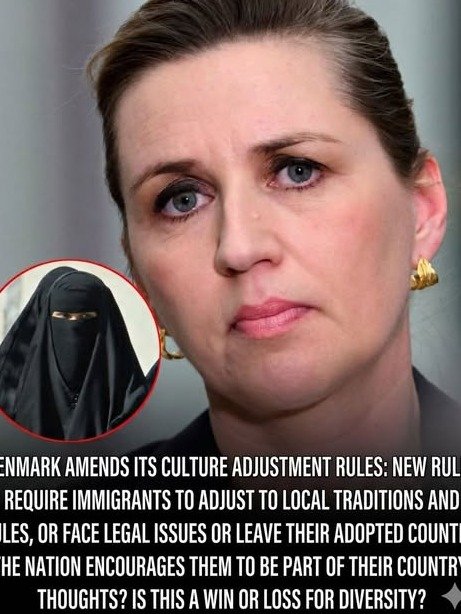
Imagine being told what you can and cannot wear in public. For many, this is a distant concept, but in Denmark, a law enacted in 2018 made it a stark reality, igniting a fierce debate about religious freedom, integration, and individual liberty that continues to reverberate across Europe and beyond. This isn’t just about a piece of fabric; it’s about deeply held beliefs, societal values, and the very definition of a free society.
The Danish ban on certain face-covering garments, often colloquially referred to as the “burqa ban” or “niqab ban,” plunged the nation into a complex policy debate that highlighted fundamental tensions. While proponents argued it was a necessary step for integration and public order, critics vehemently condemned it as discriminatory and a direct assault on religious freedom. The implications of this law extend far beyond Denmark’s borders, raising questions that resonate with anyone concerned about personal autonomy and cultural diversity.
Unpacking Denmark’s Controversial 2018 Ban
In August 2018, Denmark officially implemented a nationwide ban on wearing garments that cover the face in public spaces. This legislative move specifically targeted items like the burqa, which covers the entire face and body with a mesh over the eyes, and the niqab, which covers the entire face except for the eyes. The law also extends to other forms of face coverings, such as balaclavas or fake beards, though its primary focus and public debate centered on Islamic veils.
The Danish Parliament approved the ban with a significant majority, reflecting a broader political sentiment in the country. Penalties for violating the law include fines, starting at 1,000 Danish kroner (approximately $160 USD) for a first offense, escalating for repeat offenders. The stated aim of the legislation was multifaceted, encompassing concerns about integration, security, and the perceived breakdown of open communication in public.
The Stated Rationale: Integration and Open Communication
The Danish government, along with supporters of the ban, frequently cited “integration” as a primary driver behind the legislation. They argued that face-covering garments hinder social cohesion and prevent effective integration of minority communities into Danish society. The inability to see a person’s face, they contended, obstructs communication and trust, which are foundational to Danish cultural norms.
Ministers at the time emphasized the importance of a shared public space where individuals can interact openly. They suggested that veils create barriers, making it difficult for individuals to participate fully in civic life, education, and employment. From this perspective, the ban was framed not as an attack on religion, but as a measure to foster a more inclusive and communicative society.
“It is incompatible with the values of the Danish society to have one’s face covered in public space,” stated Søren Pape Poulsen, then Minister of Justice, when the law was introduced. “It is a matter of respect for the community and the values we share.”
Furthermore, some proponents linked the ban to broader issues of gender equality, arguing that the burqa and niqab are symbols of oppression, particularly for women. They posited that removing these garments could empower women and facilitate their participation in society on equal footing with men, aligning with Denmark’s strong commitment to gender equality.
A Storm of Criticism: Religious Freedom and Discrimination
Despite the government’s stated intentions, the law immediately drew widespread condemnation from human rights organizations, civil society groups, and international bodies. Critics argued that the ban was a clear violation of fundamental human rights, specifically the right to freedom of religion and expression, as enshrined in international conventions.
Amnesty International, for instance, called the ban a “discriminatory and disproportionate” measure that targets Muslim women. They highlighted that while the law was presented as gender-neutral, its practical impact disproportionately affected a small number of Muslim women who choose to wear the niqab or burqa as an expression of their faith.
- Violation of Religious Freedom: For many women, wearing a niqab or burqa is a deeply personal and religious choice, not a coerced act. The ban forces them to choose between their faith and participating in public life.
- Discrimination: Critics argued the law was inherently discriminatory, singling out a specific religious group and their practices under the guise of general public order.
- Counter-Productive to Integration: Far from promoting integration, opponents warned that the ban would further marginalize and isolate women who wear face coverings, pushing them out of public spaces and into their homes, thereby achieving the opposite of its stated goal.
Legal scholars and human rights advocates pointed out that existing laws already address issues of security (e.g., identity checks) and public order (e.g., masks during protests). They questioned the necessity and proportionality of a blanket ban, especially given the extremely small number of women in Denmark who actually wear these garments.
The Paradox of ‘Integration’
The most contentious aspect of the debate revolved around the concept of “integration.” While the government claimed the ban would aid integration, many argued it was a deeply flawed premise. If integration means enabling individuals to participate fully in society, then a law that restricts their ability to do so based on religious attire seems inherently contradictory.
Critics suggested that true integration fosters an environment where diverse practices can coexist, as long as they do not infringe upon the rights of others. They argued that forcing conformity, especially on deeply personal matters of faith and dress, breeds resentment and exclusion rather than genuine inclusion. The ban, in this view, sends a message that certain religious expressions are unwelcome in Danish society.
“Forcing women to remove their veils is not liberation; it is oppression,” remarked a spokesperson for a Danish Muslim women’s organization. “It tells us that our choices are not valid, and that we must conform to a singular idea of what it means to be Danish, even if it contradicts our faith.”
Moreover, the focus on a tiny minority of women who wear face coverings diverted attention from broader, more systemic challenges to integration, such as employment discrimination, housing issues, and educational disparities. Many felt the law was a political gesture, designed to appeal to a particular segment of the electorate rather than genuinely address complex societal issues.
A European Trend? Other Nations and Their Bans
Denmark was not the first European country to introduce such a ban, placing its legislation within a broader, often controversial, European trend. France led the way in 2010 with its ban on full-face veils in public, followed by Belgium in 2011. Austria implemented a similar ban in 2017, and the Netherlands has a partial ban on face coverings in specific public spaces like schools and hospitals.
These laws, while varying in their specific scope and penalties, share common underlying justifications: public safety, secularism, and integration. However, they also share common criticisms regarding their impact on religious freedom and their potential to marginalize minority communities. The European Court of Human Rights has largely upheld these bans, albeit with strong dissenting opinions, often citing a country’s right to protect its “living together” (vivre ensemble) values.
Real-World Impact and Societal Fallout
The immediate impact of the Danish ban was felt most acutely by the handful of women who wore niqabs or burqas. Many reported feeling targeted, isolated, and fearful of public harassment. Some chose to withdraw from public life, further limiting their participation in society, while others chose to defy the ban, facing fines and public scrutiny.
Beyond the direct impact on individuals, the law also sparked broader societal tensions. It fueled debates about national identity, secularism versus religious pluralism, and the limits of state intervention in personal choices. The image of police officers fining women for their attire resonated globally, drawing both support from those who agreed with the policy and outrage from those who saw it as an affront to human dignity.
The policy debate on face coverings and integration in Denmark continues to serve as a potent example of the challenges facing diverse societies. It underscores the delicate balance between upholding individual freedoms, promoting social cohesion, and defining national values in an increasingly multicultural world. The questions raised by this law are far from settled, prompting ongoing reflection on how societies navigate identity, belief, and belonging.
Ultimately, the Danish face-covering ban remains a contentious piece of legislation, symbolizing a deeper ideological struggle. Whether it truly fosters integration or merely entrenches division is a question that continues to be debated, with profound implications for human rights and the future of multicultural societies.
About the Author




