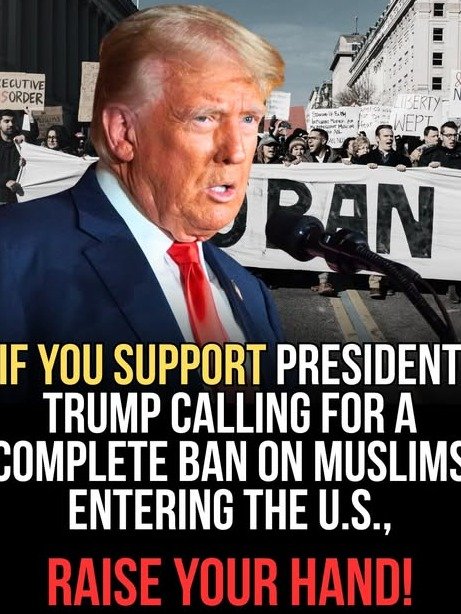
Remember the raw tension and widespread protests that erupted just days into a new presidency? Few policies in recent memory ignited such a fiery national debate and global outcry as the Trump administration’s controversial push for a travel ban, initially targeting several Muslim-majority nations. This wasn’t just a policy change; it was a seismic event that exposed deep divisions and tested the very fabric of American values.
What started as a broad, often vague campaign promise quickly escalated into a series of executive orders that sent shockwaves through airports, courtrooms, and communities across the country. The so-called ‘Muslim ban’ became a flashpoint, encapsulating debates over national security, religious freedom, presidential power, and America’s role on the world stage. But what truly happened, and what was the lasting impact of this unprecedented move?
The Genesis of a Groundbreaking Policy
The roots of the travel ban can be traced directly back to Donald Trump’s 2016 presidential campaign. During his bid for the White House, Trump repeatedly called for a “total and complete shutdown of Muslims entering the United States,” citing national security concerns in the wake of terrorist attacks. This rhetoric, while controversial, resonated with a segment of the electorate concerned about immigration and radical extremism.
Upon taking office, the administration moved swiftly to make good on this promise. The speed and scope of the initial executive order caught many by surprise, signaling a dramatic shift in U.S. immigration policy. It was a clear demonstration of the new administration’s intent to prioritize what it defined as national security above all else, even if it meant challenging long-held norms and legal precedents.
Executive Order 13769: The First Wave of Chaos
On January 27, 2017, just seven days into his presidency, President Trump signed Executive Order 13769, officially titled “Protecting the Nation from Foreign Terrorist Entry into the United States.” This order immediately suspended the entry of foreign nationals from seven Muslim-majority countries—Iran, Iraq, Libya, Somalia, Sudan, Syria, and Yemen—for 90 days. It also halted the entry of all refugees for 120 days and indefinitely banned Syrian refugees.
“The executive order was a chaotic rollout that created immediate confusion and distress for thousands of travelers and their families. It wasn’t just a policy; it was a humanitarian crisis unfolding in real-time at airports nationwide.”
The implementation was swift and often confusing, leading to widespread chaos at airports across the U.S. Travelers, including those with valid visas and even green cards, were detained, denied entry, or immediately deported. Legal challenges quickly mounted, and massive protests erupted, with thousands gathering at airports and federal courthouses to voice their opposition.
The Legal Storm: Courts Intervene
The initial executive order was met with immediate legal challenges from civil liberties groups, states, and individuals. Federal judges across the country issued temporary restraining orders, halting parts of the ban’s implementation. The Ninth Circuit Court of Appeals upheld a lower court’s block, setting the stage for a prolonged legal battle that would eventually reach the Supreme Court.
The administration argued that the ban was a necessary measure for national security, allowing time to review and strengthen vetting procedures for individuals from countries deemed high-risk. Opponents, however, contended that the order was discriminatory, unconstitutional, and violated the Establishment Clause, which prohibits the government from establishing a religion or favoring one over others.
A Revised Approach: Executive Order 13780
Facing significant legal hurdles and public backlash, the Trump administration issued a revised executive order, 13780, on March 6, 2017. This new order attempted to address some of the legal criticisms of its predecessor. It removed Iraq from the list of banned countries, clarified that green card holders would not be affected, and removed the indefinite ban on Syrian refugees, instead treating them like other refugees under a 120-day suspension.
Despite these changes, the revised ban still faced immediate legal challenges. Critics argued that the underlying intent remained discriminatory, and the changes were merely cosmetic. Federal courts once again blocked its implementation, highlighting the deep legal and constitutional questions surrounding the policy.
The Supreme Court’s Landmark Decision: Trump v. Hawaii
The legal saga culminated in the Supreme Court case of Trump v. Hawaii. The administration issued a third version of the ban, Presidential Proclamation 9645, in September 2017. This version was more targeted, based on a review of information sharing and identity management practices of various countries. It included some non-Muslim-majority countries (like Venezuela and North Korea) alongside the predominantly Muslim-majority nations (Chad, Iran, Libya, Somalia, Syria, Yemen).
In a 5-4 decision in June 2018, the Supreme Court upheld the third iteration of the ban. The majority opinion, written by Chief Justice John Roberts, stated that the President had broad authority over immigration and that the proclamation was within the scope of that authority. The Court found that the ban was “facially neutral” and not motivated by anti-Muslim animus, despite earlier statements from President Trump.
- Key Takeaways from Trump v. Hawaii:
- The Supreme Court affirmed broad presidential authority over immigration.
- It found the third version of the ban to be “facially neutral.”
- Dissenting justices strongly criticized the decision, citing evidence of discriminatory intent.
- The ruling sparked significant debate over the role of executive power and religious freedom.
The Human Cost and Global Ramifications
Beyond the legal battles, the travel ban had profound human consequences. Families were separated, students and scholars were unable to pursue their education, and individuals seeking refuge from war and persecution found doors closed. The policy created an atmosphere of fear and uncertainty for many, particularly within Muslim communities in the U.S. and abroad.
Internationally, the ban drew widespread condemnation from human rights organizations, allied nations, and the United Nations. It was seen by many as a stain on America’s reputation as a welcoming nation and a beacon of freedom, potentially fueling anti-American sentiment and undermining diplomatic efforts.
A Divisive Legacy and Future Implications
The ‘Muslim ban’ remains one of the most contentious policies of the Trump era. While supporters lauded it as a necessary measure to protect national security, critics continue to view it as a discriminatory act that targeted a religious group. Its legacy is complex, raising enduring questions about the balance between security and civil liberties, and the extent of presidential power in immigration matters.
The legal precedent set by Trump v. Hawaii has significant implications for future administrations, potentially empowering presidents to enact broad immigration restrictions under the guise of national security. It serves as a stark reminder of how quickly policy can shift and how deeply those shifts can impact the lives of millions.
Moving Forward: Lessons Learned?
Ultimately, the saga of the travel ban was more than just a political fight; it was a defining moment that forced a national reckoning on fundamental American principles. It highlighted the power of executive action, the resilience of the judiciary, and the unwavering commitment of activists and everyday citizens to advocate for justice.
As the nation looks ahead, the lessons from this tumultuous period continue to resonate. The debate over who is allowed to enter the United States, and under what conditions, remains a central and often emotional issue, shaping not only policy but also the very identity of a nation built by immigrants.
About the Author




