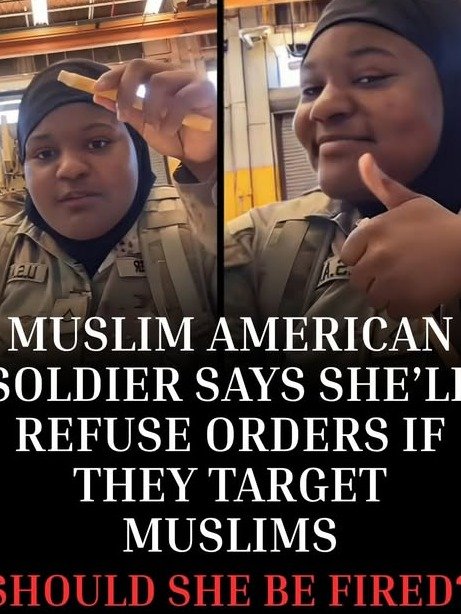
A single video clip, circulating rapidly across social media platforms, has sent shockwaves through the United States military and ignited a fiery national debate. This isn’t just another viral moment; it’s a profound challenge to the bedrock principles of military discipline and the solemn oath every service member takes. The footage, which has garnered millions of views, reportedly shows a U.S. Army soldier making an astonishing declaration: she would refuse any orders that involved targeting Muslims.
This statement, delivered with apparent conviction, immediately plunged the discourse into a complex web of military law, religious freedom, and the very nature of a soldier’s duty. For many, it represented an unthinkable breach of trust and a direct affront to the chain of command. For others, it raised uncomfortable questions about moral conscience in uniform and the potential for discriminatory directives.
The Shockwave: A Soldier’s Viral Declaration
The video, whose exact origins and context remain subject to ongoing discussion, quickly became a flashpoint. It depicted a uniformed individual, identified as a U.S. Army soldier, articulating a personal refusal to engage in specific military actions based on religious affiliation. This wasn’t a private conversation; it was a public declaration, amplified by the pervasive reach of online platforms.
Such a public stance from a serving member of the armed forces is exceptionally rare and fraught with significant implications. The military operates on a strict hierarchy and demands unwavering obedience to lawful orders. Any perceived deviation from this fundamental principle can unravel the very fabric of its operational effectiveness and unit cohesion.
The Sacred Oath: Unpacking a Soldier’s Commitment
At the heart of this controversy lies the oath of enlistment, a powerful pledge taken by every man and woman who joins the U.S. military. This isn’t merely a formality; it’s a sacred covenant. Recruits swear to “support and defend the Constitution of the United States against all enemies, foreign and domestic” and to “obey the orders of the President of the United States and the orders of the officers appointed over me, according to regulations and the Uniform Code of Military Justice.”
This oath forms the absolute foundation of military service, establishing a clear framework of duty, loyalty, and obedience. It binds individuals to a collective mission, ensuring that commands can be executed swiftly and effectively, especially in times of crisis or combat. The expectation is that personal beliefs, while deeply held, must often yield to the paramount needs of national security and unit integrity.
Military Discipline: The Unbreakable Backbone
Discipline isn’t just about saluting superiors or keeping a neat uniform; it’s the lifeblood of any effective fighting force. It ensures that complex operations can be coordinated, that orders are followed without hesitation, and that units can function as a cohesive whole under extreme pressure. Without it, chaos would quickly ensue, jeopardizing missions and lives.
The Uniform Code of Military Justice (UCMJ) meticulously outlines the standards of conduct expected from all service members. Articles like Article 90 (Assaulting or willfully disobeying superior commissioned officer) and Article 92 (Failure to obey order or regulation) directly address insubordination and dereliction of duty. These provisions underscore the seriousness with which the military treats any challenge to its authority and command structure.
The consequences for violating these articles can range from administrative punishment to court-martial, potentially leading to dishonorable discharge, imprisonment, or forfeiture of pay. These are not trivial penalties; they reflect the profound importance placed on maintaining order and obedience within the ranks.
Conscience vs. Command: Navigating the Ethical Labyrinth
While absolute obedience is a cornerstone, the military also recognizes that not all orders are created equal. There’s a critical distinction between a lawful order and an unlawful one. Soldiers are, in fact, obligated to refuse orders that are clearly illegal, such as those commanding war crimes, torture, or the targeting of non-combatants without justification.
This nuanced principle is vital for upholding ethical standards in warfare and preventing atrocities. However, the soldier in the viral video appears to be refusing orders based on the identity of the potential target group, rather than the legality of the action itself. This distinction is crucial and complicates the ethical landscape considerably.
“A soldier’s conscience is a powerful force, but it must operate within the bounds of their oath and the law of armed conflict. The challenge arises when deeply held personal beliefs clash with the imperative of military duty, especially when the orders themselves are not inherently unlawful.” – Military Ethicist (hypothetical quote)
The claim of “targeting Muslims” raises complex questions. Are these hypothetical orders discriminatory? Do they violate rules of engagement? Or is the soldier pre-emptively refusing any engagement that might involve individuals of a specific faith, regardless of their combatant status or the legality of the mission?
Distinguishing Conscientious Objection from Insubordination
It’s important to differentiate this viral incident from the established process of conscientious objection. A conscientious objector is an individual who, by reason of religious training and belief, is morally opposed to war in any form, or to the bearing of arms. This status is typically sought and granted before or early in service, following a rigorous application and review process.
Conscientious objectors are often assigned to non-combatant roles or discharged from service, but their objection is to all war, not specific targets or missions. The soldier in the video, by contrast, appears to be making a selective refusal of orders while already serving, based on the religious identity of potential adversaries. This places her actions firmly in the realm of potential insubordination rather than recognized conscientious objection.
Public Reaction: A Nation Divided
The video quickly became a lightning rod for public opinion, sparking intense debate across social media, news outlets, and community forums. Reactions were sharply divided, reflecting the diverse perspectives within American society.
- Condemnation: Many viewers, particularly veterans and those with military ties, expressed outrage. They viewed the soldier’s statement as a betrayal of her oath, a dangerous precedent for military cohesion, and an act of insubordination that undermined national security. Calls for immediate disciplinary action were widespread.
- Support: Conversely, some segments of the public lauded the soldier’s courage, viewing her as a moral hero standing up against potential discrimination or unjust warfare. They argued for the primacy of individual conscience and religious freedom, even within the strictures of military service.
- Concern: Others expressed deep concern about the implications for military recruitment, morale, and the delicate balance between individual rights and collective duty. The incident highlighted the increasing difficulty of maintaining unity in an increasingly polarized society.
The incident also underscored the power of social media to amplify such events, allowing them to transcend traditional news cycles and become subjects of widespread public discourse, often without the full context or official military response immediately available.
Broader Implications: Trust, Cohesion, and Readiness
Beyond the immediate disciplinary action, such an incident carries profound implications for the U.S. military as an institution. Trust is paramount in the armed forces – trust between leaders and subordinates, and trust among peers. An act of public insubordination, especially one based on selective obedience, can erode that trust, making units less effective and potentially endangering lives in combat situations.
Furthermore, it can impact military morale. If some service members perceive that others can selectively refuse orders without consequence, it could foster resentment and undermine the sense of shared sacrifice and duty. It also raises questions about the military’s ability to maintain a unified front in diverse and complex global conflicts.
The incident also has potential ramifications for recruitment and retention. The military strives to attract and retain individuals who are committed to its core values and willing to uphold their oath without reservation. Public controversies of this nature can either deter potential recruits or attract individuals with incompatible expectations, further complicating the military’s mission.
The Military’s Response: Upholding Standards
While specific details about any ongoing investigation or disciplinary actions against the soldier would be handled internally by the military, the overarching response is typically guided by established protocols. The military is highly likely to conduct a thorough investigation to ascertain the facts, context, and intent behind the soldier’s statement.
Any disciplinary action would fall under the UCMJ, addressing potential violations such as insubordination, conduct unbecoming an officer (if applicable), or other related offenses. The military’s primary objective in such cases is to reaffirm its core values, maintain discipline, and ensure the continued effectiveness of its forces.
This incident serves as a powerful reminder of the ongoing challenge faced by modern militaries: how to balance the need for strict discipline and unquestioning obedience with respect for individual beliefs and the rights of service members. It necessitates clear communication from leadership about expectations, the boundaries of dissent, and the unwavering commitment to the oath of service.
Conclusion: A Delicately Balanced Future
The viral video of a U.S. Army soldier declaring her refusal to obey orders targeting Muslims has done more than spark a temporary online debate; it has forced a critical examination of the very foundations of military service. It highlights the inherent tension between individual conscience and the collective imperative of national defense, a tension that is amplified in an increasingly diverse and interconnected world.
Ultimately, the strength of the U.S. military lies not only in its advanced technology or strategic prowess but in the unwavering discipline, loyalty, and commitment of its personnel. The oath taken by every soldier, sailor, airman, and marine is a pledge to uphold these principles, ensuring that the armed forces can effectively protect the nation and its interests. This incident, while troubling, provides a crucial opportunity to reinforce these fundamental truths and foster a deeper understanding of the profound responsibilities that come with wearing the uniform.
About the Author




