For years, Americans have watched in frustration as political gridlock grinds progress to a halt, often culminating in last-minute budget battles or even government shutdowns. It’s a cycle that erodes public trust and leaves vital issues unresolved, all while the very people responsible continue to collect their salaries.
But what if there was a way to make our elected officials truly feel the consequences of their inaction? What if their own paychecks were on the line, forcing them to prioritize the nation’s business over partisan bickering?
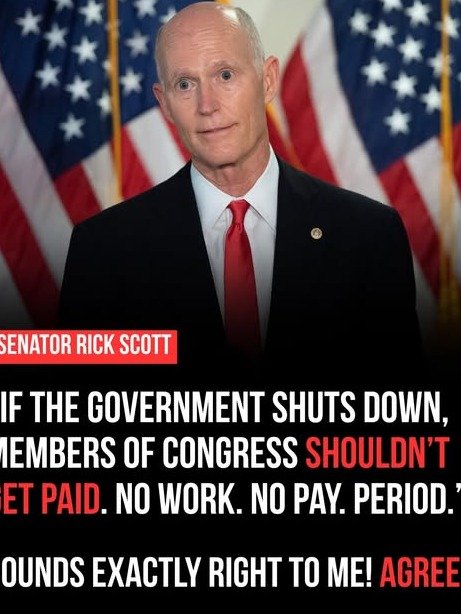
This isn’t a hypothetical question anymore. Senator Rick Scott (R-FL) is championing a bold legislative proposal known as the ‘No Budget, No Pay’ plan, a direct and impactful strategy designed to inject accountability into the heart of Congress.
The Radical Idea: Pay Them Last
The premise behind the ‘No Budget, No Pay’ plan is remarkably simple, yet its potential implications are profound. In essence, it proposes that if members of Congress fail to pass a federal budget by the statutorily mandated deadline, they should not receive their salaries until they fulfill this fundamental duty.
This isn’t about punishing lawmakers arbitrarily; it’s about aligning their personal financial incentives with their constitutional responsibilities. The plan targets one of the most basic expectations of governance: providing a clear financial roadmap for the nation.
Currently, even as government funding teeters on the brink or shuts down entirely, congressional salaries often remain unaffected. This perceived disconnect between performance and compensation fuels public cynicism and highlights a perceived lack of urgency among some elected officials.
Why Accountability is Crucial Now More Than Ever
The issue of congressional dysfunction isn’t new, but it has arguably reached a critical point. Over the past few decades, budget deadlines have frequently been missed, leading to a reliance on stopgap spending measures, known as continuing resolutions, which only kick the can down the road.
These short-term fixes create uncertainty for federal agencies, hinder long-term planning, and can have significant ripple effects across the economy. Businesses, states, and individual citizens rely on the stability and predictability that a well-crafted, timely budget provides.
“Americans are tired of the political games,” Senator Scott has stated. “They expect Congress to do its job, and that starts with passing a budget. If we can’t do that, why should we get paid?”
The ‘No Budget, No Pay’ plan seeks to disrupt this pattern by introducing a direct, personal consequence for failure to meet one of Congress’s most basic obligations. It’s a mechanism to force focus and cooperation in an environment often defined by division.
How the ‘No Budget, No Pay’ Plan Would Work
Under Senator Scott’s proposal, congressional salaries would be withheld if a full budget isn’t enacted by the October 1st start of the fiscal year. This means that instead of receiving their regular bi-weekly payments, lawmakers would see their paychecks paused.
The salaries would only be reinstated, and any withheld pay released, once Congress successfully passes and enacts a comprehensive budget for the upcoming fiscal year. This creates a powerful, immediate incentive for members of both parties to find common ground.
The plan targets the very individuals responsible for the legislative process, making sure that the financial discomfort is felt directly by those with the power to act. It’s a stark contrast to past scenarios where only federal workers or critical services bore the brunt of budget impasses.
The Growing Call for Congressional Accountability
This isn’t the first time such an idea has surfaced. The concept of linking congressional pay to performance has resonated with the public for years, often gaining traction during periods of heightened political gridlock or government shutdowns.
Public opinion polls consistently show high levels of dissatisfaction with Congress, with many Americans feeling that their elected representatives are out of touch or more focused on partisan battles than on the needs of the country. A plan like ‘No Budget, No Pay’ taps into this widespread frustration.
- Increased Urgency: It would create a powerful, personal deadline for lawmakers.
- Fairness to Taxpayers: Many argue it’s unfair for politicians to be paid while failing to perform a core duty.
- Restoring Trust: Could signal a commitment to accountability and responsibility.
- Motivating Bipartisanship: The shared financial consequence might encourage compromise.
The plan is not just about penalizing inaction; it’s about creating a strong, undeniable incentive for action. It aims to shift the calculus, making the cost of inaction far greater for individual members of Congress.
Addressing Potential Challenges and Criticisms
While the ‘No Budget, No Pay’ plan enjoys broad public support, it also faces potential challenges and criticisms within the political establishment. One common concern revolves around the 27th Amendment to the U.S. Constitution, which states that “No law, varying the compensation for the services of the Senators and Representatives, shall take effect, until an election of Representatives shall have intervened.”
However, proponents argue that withholding pay is not a permanent ‘variation’ of compensation but rather a temporary deferral, with the pay ultimately disbursed once the legislative duty is met. Legal interpretations would undoubtedly be a central part of any debate.
Another critique suggests that such a measure could lead to rushed, poorly considered budgets just to meet a deadline and restore pay. Critics worry it might prioritize speed over quality, potentially leading to wasteful spending or insufficient planning.
Furthermore, some argue that it could disproportionately affect members of Congress who are not independently wealthy, potentially creating an uneven playing field. Despite these concerns, the plan’s proponents believe the benefits of increased accountability outweigh the potential drawbacks.
A Path Towards a More Functional Government?
Senator Scott’s ‘No Budget, No Pay’ plan represents a significant push for greater accountability in Washington. It’s a direct response to years of perceived congressional inaction and a growing public demand for elected officials to prioritize their duties.
While the legislative path for such a bill may be challenging, its introduction forces a crucial conversation about the responsibilities of public service. It asks a fundamental question: Should lawmakers be compensated regardless of whether they perform one of their most basic constitutional functions?
The plan has the potential to fundamentally alter the dynamics of budget negotiations, pushing members of Congress to find common ground and deliver results for the American people. It’s a bold move, and one that many believe is long overdue.
What This Means for You
For the average American, the implications of a ‘No Budget, No Pay’ plan are significant. A more functional Congress, compelled to pass timely budgets, could lead to greater stability in government services, more predictable economic conditions, and a renewed sense of confidence in the nation’s leadership.
It means less uncertainty around critical programs, less political drama, and potentially, a more efficient allocation of taxpayer dollars. The plan aims to shift the focus from political posturing back to practical governance, where the needs of the country take precedence.
As this proposal gains traction, it will undoubtedly spark intense debate on Capitol Hill. But for millions of frustrated citizens, the idea of finally making lawmakers feel the consequences of their own dysfunction is a compelling and long-awaited solution.
The future of congressional accountability might just hinge on whether our elected officials are willing to put their money where their mandate is.
About the Author




