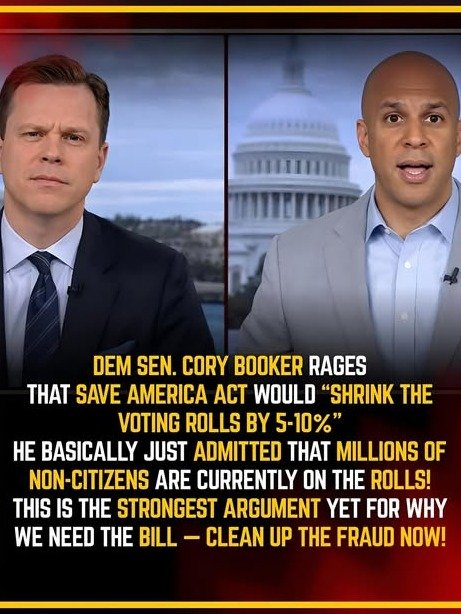
Imagine a future where the fundamental act of casting your ballot becomes entangled in a web of new requirements, potentially sidelining millions of eligible citizens. This isn’t a dystopian novel; it’s the very real concern at the heart of a heated national debate surrounding the proposed SAVE America Act, a piece of legislation that has drawn sharp criticism from prominent political figures, including Senator Cory Booker.
The mere mention of this bill has ignited a firestorm, raising fundamental questions about election integrity, voter access, and the very fabric of American democracy. Why is a bill centered on voter registration sparking such intense opposition, and what could its passage mean for your ability to participate in future elections? The answers delve deep into the ongoing struggle to balance security with accessibility in our democratic process.
Unpacking the SAVE America Act: A Closer Look
At its core, the proposed SAVE America Act seeks to fundamentally alter how Americans register to vote. The bill mandates that individuals provide proof of U.S. citizenship when registering to cast a ballot in federal elections. This seemingly straightforward requirement is intended by its proponents to bolster election integrity and prevent non-citizens from participating in the electoral process, thereby ensuring that only eligible voters exercise their constitutional right.
Currently, federal law, specifically the National Voter Registration Act of 1993 (NVRA), requires states to allow individuals to attest under penalty of perjury that they are citizens. While some states already require documentary proof of citizenship for voter registration, the SAVE America Act would make this a nationwide federal mandate, significantly changing the landscape for many states and millions of prospective voters.
The Stance of Senator Cory Booker: A Vocal Opponent
Senator Cory Booker has emerged as a leading voice in opposition to the SAVE America Act. His concerns are rooted in a deep conviction that while election security is vital, the proposed method of achieving it would create undue barriers to the ballot box, particularly for vulnerable populations. Booker argues that requiring documentary proof of citizenship would disproportionately impact certain groups, making it harder for them to register and vote.
He, along with other critics, views the bill not as a safeguard for democracy, but as a potential instrument of voter suppression. His strong objections highlight the delicate balance between ensuring only eligible citizens vote and safeguarding the fundamental right to vote for all who are entitled to it.
Arguments for the SAVE America Act: Proponents’ Perspective
Advocates for the SAVE America Act contend that it is a necessary measure to protect the sanctity of U.S. elections. They argue that requiring proof of citizenship is a common-sense step to prevent voter fraud and maintain public confidence in election results. The central premise is simple: if you must be a citizen to vote, you should prove your citizenship to register.
“Ensuring that only U.S. citizens cast ballots is not just a matter of law, but a cornerstone of our national sovereignty. This bill simply reinforces a basic principle that should be universally accepted.”
Proponents often cite concerns about the potential for non-citizen voting, even if evidence of widespread fraud is often debated. They believe that current systems, which rely heavily on self-attestation, are insufficient and create loopholes that could be exploited, undermining the integrity of federal elections. For them, this bill is a proactive measure to secure the electoral process against any potential vulnerabilities.
The Historical Shadow: Voter ID Laws and Disenfranchisement
The debate around the SAVE America Act is not new; it echoes historical battles over voter access and restrictive voting laws. Throughout American history, various measures, often under the guise of preventing fraud or ensuring order, have been implemented that disproportionately suppressed the votes of specific populations, including African Americans, immigrants, and low-income individuals.
From poll taxes and literacy tests of the Jim Crow era to more modern voter ID laws, the impact on voter turnout and democratic participation has been well-documented. Critics like Senator Booker draw parallels, warning that while the intent may be stated as security, the practical outcome of the SAVE America Act could be a regression in voting rights for millions of eligible Americans.
Who Could Be Affected? The Real-World Impact
The implications of a nationwide proof-of-citizenship requirement extend far beyond a simple administrative step. Consider the practical challenges for millions of Americans who may not readily possess the required documents, such as birth certificates or passports.
- Elderly Citizens: Many older Americans were born at home or in rural areas where birth records were not meticulously kept, or their original documents may have been lost or destroyed over decades. Obtaining new copies can be a costly and time-consuming bureaucratic nightmare.
- Low-Income Individuals: The fees associated with obtaining replacement birth certificates, naturalization papers, or passports can be prohibitive for those living paycheck to paycheck. The time off work required to navigate government agencies can also be a significant barrier.
- Minority Groups and Naturalized Citizens: Certain communities, including those with historical distrust of government institutions or naturalized citizens who may face language barriers, could find the process particularly daunting.
- Students and Transients: Individuals who frequently move or those without stable housing may find it challenging to maintain and present the necessary documentation.
Booker’s opposition highlights these very real human consequences, arguing that the burden of proof would fall heaviest on those least equipped to bear it, effectively creating a two-tiered system of voter access.
Potential Administrative and Legal Hurdles
Beyond the impact on individual voters, implementing the SAVE America Act would present significant administrative challenges for state and local election officials. Verifying citizenship for millions of new registrants and potentially re-verifying existing ones would require a massive overhaul of current systems, new training, and considerable financial investment.
Moreover, such a law would almost certainly face immediate legal challenges. Opponents would likely argue that it violates the National Voter Registration Act (NVRA), the Voting Rights Act, and potentially the 14th Amendment’s Equal Protection Clause, which protects the right to vote free from undue burdens. The constitutionality of such sweeping federal mandates on state election administration would be fiercely debated in courts across the country.
The Broader Battle for Voting Rights
The debate over the SAVE America Act is a microcosm of a much larger, ongoing battle for the future of voting rights in the United States. On one side are those prioritizing election security, often advocating for stricter identification requirements and tighter registration rules. On the other are those who prioritize voter access, arguing that every eligible citizen should be able to vote with minimal barriers.
Senator Booker’s stance aligns firmly with the latter, emphasizing that a robust democracy thrives when participation is encouraged, not restricted. He views the bill as an unnecessary and harmful measure that could undermine the very principles of inclusive democracy.
Finding the Balance: Security vs. Access
Ultimately, the challenge lies in finding a balance that ensures election integrity without disenfranchising eligible voters. Are there less restrictive methods to prevent non-citizen voting? Many argue that existing laws, which make it a felony for non-citizens to vote, combined with robust post-election audits, are sufficient deterrents and safeguards.
The conversation around the SAVE America Act forces us to confront fundamental questions about who we trust, how we define citizenship, and what price we are willing to pay for perceived security. For Senator Booker and his allies, that price is too high if it means sacrificing the voting rights of millions of Americans.
What This Means for You
Whether you support or oppose the SAVE America Act, its implications are profound. If enacted, it could change the way you, your friends, and your family register to vote, potentially introducing new hurdles and requirements. The debate is a powerful reminder that our voting rights are not static; they are constantly shaped by legislation, political will, and public discourse.
Senator Cory Booker’s vocal opposition serves as a critical alarm bell, urging every American to pay attention to these legislative efforts. Understanding the details of bills like the SAVE America Act, and the arguments for and against them, is crucial for anyone who believes in the power and importance of their ballot. Your vote truly is your future, and its protection remains a central pillar of our shared democracy.
About the Author




