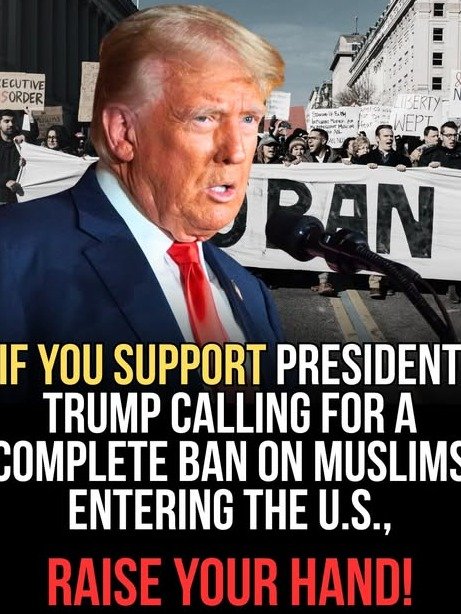
Imagine a policy so divisive, so instantly controversial, that it sparked protests at airports nationwide within hours of its announcement. This wasn’t a slow-burn debate; it was an explosive flashpoint that ripped through the fabric of American society and sent shockwaves across the globe.
For many, the Trump-era push for a ban tied to Muslim-majority countries wasn’t just another immigration fight; it was a defining moment, a stark challenge to core American values, and a national security gamble that continues to resonate today. The controversy ignited fierce legal battles, massive public outcry, and a profound re-evaluation of who we are as a nation.
The Birth of a Storm: Executive Order 13769
The saga began just seven days into Donald Trump’s presidency, on January 27, 2017, with the signing of Executive Order 13769, titled “Protecting the Nation from Foreign Terrorist Entry into the United States.” While the administration framed it as a necessary measure for national security, its immediate effect and perceived intent quickly earned it the moniker “the Muslim Ban.”
This initial order barred citizens from seven Muslim-majority countries—Iran, Iraq, Libya, Somalia, Sudan, Syria, and Yemen—from entering the U.S. for 90 days. It also suspended the U.S. Refugee Admissions Program for 120 days and indefinitely banned Syrian refugees. The speed and breadth of the order caught many off guard, including government agencies tasked with its implementation.
Chaos at the Gates: Immediate Fallout and Public Fury
The impact was immediate and chaotic. Travelers already in transit were detained at airports, families were separated, and green card holders, initially unclear if they were exempt, faced uncertainty and fear. Lawyers rushed to airports, offering pro bono assistance to those trapped in legal limbo.
News reports quickly filled with images of distraught individuals, tearful reunions, and the palpable confusion reigning at international arrival terminals. The public response was equally swift and passionate, with spontaneous protests erupting at major airports across the country, signaling the depth of opposition to the new policy.
“The executive order created immediate human suffering and sowed widespread confusion, demonstrating a profound disregard for due process and established legal norms.” – ACLU Statement, January 2017
These protests weren’t just about immigration; they were about religious freedom, civil liberties, and the very identity of America as a welcoming nation. The scenes of thousands gathering to demand the release of detainees underscored the intensity of the public’s emotional investment in the issue.
A Legal Minefield: Courts Step In
The legal challenges began almost as soon as the ink dried on the executive order. Civil liberties organizations, led by the American Civil Liberties Union (ACLU), swiftly filed lawsuits, arguing that the ban was unconstitutional, discriminatory, and violated established immigration laws.
Federal judges across the country issued temporary restraining orders and preliminary injunctions, effectively halting parts of the ban. These early legal victories were a significant blow to the administration, highlighting the judiciary’s critical role in checking executive power and protecting individual rights.
The Evolution of the Ban: From EO to Proclamation
Facing legal setbacks and widespread condemnation, the Trump administration revised the policy multiple times. On March 6, 2017, Executive Order 13780 replaced the original, removing Iraq from the list of banned countries and clarifying that green card holders were exempt. This version still faced legal challenges.
Ultimately, the administration issued Presidential Proclamation 9645 in September 2017, which became the definitive version of the policy. This proclamation imposed varying restrictions on travelers from eight countries: Chad, Iran, Libya, North Korea, Somalia, Syria, Venezuela, and Yemen. Sudan was removed, and Chad, North Korea, and Venezuela were added, ostensibly to demonstrate a non-religious basis for the restrictions.
The Supreme Court’s Verdict: Trump v. Hawaii
The legal battle culminated in the Supreme Court case, Trump v. Hawaii. In June 2018, the Supreme Court, in a 5-4 decision, upheld the third version of the travel ban. The majority opinion, authored by Chief Justice John Roberts, deferred to the President’s authority on matters of national security and foreign policy.
The Court found that the Proclamation was within the President’s statutory authority to regulate immigration and that the plaintiffs had not demonstrated that the policy was motivated by anti-Muslim animus. This ruling was a significant victory for the Trump administration, yet it did little to quell the passionate debate surrounding the policy’s fairness and intent.
The Arguments For and Against
Proponents of the ban consistently argued that it was a vital measure to protect national security. They claimed that existing vetting procedures for individuals from these countries were insufficient and that the ban was necessary to prevent potential terrorists from entering the U.S. They emphasized the President’s constitutional authority to control who enters the country.
- National Security: The primary justification was the need to protect the U.S. from foreign terrorist threats.
- Presidential Authority: Citing statutes that grant the President broad powers over immigration and national security.
- Improved Vetting: The ban was framed as a temporary measure to allow for a review and enhancement of vetting procedures.
Opponents, however, countered that the ban was a thinly veiled act of religious discrimination, violating the Establishment Clause of the First Amendment. They pointed to President Trump’s campaign rhetoric, where he had openly called for “a total and complete shutdown of Muslims entering the United States.”
- Religious Discrimination: Critics argued the ban targeted Muslims, despite the inclusion of non-Muslim majority countries in later versions.
- Humanitarian Concerns: The policy separated families, stranded refugees, and caused immense distress.
- Economic Impact: Restrictions on travel and immigration had negative effects on various sectors, including tourism and education.
- Undermining American Values: Many felt the ban betrayed America’s historical role as a haven for immigrants and a beacon of religious freedom.
Impact on Individuals and International Standing
Beyond the legal and political arenas, the travel ban had a profound human cost. Families were torn apart, students faced uncertainty about their education, and refugees seeking safety found doors slammed shut. The psychological toll on those directly affected, living in constant fear and uncertainty, was immense.
Internationally, the ban drew widespread condemnation from allies and adversaries alike. It was seen by many as a stain on America’s reputation, undermining its moral authority and its standing as a leader in human rights. Diplomatic relations were strained, and the perception of the U.S. as an open and welcoming nation suffered significantly.
A Lasting Legacy: What Did We Learn?
The “Muslim Ban” remains one of the most contentious and defining policies of the Trump administration. Its legacy is complex, touching upon fundamental questions about executive power, judicial review, religious freedom, and national identity. While the ban was ultimately rescinded by President Biden on his first day in office, its impact continues to reverberate.
The fight over the ban highlighted the deep divisions within American society regarding immigration and national security. It underscored the power of public activism and the critical role of the judiciary in safeguarding constitutional principles. Moreover, it forced a national conversation about what it means to be an American and the values we truly uphold.
The events surrounding the travel ban serve as a powerful reminder of how quickly policy decisions can ignite national and global debate, shaping lives and altering the course of history. It’s a chapter that will undoubtedly be studied for generations, offering crucial lessons on the intersection of politics, law, and human rights.
About the Author




