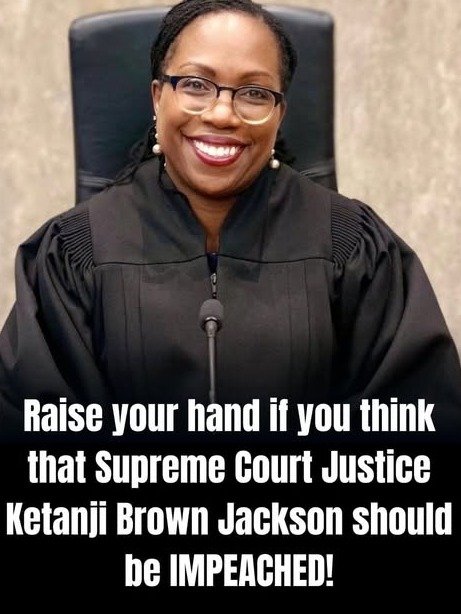
The demand to impeach a sitting Supreme Court Justice is one of the most serious and politically charged statements that can be made in American public discourse. When such a call targets a figure like Justice Ketanji Brown Jackson, it immediately sparks intense debate and raises profound questions about the stability and integrity of our judicial system.
But beyond the headline-grabbing rhetoric, what does it truly mean to impeach a Supreme Court Justice? What are the actual constitutional grounds, and how incredibly rare is such an action? The reality is far more complex and legally rigorous than many realize, involving a process designed to protect judicial independence.
The Extreme Rarity of Judicial Impeachment
Calling for the impeachment of a Supreme Court Justice is not a casual matter; it represents an extraordinary challenge to one of the three co-equal branches of government. Our nation’s founders deliberately created a system where federal judges, including Supreme Court Justices, serve for life during “good Behaviour,” ensuring their independence from political pressures and fleeting public opinion.
This life tenure is a cornerstone of judicial impartiality, allowing justices to make decisions based on the law and the Constitution, rather than fearing political reprisal. Consequently, the bar for removing a justice is exceptionally high, reflecting the immense gravity of such an action and its potential to destabilize the judiciary.
Constitutional Grounds: “High Crimes and Misdemeanors”
The U.S. Constitution, specifically Article II, Section 4, outlines the grounds for impeachment for all civil officers, including Supreme Court Justices:
“The President, Vice President and all civil Officers of the United States, shall be removed from Office on Impeachment for, and Conviction of, Treason, Bribery, or other high Crimes and Misdemeanors.”
This critical phrase, “high Crimes and Misdemeanors,” is often misunderstood. It does not necessarily refer to ordinary criminal offenses, but rather to abuses of power or breaches of public trust that are considered grave enough to warrant removal from office. For a judge, this could involve serious ethical misconduct, corruption, or a fundamental dereliction of duty, not merely disagreement with their legal opinions or judicial philosophy.
The standard is incredibly stringent because the purpose of impeachment is not to punish political opponents or overturn unpopular rulings. Instead, it is a safeguard against profound abuses that undermine the functioning of government and the rule of law. Disagreement with a justice’s interpretive approach or specific decisions, no matter how fervent, does not constitute an impeachable offense.
The Impeachment Process: A Constitutional Gauntlet
The actual process for impeaching and removing a Supreme Court Justice is a multi-stage constitutional gauntlet, mirroring the process for impeaching a President or other federal officers. It begins in the House of Representatives and concludes with a trial in the Senate.
- House of Representatives: The House has the sole power of impeachment. This involves investigations, hearings, and ultimately, a vote on articles of impeachment. A simple majority vote in the House is required to impeach, meaning to formally charge, the Justice.
- Senate Trial: If the House votes to impeach, the process moves to the Senate, which has the sole power to try all impeachments. The Chief Justice of the United States presides over the trial.
- Conviction and Removal: For a Justice to be convicted and removed from office, a two-thirds majority vote of the Senators present is required. This high threshold ensures that removal is a bipartisan decision, not a simple partisan maneuver.
This arduous process is intentionally designed to be difficult. It acts as a powerful deterrent against frivolous or politically motivated attempts to remove judges, preserving the judiciary’s essential independence from the legislative and executive branches.
Historical Precedents and Near Misses
In the entire history of the United States, only one Supreme Court Justice has ever been impeached by the House of Representatives: Justice Samuel Chase in 1804. Chase was a Federalist who was perceived by the Jeffersonian Republicans as overly partisan and biased in his rulings.
The House impeached Chase on eight articles, including allegations of arbitrary and oppressive conduct in court. However, the Senate acquitted him on all charges in 1805. This acquittal set a crucial precedent: a Supreme Court Justice cannot be removed merely for political disagreement or unpopular judicial decisions, but only for truly egregious misconduct.
Other justices have faced calls for impeachment throughout history, though none have advanced as far as Chase’s case. For example, Justice William O. Douglas faced impeachment efforts in the late 1960s and early 1970s, primarily over alleged financial improprieties and his perceived “liberal activism.” These efforts ultimately failed to gain significant traction, highlighting the extreme difficulty of meeting the constitutional standard.
Why Do Impeachment Calls Arise? Understanding the Motivations
Calls for the impeachment of a Supreme Court Justice often stem from a confluence of factors, ranging from genuine concerns about ethical conduct to profound disagreements over judicial philosophy and specific court rulings. While the original statement about Justice Ketanji Brown Jackson provided no specific grounds, such demands typically fall into a few broad categories:
- Judicial Philosophy Differences: Many impeachment calls are fueled by strong opposition to a justice’s interpretive approach to the Constitution (e.g., originalism vs. living constitutionalism) or their perceived “activism” in ruling. Critics might accuse a justice of legislating from the bench or exceeding their judicial authority.
- Public Disapproval of Rulings: Highly controversial or unpopular Supreme Court decisions can ignite public outrage, leading some to demand the removal of justices involved. However, disagreement with a ruling, even if widespread, is not an impeachable offense.
- Allegations of Ethical Misconduct: These are the most constitutionally relevant grounds. Such allegations could include bribery, conflicts of interest, perjury during confirmation hearings, or other serious breaches of judicial ethics that demonstrate a lack of “good Behaviour.” Without specific, verifiable evidence, these remain mere accusations.
- Partisan Animosity: In an increasingly polarized political climate, calls for impeachment can also be driven by intense partisan animosity, seeking to undermine the legitimacy of a justice appointed by an opposing political party or to shift the ideological balance of the Court.
It is crucial to distinguish between legitimate concerns about a justice’s conduct and politically motivated attacks aimed at discrediting the judiciary. The Constitution provides a mechanism for removal, but it is reserved for the most serious offenses.
The Unique Position of a Supreme Court Justice
A Supreme Court Justice holds a unique and powerful position within the American constitutional framework. They are not elected, nor are they directly accountable to the electorate in the same way as members of Congress or the President. This insulation is by design, intended to foster an independent judiciary capable of impartially interpreting the law without fear of political retribution.
Life tenure, coupled with the high bar for impeachment, serves to protect this independence. It allows justices to render decisions that may be unpopular but are, in their judgment, constitutionally sound. Undermining this independence through politically motivated impeachment attempts could set a dangerous precedent, transforming the judiciary into another battleground for partisan warfare.
The Political and Legal Ramifications of an Impeachment Attempt
Even an unsuccessful impeachment attempt against a Supreme Court Justice carries immense political and legal ramifications. It can deeply polarize the nation, erode public trust in the judiciary, and consume significant legislative resources.
Such an effort would inevitably be viewed through a highly partisan lens, regardless of the stated grounds. It would force members of Congress to take public stances on complex constitutional and ethical issues, often along party lines, further entrenching political divisions. Moreover, it could set a precedent where future justices are routinely targeted for removal based on ideological differences, severely weakening the judiciary’s ability to act as a neutral arbiter of the law.
Conclusion: An Extremely High Bar for Removal
The call for Justice Ketanji Brown Jackson’s impeachment, like any such demand for a Supreme Court Justice, highlights the deep passions and political divisions that often surround the nation’s highest court. However, understanding the constitutional framework reveals the extraordinary difficulty and gravity of such an undertaking.
The founders deliberately established an extremely high bar for removing a federal judge, requiring evidence of “Treason, Bribery, or other high Crimes and Misdemeanors” and a supermajority vote in the Senate. This rigorous process is a vital safeguard, designed to protect the independence of the judiciary and ensure that justices can uphold the Constitution without succumbing to transient political pressures. While calls for impeachment can be loud and dramatic, the reality of removing a Supreme Court Justice remains one of the most challenging and historically rare actions in American governance.
About the Author




