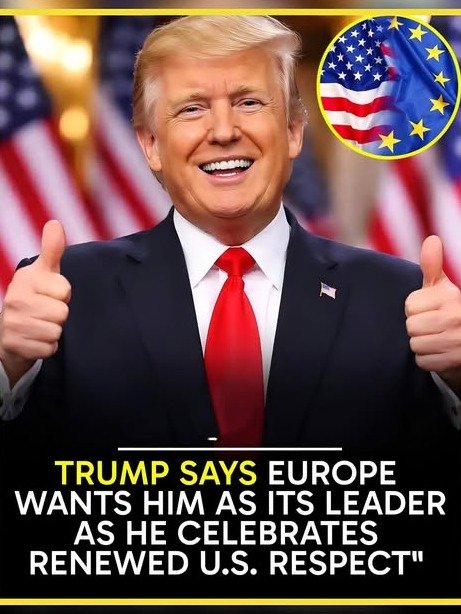
Imagine a world where the very leaders who once openly criticized Donald Trump are now, behind closed doors, contemplating a different future. A future where his controversial ‘America First’ doctrine finds surprising resonance across the Atlantic. This isn’t a hypothetical scenario; it’s the very discussion sparked by Donald Trump himself, hinting at a potential shift in European sentiment that could redefine global alliances and challenge long-held diplomatic norms.
The former U.S. President recently ignited a firestorm of debate by suggesting that certain European nations might actually respond positively to his unique leadership style, particularly his strong views on national security and international trade. This bold assertion forces us to look beyond the often-unanimous public condemnations and consider the complex, sometimes contradictory, undercurrents within the European political landscape.
The ‘America First’ Doctrine: A European Appeal?
Donald Trump’s political philosophy, famously encapsulated by the slogan ‘America First,’ prioritizes national interests above all else. This approach, while often seen as isolationist by critics, champions a strong, independent nation state capable of dictating its own terms in global affairs. For some European leaders, particularly those grappling with the perceived overreach of supranational bodies like the European Union or struggling with internal nationalist movements, this emphasis on sovereignty can hold a surprising allure.
His consistent critique of multilateral agreements and his preference for bilateral negotiations often resonate with factions within Europe that feel their national identity or economic interests are being diluted by broader European integration. They might see an ally in Trump’s willingness to challenge established global frameworks, believing it could empower their own nations on the world stage.
Security Concerns and NATO’s Future
One of the most contentious, yet potentially appealing, aspects of Trump’s foreign policy centers on security, specifically the North Atlantic Treaty Organization (NATO). Throughout his previous term, Trump was an outspoken critic of what he perceived as an unfair burden-sharing within the alliance. He repeatedly called on member states to meet their commitment of spending 2% of their GDP on defense, threatening to withdraw U.S. support if they did not.
While these threats caused widespread alarm, they also spurred some European nations to significantly increase their defense spending. For countries that were already committed to strong national defense and felt frustrated by the slow pace of others, Trump’s pressure might have been seen as a necessary, albeit blunt, catalyst. Nations bordering Russia, for instance, often prioritize robust defense and might appreciate a U.S. leader who demands strength and accountability from allies, even if his rhetoric is unsettling.
The Trade Wars: A Double-Edged Sword
Trump’s views on international trade are another cornerstone of his appeal to certain European factions. He has consistently advocated for protectionist policies, including imposing tariffs on goods from countries he deems to be engaging in unfair trade practices. His focus on reducing trade deficits and promoting domestic industries, while controversial, strikes a chord with European industries struggling against global competition or those that feel disadvantaged by existing trade agreements.
For some European nations or specific sectors within them, the idea of renegotiating trade deals or imposing tariffs might be viewed not as a threat, but as an opportunity to protect their own struggling industries or to gain a more favorable position in bilateral agreements with the U.S. They might see a strong, protectionist U.S. as a model for their own national economic strategies, even if it disrupts the broader global trading system.
Immigration and Border Control: A Shared Stance?
Beyond security and trade, Trump’s hardline stance on immigration and border control has also found resonance in parts of Europe. As many European countries grapple with complex immigration challenges and the rise of populist movements advocating for stricter border policies, Trump’s rhetoric on national borders and sovereignty can seem less radical and more aligned with their domestic political debates. Leaders and parties who champion similar policies often look to Trump’s approach as a validation of their own positions.
The emphasis on controlling national borders and prioritizing national citizens in matters of social welfare and security is a theme that runs through many populist movements across Europe. These groups, often critical of the EU’s open border policies, might view a Trump presidency as an opportunity for greater alignment on these issues, potentially strengthening their own domestic political standing.
Which Nations Might Lean Towards Trump?
While it’s impossible to provide a definitive list, analysis suggests that certain Central and Eastern European nations, which often have a more nationalistic bent and a strong emphasis on national sovereignty, might be more open to Trump’s leadership. Countries that feel a direct security threat from Russia, for example, might prioritize a strong American commitment to deterrence, even if they dislike Trump’s rhetoric towards NATO.
Additionally, nations with strong populist or nationalist parties in power, or those experiencing significant internal discontent with the European Union’s direction, could find Trump’s ‘America First’ philosophy appealing. These leaders might see an opportunity to leverage a more transactional U.S. foreign policy to their national advantage, rather than adhering strictly to traditional multilateral frameworks.
“Donald Trump’s willingness to disrupt the status quo, while alarming to many, is precisely what appeals to others who feel the status quo isn’t working for them,” noted one geopolitical analyst. “It’s a gamble, but for some, the potential rewards of a more assertive national stance outweigh the risks of alienating traditional allies.”
The Counter-Narrative: Deep European Concerns
It’s crucial to acknowledge that the potential positive reception in some quarters is far from universal. A vast majority of European leaders and citizens remain deeply wary of Trump’s approach. His previous presidency was marked by significant friction with key European allies over issues ranging from climate change (withdrawal from the Paris Agreement) to the Iran nuclear deal, trade tariffs, and the perceived undermining of democratic institutions.
Many fear that a second Trump term would further destabilize global alliances, weaken international cooperation, and embolden authoritarian regimes. The prospect of the U.S. retreating from its leadership role in NATO or embracing widespread protectionism causes significant anxiety for economies reliant on open trade and for nations dependent on the collective security framework.
Historical Context: Strained Transatlantic Ties
The transatlantic relationship, traditionally a cornerstone of global stability, experienced unprecedented strain during Trump’s first term. His administration often treated European allies more as competitors or even adversaries than partners. This led to a scramble among European nations to assert greater strategic autonomy and to strengthen the European Union’s role on the global stage, independent of Washington.
The memory of these tensions, coupled with concerns about the long-term implications of a transactional foreign policy, means that for many European leaders, a Trump comeback represents a period of profound uncertainty and potential disruption. They remember the challenges of navigating a relationship where long-standing norms and diplomatic courtesies were frequently disregarded.
What a Second Trump Term Could Mean for Europe
Should Donald Trump return to the White House, Europe would likely face a renewed period of intense introspection and strategic adaptation. We could see:
- Increased Defense Spending: Further pressure on NATO allies to meet or exceed defense spending targets, potentially leading to more robust European military capabilities, but also internal friction.
- Trade Realignments: A potential resurgence of tariffs and trade disputes, forcing European nations to diversify their economic partnerships and reconsider their global supply chains.
- Shifting Alliances: Some nations might seek closer bilateral ties with the U.S., while others might double down on European integration and cooperation with non-U.S. partners like China or developing economies.
- Geopolitical Instability: A less predictable U.S. foreign policy could lead to greater global instability, particularly concerning conflicts in Ukraine and the Middle East, requiring Europe to take a more independent and assertive role.
The implications are profound, forcing Europe to confront its own strategic dependencies and chart a more independent course in a rapidly changing world order. The discussions Trump has sparked are not merely about his personality, but about the fundamental future of transatlantic cooperation and global governance.
Conclusion: A Continent Divided, A Future Uncertain
Donald Trump’s assertion that some European nations might welcome his leadership style is more than just a provocative statement; it’s a window into the complex and often fragmented political realities across the continent. While many European leaders and citizens would undoubtedly view a second Trump presidency with trepidation, there are indeed pockets of sentiment – driven by nationalist impulses, economic grievances, or security imperatives – that might see an opportunity in his ‘America First’ approach.
The debate he has ignited underscores the deep divisions within Europe itself and highlights the ongoing struggle between globalist and nationalist ideologies. As the world watches, the question isn’t just whether Trump will return, but how Europe will navigate a future where its traditional alliances and strategic certainties are increasingly called into question.
About the Author




