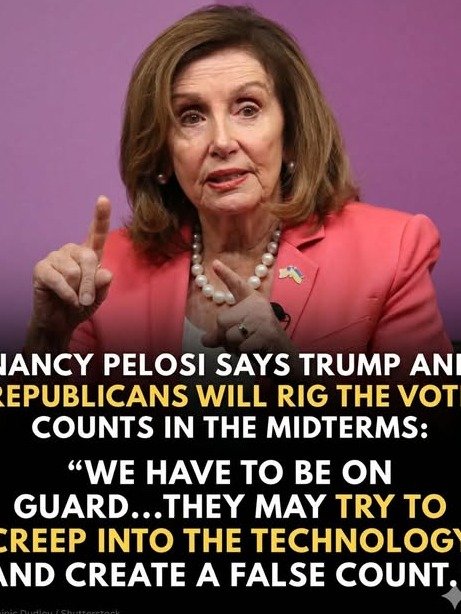
What if the very systems designed to protect our democracy are being targeted, not by foreign adversaries, but by those within our own political landscape? This isn’t a hypothetical question, but the core of a recent, highly contentious claim made by former Speaker of the House, Nancy Pelosi.
Her assertion has ignited a furious debate, suggesting that efforts to protect elections are being framed as a “threat” to the democratic process. This stance starkly contrasts with what many Americans believe: that safeguarding the integrity of our votes should be a non-negotiable priority.
The Core of Pelosi’s Accusation
Nancy Pelosi recently brought to light a significant accusation, claiming that former President Donald Trump is actively seeking to undermine the very technology that underpins our voting systems. This isn’t a minor charge; it suggests a deliberate strategy to weaken the infrastructure of American democracy.
According to Pelosi, Trump’s actions, or proposed actions, regarding voting technology are not merely criticisms but an attempt to destabilize the electoral process. She argues that what might appear to some as an effort to ensure election integrity is, in fact, a dangerous maneuver to sow doubt and disrupt the system from within.
This perspective frames any challenge to existing voting technology, especially from high-profile figures, as a direct assault on the electoral system. It suggests a critical need to differentiate between legitimate concerns about security and what she perceives as politically motivated attacks designed to erode public trust.
Understanding the “Threat” Paradox
Perhaps the most provocative element of Pelosi’s statement is her characterization of protecting elections as a “threat.” This isn’t a simple semantic choice; it reflects a deep ideological chasm in how different political factions view election security and the role of oversight.
For Pelosi and her allies, the “threat” arises when specific challenges to voting technology are seen as an attempt to delegitimize election outcomes or suppress voter participation. She implies that certain calls for “election protection” are thinly veiled attempts to create chaos or justify future challenges to democratic results.
“When you have someone actively trying to discredit the very mechanisms by which we cast our votes, that is a threat to democracy itself, regardless of their stated intentions,” Pelosi stated, emphasizing the gravity of her concerns.
This perspective suggests that some forms of “election protection” rhetoric, particularly those questioning established and certified voting machines, can paradoxically undermine public confidence more than they build it. It forces us to ask: at what point does scrutiny become sabotage?
The Public’s Perspective on Election Integrity
In stark contrast to Pelosi’s nuanced (and to some, controversial) interpretation, the overwhelming majority of the American public holds a fundamentally different view. For them, protecting elections is not a threat, but a foundational pillar of democratic governance.
Surveys consistently show that voters, regardless of political affiliation, prioritize secure and fair elections. They want to know their vote counts, that the process is transparent, and that the results are accurate. This desire for integrity is a bipartisan sentiment.
The public generally interprets “protecting elections” as taking concrete steps to prevent fraud, ensure accessibility, and safeguard against cyberattacks or foreign interference. They expect robust systems and accountability, seeing these as essential safeguards for their democratic rights.
The Landscape of Voting Technology
To fully grasp the stakes, it’s crucial to understand the diverse landscape of voting technology currently in use across the United States. From touch-screen Direct Recording Electronic (DRE) machines to optical scan systems that read paper ballots, each technology comes with its own set of advantages and vulnerabilities.
Many states rely on paper ballots counted by optical scanners, which offer a verifiable paper trail for audits. Other jurisdictions utilize DRE machines, some with voter-verifiable paper audit trails (VVPATs), while older models may lack this crucial component.
- Direct Recording Electronic (DRE) Machines: Voters make selections directly on an electronic screen, with votes recorded in the machine’s memory.
- Optical Scan Systems: Voters mark paper ballots, which are then fed into a scanner that tabulates the votes.
- Hand-Marked Paper Ballots: Some jurisdictions still use purely manual counting for paper ballots, though this is less common for large-scale elections.
The debates often center on the security and auditability of these systems. Concerns range from the potential for software manipulation in DRE machines to the integrity of ballot chain-of-custody in paper-based systems.
Allegations of Undermining: What Does It Entail?
When Pelosi claims Trump seeks to “undermine” voting technology, what specific actions or intentions is she referring to? This isn’t merely about expressing skepticism; it points to a pattern of behavior that, in her view, goes beyond legitimate questioning.
“Undermining” in this context could refer to several strategies: spreading disinformation about the reliability of machines, advocating for radical changes without proper vetting, or attempting to install officials who might compromise the independence of election administration.
It also encompasses rhetoric that erodes public faith in the electoral process itself. If a significant portion of the populace believes their votes aren’t counted accurately due to flaws in technology, it can have far-reaching implications for civic participation and the peaceful transfer of power.
The Role of Political Rhetoric and Public Trust
The language used by political leaders plays an enormous role in shaping public perception and trust in democratic institutions. When high-profile figures make claims about election integrity, whether positive or negative, those words carry immense weight.
Rhetoric that suggests widespread fraud or technological compromise, even without concrete evidence, can lead to significant drops in public confidence. Conversely, strong, unified messages about the security and fairness of elections can bolster trust, even amidst challenges.
This creates a delicate balance: politicians have a right, and perhaps a duty, to scrutinize election systems. However, when that scrutiny morphs into broad, unsubstantiated attacks on the foundational technology, it risks doing irreparable harm to the very democracy they claim to protect.
Ensuring Robust Election Security: A Multifaceted Approach
True election security is not a single fix but a comprehensive, multi-layered approach involving technology, policy, and human oversight. It requires constant vigilance and adaptation to new threats, whether from cyberattacks or attempts at internal manipulation.
Key components of robust election security include:
- Physical Security: Protecting voting machines and ballots from tampering.
- Cybersecurity: Safeguarding voter registration databases and election management systems from hacking.
- Post-Election Audits: Regularly conducting risk-limiting audits to verify machine counts against paper records.
- Transparency: Ensuring public access to election processes and data, where appropriate.
- Non-Partisan Administration: Maintaining independent election officials free from political pressure.
These measures are designed to build resilience and provide multiple points of verification, ensuring that even if one component is compromised, the overall integrity of the election remains intact. It’s about layers of defense, not just a single barrier.
The Path Forward: Rebuilding Bipartisan Trust
Pelosi’s claims underscore a critical challenge facing American democracy: the deep partisan divide over the very mechanisms of voting. Rebuilding trust in election systems will require more than just technological fixes; it demands a shift in political discourse.
Both sides must find common ground on the importance of secure, transparent, and accessible elections, and commit to advocating for improvements based on evidence and expert consensus, rather than political expediency. This means engaging in constructive dialogue, not just making accusations.
Ultimately, the American public deserves to feel confident that their vote is counted fairly and accurately. Achieving this requires political leaders to prioritize the integrity of the electoral process above partisan gain, fostering an environment where “protecting elections” is universally understood as a shared democratic imperative, not a political weapon.
The debate sparked by Pelosi’s comments serves as a potent reminder of the fragility of democratic institutions and the constant need for vigilance, dialogue, and a shared commitment to upholding the fundamental principles of free and fair elections.
About the Author




