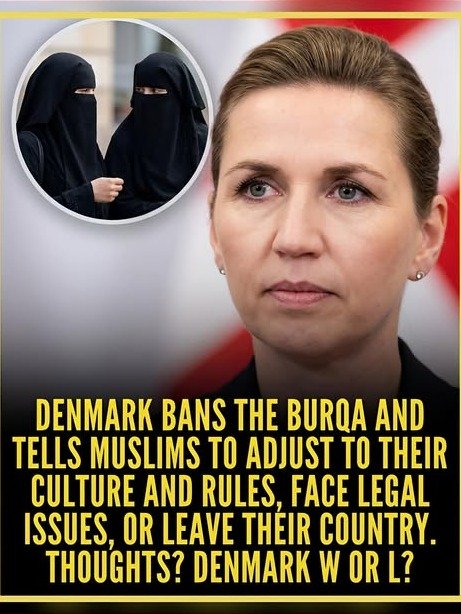
Imagine a law that dictates what you can and cannot wear in public, sparking fierce debates from Copenhagen to the furthest corners of the globe. Denmark’s 2018 ban on certain face coverings, often controversially dubbed the ‘burqa ban,’ is once again drawing intense international scrutiny, pushing fundamental questions about freedom, integration, and national identity to the forefront.
This isn’t just a local Danish policy; it’s a lightning rod for a much larger discussion about how societies balance individual rights with collective values. Why is a law enacted years ago suddenly back in the spotlight, and what does its enduring controversy reveal about the complex cultural landscape of modern Europe?
The Genesis of a Divisive Law: Denmark’s 2018 Ban
The law, officially known as the ‘Ban on covering the face in public,’ came into effect in August 2018. It prohibits wearing garments that cover the entire face, such as the niqab and burqa, as well as other items like balaclavas, false beards, and masks, in public spaces. The Danish Parliament passed the legislation with a clear majority, reflecting a long-standing political discussion within the country.
Proponents argued that the ban was crucial for integration, promoting open communication, and upholding Danish values of openness and trust. They maintained that face coverings hinder social interaction and are incompatible with a free and equal society. For many, it represented a symbolic stand for secularism and gender equality.
<
What the Law Actually Prohibits (and Permits)
It’s important to understand the specifics of the ban. While often referred to as a ‘burqa ban,’ the law is broader, applying to any garment that covers the face to an extent that makes identification difficult. This includes:
- Niqabs and Burqas: These are the primary targets due to their religious significance.
- Balaclavas and Ski Masks: Unless worn for specific, justifiable reasons like extreme cold during outdoor activities.
- False Beards and Masks: Items that obscure facial features.
However, the law also includes several exemptions. For instance, people can still wear face coverings for specific purposes such as cold weather, professional protective gear (like helmets or masks for construction workers), or even carnival masks during festive events. The key distinction lies in the intent and context of the covering.
“The ban is not directed at any religion and is not a ban on headscarves, turbans or kippahs. The ban is about ensuring that faces can be seen in public spaces.” – Danish Ministry of Justice statement (paraphrased)
Arguments for the Ban: Integration, Equality, and Security
The rationale behind Denmark’s face covering ban is multifaceted, drawing on arguments related to societal integration, gender equality, and public safety. Advocates believe these restrictions are necessary for a cohesive society.
One of the primary arguments centers on integration. Proponents assert that visible communication is fundamental to social interaction and integration into Danish society. They argue that face coverings create barriers to communication and understanding, making it harder for individuals to participate fully in public life, education, and employment.
Another significant point is gender equality. Many politicians and activists view the burqa and niqab as symbols of female oppression, arguing that the ban liberates women from patriarchal norms. They contend that forcing women to cover their faces is antithetical to the principles of equality and individual freedom upheld in Denmark.
Furthermore, public safety and security are often cited. The ability to identify individuals in public spaces is considered essential for law enforcement and security. Face coverings, by obscuring identity, are seen by some as posing a potential security risk, especially in an era of heightened concerns about crime and terrorism.
The Counter-Arguments: Religious Freedom and Discrimination
Despite the stated intentions, the ban has faced considerable backlash from human rights organizations, international bodies, and religious minority groups. Critics argue that the law is discriminatory, infringes upon religious freedom, and is ultimately counterproductive.
The most vocal opposition comes from those who see the ban as a direct attack on religious freedom. For Muslim women who choose to wear the niqab or burqa, it is a deeply personal and spiritual decision, an expression of their faith. Critics argue that a state imposing restrictions on such an intimate act of religious observance is a violation of fundamental human rights.
Concerns about discrimination are also prominent. Opponents contend that while the law is phrased neutrally, its practical impact disproportionately affects Muslim women. They argue that it singles out a specific religious minority, fostering an environment of intolerance rather than integration. Instead of promoting inclusion, it risks alienating and isolating these women further.
“The general prohibition on wearing face coverings is neither necessary nor proportionate and violates the rights to freedom of expression and religion.” – Amnesty International, 2018
Moreover, critics question the ban’s effectiveness in achieving its stated goals. They argue that criminalizing face coverings does not lead to better integration but rather pushes women who wear them further out of public view, potentially limiting their access to education, healthcare, and social services. It may force them to remain at home, exacerbating the very isolation the law claims to combat.
The Real-World Impact and Enforcement
Since its implementation, the Danish face covering ban has seen relatively few enforcement actions, which some interpret as a sign of its limited scope or, conversely, its chilling effect. Police have issued fines, typically around 1,000 DKK (approximately 130 EUR) for a first offense, escalating for repeat violations. However, the number of incidents remains low.
This low enforcement rate could suggest that few women in Denmark actually wear full face veils, or that those who do have opted to stay out of public spaces to avoid fines and confrontation. Anecdotal evidence suggests that some women have indeed felt compelled to restrict their movements or remove their veils in public, highlighting the direct impact on their daily lives.
A Broader European Trend and Renewed Global Attention
Denmark is not alone in enacting such legislation. Several other European countries, including France, Belgium, Austria, and parts of Germany, have implemented similar bans on full face coverings in public. This trend reflects a wider European debate on secularism, national identity, and the place of religious symbols in public life.
The renewed global attention to Denmark’s policy often stems from ongoing legal challenges, human rights reports, or simply the persistent cultural and political discourse surrounding these issues. Every time a new case emerges, or a prominent figure speaks out, the debate reignites, forcing societies to re-examine their values and priorities.
- France: Was the first European country to implement a full ban in 2010.
- Belgium: Followed suit in 2011.
- Austria: Introduced its ban in 2017.
- Netherlands: Has a partial ban on face coverings in public transport, schools, hospitals, and government buildings.
These bans are often framed within a narrative of protecting national values or promoting women’s rights, yet they consistently draw criticism for potentially marginalizing minority communities and infringing on fundamental freedoms. The international community, including bodies like the United Nations Human Rights Committee, has expressed concerns, sometimes ruling against such bans as disproportionate.
The Lingering Questions and Future of the Debate
The Danish face covering ban, like its counterparts across Europe, continues to pose complex questions with no easy answers. How do liberal democracies balance the rights of individuals to express their religion with societal expectations for integration and public order? What constitutes genuine integration, and can it be legislated?
The ongoing global attention underscores that this is far from a settled issue. It represents a fundamental tension between different conceptions of freedom, identity, and community. As societies become increasingly diverse, these debates are likely to intensify, challenging nations like Denmark to continuously re-evaluate their policies and their impact on all citizens.
Ultimately, the discussion around Denmark’s ‘burqa ban’ serves as a critical barometer for the health of pluralism in modern societies. It forces us to confront uncomfortable truths about belonging, acceptance, and the true cost of legislative decisions on the lives of individuals.
About the Author




