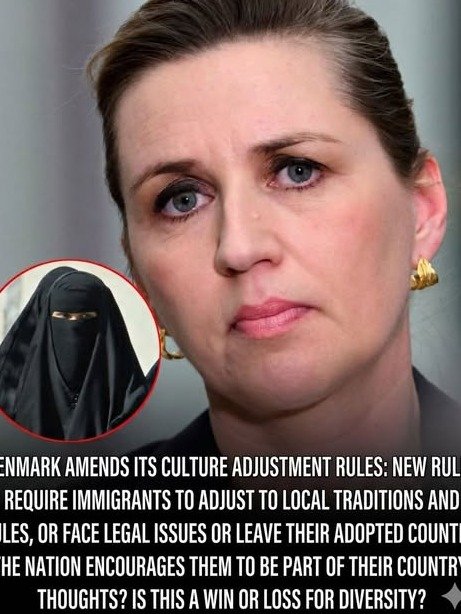
Imagine a country where wearing certain garments could lead to a fine, simply for obscuring your face. This isn’t a scene from a dystopian novel; it’s the reality that unfolded in Denmark in 2018, when the nation implemented a controversial law restricting the use of specific face-covering garments, most notably the burqa and niqab.
This legislative move, often colloquially referred to as the ‘burqa ban,’ ignited an immediate and intense international debate. It brought to the forefront complex questions about religious freedom, national identity, gender equality, and the very meaning of integration in modern European societies.
The Genesis of a Controversial Law
The Danish law, officially known as the ‘Act on a ban on wearing garments that cover the face,’ came into effect on August 1, 2018. It prohibits individuals from wearing clothing that covers the face in public places, making it impossible to identify the person. While not explicitly naming the burqa or niqab, these garments were the clear targets of the legislation, alongside balaclavas and fake beards (though exceptions were made for cold weather or specific professions).
Denmark was not alone in this legislative trend. Several other European countries, including France, Belgium, Austria, and parts of Germany, had already introduced similar restrictions or outright bans on full face coverings in public spaces. This growing movement across the continent reflected a broader societal discussion about security concerns, secular values, and the integration of Muslim minority populations.
Unpacking the ‘Why’: Arguments for the Ban
Proponents of the Danish law presented a multifaceted argument, rooted in deeply held beliefs about national identity, public safety, and social cohesion. One of the primary justifications centered on the idea of shared societal values.
Many argued that visible face coverings fundamentally contradict Danish and broader Western norms of open communication and mutual recognition. They emphasized the importance of being able to see a person’s face to foster trust and facilitate interaction in public life, viewing face coverings as a barrier to true social integration.
“It’s incompatible with the values of Danish society or the respect for the community to keep your face hidden when meeting each other in public space,” stated Søren Pape Poulsen, Denmark’s then-Minister of Justice, reflecting the government’s stance.
Another significant argument revolved around gender equality. Critics of the burqa and niqab argued that these garments are symbols of women’s oppression and patriarchal norms. They contended that banning them could help liberate women from conservative religious practices and promote their full participation in society.
Furthermore, security concerns were frequently cited. While often less emphasized than cultural or integration arguments, some proponents suggested that face coverings could pose a security risk by hindering identification, particularly in an era of heightened awareness about terrorism and public safety.
The Other Side of the Veil: Criticisms and Concerns
The Danish ban, much like its predecessors in other European nations, faced fierce opposition from human rights organizations, civil liberties advocates, and various international bodies. Critics argued that the law constituted a clear violation of fundamental human rights, particularly the right to freedom of religion and expression.
For many Muslim women, wearing a niqab or burqa is a deeply personal and religious choice, an expression of their faith and identity. Banning these garments, opponents argued, directly infringes upon their ability to practice their religion freely and live according to their conscience. It essentially dictates what individuals can and cannot wear based on religious attire.
Amnesty International’s Europe Director, Gauri van Gulik, condemned the ban, stating, “All women should be free to dress as they choose and to wear clothes that express their identity or beliefs. This ban will have a particularly negative impact on Muslim women who choose to wear the niqab or burqa.”
Moreover, critics pointed out the discriminatory nature of the law. While framed as a general ban on face coverings, its practical effect disproportionately targeted Muslim women, leading to accusations of state-sanctioned discrimination. Many argued that rather than promoting integration, such bans could further marginalize and alienate Muslim communities, pushing women who choose to wear face coverings further into isolation.
The argument that the ban promotes gender equality also came under scrutiny. Opponents suggested that compelling women to remove their chosen attire, even if seen as oppressive by outsiders, is itself a form of coercion and does not genuinely empower women. True empowerment, they argued, comes from choice and agency, not from state-imposed dress codes.
Real-World Impact: Lives and Livelihoods
Since its implementation, the Danish face-covering ban has had tangible impacts on the lives of a small, yet significant, number of women. While the exact number of women in Denmark who regularly wear a niqab or burqa is relatively small (estimated to be around 150-200 at the time of the ban), the law’s effects extended beyond just those individuals.
- Fines and Enforcement: Women found in violation of the law faced initial fines of 1,000 Danish kroner (approximately $160 USD), with repeat offenses leading to higher penalties, up to 10,000 kroner. Police were tasked with enforcing the law, leading to instances of public confrontations and arrests.
- Increased Marginalization: For women who chose to continue wearing their face coverings, the law often meant restricting their public life, limiting their access to education, employment, and social activities. This paradoxically worked against the stated goal of integration.
- Psychological Impact: The constant threat of fines and public scrutiny created a climate of fear and anxiety for some women, making them feel unwelcome and targeted in their own country.
The law also sparked public demonstrations, both in support and opposition. Activists organized ‘burqa ban’ protests, with some women deliberately wearing face coverings in public to challenge the legislation and highlight its perceived injustice.
A Broader European Dialogue
The Danish ban is not an isolated incident but part of a wider trend across Europe, reflecting a continent grappling with evolving national identities, increasing diversity, and the role of religion in public life. Each country’s approach has been subtly different, but the underlying tensions remain similar.
France, for instance, implemented its full-face veil ban in 2010, citing principles of secularism (laïcité) and the dignity of women. Belgium followed suit shortly after. Austria’s 2017 law, similar to Denmark’s, also targeted face coverings in public spaces, emphasizing the importance of ‘visible integration’. These legislative acts highlight a European-wide effort to define and enforce what constitutes acceptable public conduct and appearance in diverse societies.
Internationally, the bans have drawn criticism from various human rights bodies. The UN Human Rights Committee, for example, found in 2018 that France’s ban on the niqab violated the human rights of two women, emphasizing that the general ban was a disproportionate measure. These international rulings underscore the ongoing tension between national sovereignty in lawmaking and universal human rights principles.
The Path Forward: Integration, Identity, and Policy
The debate surrounding Denmark’s face-covering law is far from over. It continues to serve as a potent symbol of the broader challenges European societies face in balancing individual freedoms with collective societal norms, particularly in the context of religious and cultural diversity.
For many, the law represents a necessary step to uphold national values and promote genuine integration. For others, it stands as a discriminatory measure that alienates minority groups and undermines fundamental liberties. The effectiveness of such bans in achieving their stated goals—like improving integration or empowering women—remains highly contentious and subject to ongoing scrutiny.
Ultimately, the Danish ‘burqa ban’ compels us to reflect on deeper questions: What does it truly mean to integrate into a society? Whose values take precedence? And how can diverse populations coexist while respecting both individual rights and collective identities? These are questions that Denmark, and indeed many other nations, will continue to grapple with for years to come.
Conclusion
The 2018 Danish law on face coverings sparked a profound and complex policy debate, touching upon the very fabric of society. While intended to foster integration and uphold national values, it simultaneously raised serious concerns about religious freedom and discrimination. The story of Denmark’s ‘burqa ban’ is a powerful reminder that the path to a harmonious, integrated society is rarely straightforward, often requiring difficult conversations and a careful balancing act between competing principles.
About the Author




