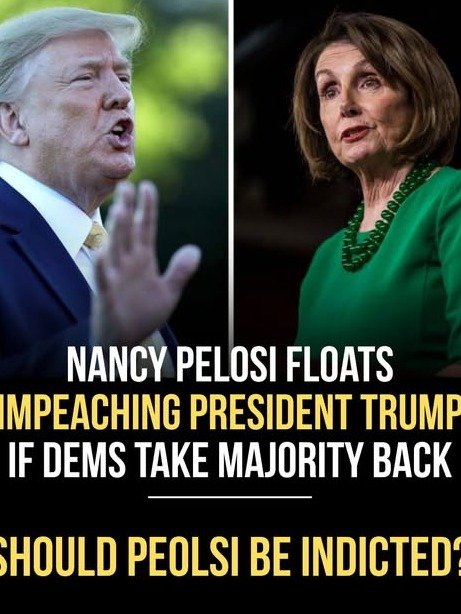
Imagine a political landscape where the echoes of past battles never truly fade, only to resurface with renewed intensity. A recent statement from a prominent political figure has sent ripples through Washington, suggesting that one of the most contentious chapters in recent American history might be far from closed.
House Speaker Emerita Nancy Pelosi has recently made remarks that strongly imply a potential return to impeachment proceedings against former President Donald Trump, should Democrats regain significant power. This isn’t just a a casual comment; it’s a strategic signal that could redefine the political agenda and reignite a deeply polarizing debate across the nation.
For many Americans, the mere mention of ‘impeachment’ conjures up images of intense partisan conflict, gridlock, and a nation divided. The prospect of revisiting such a contentious process raises critical questions about political priorities, the pursuit of accountability, and the very fabric of democratic governance.
The Echo of Impeachment Past: A Brief Recap
To understand the weight of Pelosi’s recent hints, it’s crucial to recall the two previous impeachment efforts against Donald Trump during his presidency. Each instance was a monumental political event that captivated the nation and deepened existing partisan divides, leaving an indelible mark on American politics.
The first impeachment, in late 2019, centered on allegations that Trump abused his power by pressuring Ukraine to investigate political rival Joe Biden, and subsequently obstructed Congress’s investigation. House Democrats argued that his actions constituted high crimes and misdemeanors, threatening national security and the integrity of U.S. elections.
Despite a vote to impeach in the House, the Republican-controlled Senate ultimately acquitted him in early 2020. The proceedings were marked by intense debate over executive privilege, the scope of presidential power, and the very definition of impeachable offenses.
The second impeachment occurred in January 2021, following the attack on the U.S. Capitol. This time, Trump was charged with “incitement of insurrection.” Democrats argued that his rhetoric and actions directly fueled the violent events of January 6th, representing a profound betrayal of his oath of office.
Though impeached by the House just days before leaving office, Trump was again acquitted by the Senate. This second trial, occurring after his term ended, sparked further constitutional debate about the applicability of impeachment to former officeholders, further polarizing the political discourse.
Pelosi’s Warning Shot: A Glimpse into the Future?
Nancy Pelosi, a central figure in both previous impeachment efforts, has now publicly indicated that the possibility of future impeachment proceedings remains on the table. Her statements suggest that if Democrats were to regain control of both chambers of Congress and the White House, they might feel compelled to pursue further action against Trump.
This isn’t an idle threat; it’s a calculated move that serves multiple purposes. It energizes a segment of the Democratic base that believes Trump has never truly been held accountable for his actions, particularly those surrounding January 6th. It also sends a clear message to political opponents about the potential consequences of certain behaviors.
The specific phrasing of her comments often alludes to a sense of unfinished business, a constitutional duty to uphold the rule of law. For many within her party, the past acquittals were not exonerations but rather failures of the Senate to deliver justice, leaving open the door for future action.
The Democratic Rationale: Accountability or Strategy?
From the Democratic perspective, the pursuit of impeachment is fundamentally about accountability. Proponents argue that a president, even a former one, must be held to the highest standards of conduct, and that alleged abuses of power, particularly those that threaten democratic institutions, cannot go unaddressed.
“Our oath to the Constitution is sacred, and it demands that we pursue justice wherever it leads, ensuring that no one is above the law,” a Democratic strategist might assert, reflecting the party’s core belief in constitutional checks and balances.
This viewpoint emphasizes the long-term health of the republic, suggesting that ignoring past transgressions could set dangerous precedents for future leaders. They believe that if certain actions are left unchallenged, it could erode public trust and undermine the very foundations of American democracy.
However, critics from across the political spectrum also see a strategic element at play. For some, the repeated focus on impeachment serves as a powerful political tool, designed to keep a formidable political opponent marginalized and to rally the party’s base around a common cause.
The Republican Counter: “Weaponized Politics”
On the other side of the aisle, Pelosi’s remarks are immediately met with fierce condemnation, often framed as evidence of a Democratic “impeachment obsession.” Republicans frequently decry such efforts as thinly veiled political attacks, designed to undermine their political rivals rather than to uphold constitutional principles.
They argue that repeated impeachment attempts, especially after a president has left office, are a dangerous precedent that weaponizes a serious constitutional power for partisan gain. This, they contend, distracts from the real issues facing the nation and further polarizes an already divided populace.
Key Republican arguments often include:
- Political Witch Hunt: The perception that Democrats are relentlessly pursuing a political enemy without sufficient cause.
- Waste of Resources: Impeachment proceedings are costly and time-consuming, diverting attention and taxpayer money from pressing national concerns.
- Undermining Elections: The belief that impeachment is used to overturn election results or prevent a candidate from running again, rather than addressing genuine wrongdoing.
- Setting a Dangerous Precedent: The concern that if impeachment becomes a regular tool of partisan warfare, it will weaken the presidency and the stability of government.
For many conservatives, the cycle of impeachment has become synonymous with Democratic overreach, fueling a narrative of a party more interested in political vengeance than in effective governance.
Public Opinion: Fatigue and Frustration
While each impeachment effort initially captures significant public attention, there is growing evidence of widespread fatigue among American voters regarding the process. Many citizens, regardless of their political affiliation, express frustration with the constant political infighting and the perceived lack of focus on substantive policy issues.
Surveys often show a significant portion of the electorate feeling that impeachment proceedings are a distraction from critical challenges such like economic stability, healthcare, immigration, or foreign policy. They desire a political environment where leaders can collaborate and address the nation’s pressing needs.
This sentiment of ‘impeachment fatigue’ can be a double-edged sword for both parties. While it might energize a dedicated base, it risks alienating independent voters and those who prioritize practical solutions over political drama. The constant churn of investigations and trials can lead to cynicism about the political process itself.
The Constitutional Crossroads: Defining Impeachment
The ongoing debate around potential future impeachments also highlights fundamental disagreements about the very nature and purpose of impeachment itself. Is it a tool for removing a sitting president, or can it also serve as a form of censure or disqualification for future office, even for a private citizen?
Constitutional scholars and legal experts are divided on these interpretations. The founders envisioned impeachment as a grave measure, reserved for “high crimes and misdemeanors,” to protect the republic from tyrannical or corrupt leaders. Its infrequent use throughout history underscores its seriousness.
However, the modern political landscape has seen a more frequent consideration and application of impeachment, leading to questions about whether its original intent is being preserved or if it’s evolving into something different. The very definition of what constitutes an impeachable offense continues to be a battleground.
Beyond Impeachment: The Cost to Governance
The shadow of potential impeachment proceedings carries significant implications for the broader landscape of American governance. When political energy and resources are heavily invested in such battles, it inevitably diverts attention from legislative priorities and bipartisan cooperation.
A renewed focus on impeachment could lead to further gridlock in Congress, making it even harder to pass essential legislation, confirm appointments, or address pressing national and international crises. The constant threat of such a process can poison the well of political discourse, making compromise nearly impossible.
Moreover, it risks deepening the already profound ideological chasm between the two major parties. Instead of seeking common ground, politicians might become even more entrenched in their positions, viewing every issue through the lens of partisan advantage and potential future conflict.
A Cycle of Retribution?
Some political observers warn that a relentless pursuit of impeachment by one party could trigger a dangerous cycle of retribution. If Democrats were to move forward with another impeachment effort, it could set a precedent that future Republican-controlled Congresses might feel compelled to follow against Democratic presidents or officials.
This tit-for-tat dynamic would transform impeachment from a solemn constitutional check into a regular feature of partisan warfare, further destabilizing the political system. The erosion of norms and the escalation of political hostilities could have long-lasting, detrimental effects on democratic institutions.
The question becomes: at what point does the pursuit of accountability cross the line into endless political vendetta? Finding that balance is crucial for the health of the republic, and many fear that the line has already become dangerously blurred.
What’s at Stake for American Voters?
For the average American voter, the prospect of another impeachment battle represents more than just political theater. It signifies a potential future where their leaders are consumed by internal conflict rather than focusing on the issues that directly impact their daily lives.
Voters are increasingly looking for stability, effective governance, and solutions to tangible problems. The promise of continued partisan warfare, even if framed as a fight for justice, may fall flat with an electorate yearning for a more functional and less divisive political environment.
Ultimately, the decision to pursue or avoid another impeachment effort will have profound consequences for the direction of the country, the nature of its political discourse, and the trust citizens place in their elected representatives. It’s a choice that could either reinforce constitutional principles or further unravel the fabric of national unity.
Conclusion: The Path Forward
Nancy Pelosi’s recent remarks serve as a potent reminder that the specter of impeachment continues to loom large over American politics. Whether these are merely strategic warnings or genuine intentions for future action, they highlight the deep divisions and unresolved tensions that define the current political landscape.
As the nation moves closer to critical elections, the debate over accountability, political strategy, and the use of constitutional powers will undoubtedly intensify. The choice between relentless pursuit of past grievances and a forward-looking agenda for national unity will be one of the most significant challenges facing America’s leaders.
The path forward remains uncertain, but one thing is clear: the conversation around impeachment is far from over, and its potential resurgence could dramatically reshape the future of American governance and political discourse.
About the Author




