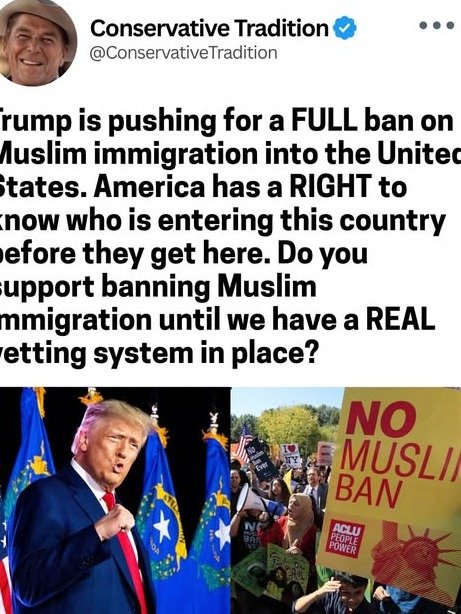
Imagine a nation grappling with an existential question: how do you secure your borders and protect your citizens in an increasingly complex world? This isn’t a hypothetical scenario, but the very real debate sparked by former President Donald Trump’s controversial push for a comprehensive ban on Muslim immigration into the United States. This policy proposal ignited a firestorm of discussion, touching upon deeply held beliefs about national security, religious freedom, and America’s role on the global stage.
At the heart of this contentious proposal lies a simple, yet profoundly impactful, argument: the belief that a nation cannot effectively safeguard its citizens if it cannot adequately vet those entering its borders. Proponents argue that in an era of global terrorism and evolving threats, the conventional immigration screening processes may fall short, particularly when dealing with regions prone to extremism or lacking stable governmental infrastructure for reliable data sharing.
Understanding the National Security Rationale
The case for a full ban, as articulated by its supporters, often boils down to national security. The premise is that if intelligence agencies and immigration authorities cannot sufficiently scrutinize individuals from certain countries or backgrounds, then the only viable recourse to prevent potential threats from entering the country is to temporarily or permanently restrict their entry. This perspective prioritizes the safety of current citizens above all else, viewing any potential security loophole as an unacceptable risk.
This argument gained significant traction following several high-profile terrorist attacks both domestically and internationally. These incidents fueled concerns that existing immigration frameworks were insufficient to filter out individuals with extremist ties or intentions. The call for a ban, therefore, emerged as a drastic measure designed to close what some perceived as critical vulnerabilities in the nation’s defense.
Key arguments often presented by proponents of a ban include:
- Inadequate Vetting Capabilities: Concerns that some countries lack the robust record-keeping or cooperative intelligence infrastructure needed to thoroughly vet immigrants.
- Threat of Radicalization: The fear that individuals from certain regions might be susceptible to radical ideologies, posing a domestic security risk.
- Preventative Measure: A belief that a ban acts as a proactive defense mechanism, preventing potential threats from ever reaching U.S. soil.
- National Sovereignty: The assertion that a sovereign nation has the inherent right to control who enters its borders, especially when national security is at stake.
The ‘Straightforward’ Case: A Deeper Look
When the argument is framed as ‘straightforward,’ it typically implies a direct cause-and-effect: uncontrolled entry leads to increased risk, therefore controlled (or banned) entry leads to reduced risk. This simplifies a complex geopolitical issue into a binary choice, often appealing to those who feel a sense of urgency and vulnerability regarding national safety.
This ‘straightforward’ logic suggests that the burden of proof for safety should fall squarely on the immigrant, and if that proof cannot be unequivocally established, then entry should be denied. It posits that the risk of even a single security breach outweighs the benefits of open immigration policies from certain regions. This perspective emphasizes a zero-tolerance approach to potential threats, placing national security as the paramount concern.
“You cannot protect your country when you cannot properly identify and vet who is coming in,” is a common refrain among those advocating for such measures. This statement encapsulates the core belief that without absolute certainty in vetting, the nation remains exposed.
The Legal and Ethical Firestorm
Unsurprisingly, the proposal for a Muslim immigration ban triggered an immediate and intense backlash from legal experts, civil rights organizations, and international bodies. Critics argued that such a policy would be overtly discriminatory, violating fundamental principles of religious freedom enshrined in the U.S. Constitution, specifically the First Amendment’s Establishment Clause and Free Exercise Clause.
They contended that singling out an entire religious group for exclusion, regardless of individual merit or threat assessment, constitutes religious discrimination. Furthermore, opponents highlighted that the United States has historically been a beacon of hope for immigrants and refugees, and a ban based on religion would fundamentally betray these core American values.
Broader Implications and Counterarguments
Beyond the legal and ethical challenges, a ban on Muslim immigration raised significant concerns about its practical implications and potential unintended consequences. Critics argued that such a policy could be counterproductive, potentially fueling anti-American sentiment abroad and serving as a propaganda tool for extremist groups.
Many also pointed out that radicalization is a complex phenomenon not tied to any single religion or nationality, and that a broad ban would unfairly target millions of peaceful individuals while failing to address the root causes of extremism. They argued that such a policy could alienate allies, damage international relations, and hinder intelligence sharing efforts crucial for combating global terrorism.
Counterarguments often raised against a ban include:
- Religious Discrimination: Violates constitutional protections against religious discrimination.
- Ineffectiveness: Does not address the global nature of terrorism and could be exploited by extremists.
- Harm to U.S. Image: Damages America’s reputation as a diverse and welcoming nation.
- Economic Impact: Could deprive the U.S. of skilled workers, innovators, and entrepreneurs.
- Humanitarian Concerns: Ignores the plight of refugees and asylum seekers fleeing persecution.
- Alienation of Allies: Strains relationships with Muslim-majority countries that are key partners in counter-terrorism efforts.
The Search for a Balance: Security vs. Values
The debate surrounding a Muslim immigration ban encapsulates a fundamental tension in modern governance: how to balance robust national security imperatives with cherished democratic values and international obligations. While proponents see a ban as a necessary, albeit drastic, measure for immediate protection, opponents view it as a dangerous precedent that undermines the very fabric of American society and its constitutional principles.
This complex issue forces a critical examination of how a nation defines its identity, manages its borders, and responds to global challenges. It’s a conversation that extends far beyond political rhetoric, impacting individuals, communities, and the nation’s standing in a rapidly changing world.
The Evolving Landscape of Immigration Policy
The discussion around a Muslim immigration ban is not isolated; it’s part of a larger, ongoing debate about immigration reform, border security, and the future of America’s demographic landscape. Every administration grapples with the challenge of crafting policies that are both effective in safeguarding the nation and reflective of its values.
The push for such a ban, regardless of its ultimate implementation or legality, underscores the profound anxieties and differing philosophies that shape public discourse on national security and immigration. It serves as a potent reminder that in a globalized world, domestic policies often have far-reaching international consequences, and vice versa.
What Does This Mean for the Future?
The legacy of this policy discussion continues to resonate, shaping future debates on immigration and national identity. It forces citizens and policymakers alike to confront difficult questions about who we are as a nation, what principles we uphold, and how we choose to protect our future.
Whether through comprehensive vetting enhancements, targeted security measures, or a re-evaluation of immigration priorities, the conversation about how to secure the nation while upholding its values remains at the forefront. The ‘straightforward’ argument for a ban, while compelling to some, opens up a Pandora’s box of complex legal, ethical, and practical considerations that demand careful and nuanced deliberation from all sides.
Ultimately, the discussion around a Muslim immigration ban is a microcosm of the larger struggle to define national identity and security in the 21st century. It’s a debate that touches every citizen, shaping not just who enters the country, but also the very soul of the nation itself.
About the Author




