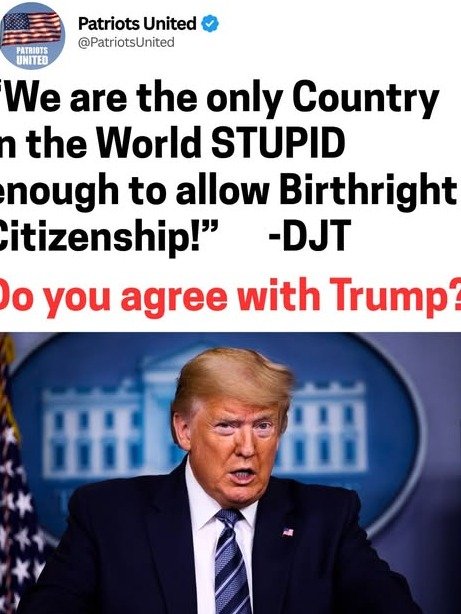
Did you know that a fundamental aspect of American identity, birthright citizenship, became the unexpected battleground for a potential constitutional crisis? President Trump’s administration consistently challenged long-held interpretations of the 14th Amendment, igniting a fiery debate that reached the highest echelons of legal discourse. His pronouncements, particularly those regarding a ‘Day One’ executive order aimed at limiting birthright citizenship, sent shockwaves through the political and legal landscape, culminating in a dramatic ‘firing back’ after intense legal scrutiny.
This isn’t just about policy; it’s about the very fabric of who is considered an American from birth. The former President’s strong words, often delivered with characteristic bluntness, have consistently pushed the boundaries of established legal precedent. His comments often reflect a deeply held belief that the current system is flawed, leading him to question a constitutional interpretation that has stood for over a century, and to propose radical changes that would profoundly reshape the nation.
The Core of the Controversy: Birthright Citizenship
At the heart of this contentious debate lies the concept of birthright citizenship, enshrined in the 14th Amendment to the U.S. Constitution. Ratified in 1868 in the aftermath of the Civil War, the amendment states:
“All persons born or naturalized in the United States, and subject to the jurisdiction thereof, are citizens of the United States and of the State wherein they reside.”
For generations, this clause has been widely interpreted to mean that nearly anyone born on American soil is automatically a U.S. citizen, regardless of their parents’ immigration status.
This interpretation was famously solidified by the Supreme Court in the 1898 case of United States v. Wong Kim Ark. In this landmark ruling, the Court affirmed that a child born in the U.S. to Chinese immigrant parents, who were not citizens, was indeed an American citizen. This precedent has largely guided legal understanding for well over a century, making the idea of unilaterally changing birthright citizenship a monumental legal challenge.
Trump’s Stance and the ‘Day One’ Order Proposal
From the moment he stepped onto the political stage, President Trump made it clear that he viewed birthright citizenship as a significant flaw in the U.S. immigration system. He repeatedly argued that it incentivized illegal immigration and was an outdated interpretation of the Constitution. His administration explored various avenues to challenge or alter this policy, including the controversial idea of an executive order.
The concept of a ‘Day One’ executive order on this issue, while perhaps more aspirational or symbolic in its initial framing, underscored the urgency and priority Trump placed on this matter. While a direct ‘Day One’ executive order specifically limiting birthright citizenship that reached the Supreme Court for oral arguments in the traditional sense is a complex historical point, Trump’s frequent public statements and his administration’s internal discussions consistently fueled intense legal and political debate surrounding the constitutionality and feasibility of such an action. The legal community, including constitutional scholars and Supreme Court watchers, extensively analyzed what the arguments *would* be if such an order were issued and challenged.
The Supreme Court’s Shadow: Legal Arguments and Counterarguments
The President’s proposals immediately drew the attention of legal experts, who began to dissect the constitutional implications. The primary argument against an executive order limiting birthright citizenship centers squarely on the 14th Amendment’s Citizenship Clause. Proponents of the traditional interpretation argue that the text is clear and unambiguous:
About the Author




