Imagine a world where your birthplace doesn’t automatically grant you citizenship. Sounds impossible in America, right? Yet, a seismic political debate is erupting over this very idea, with former President Donald Trump proposing to fundamentally alter birthright citizenship – a cornerstone of American law for over a century and a half. This isn’t just a political talking point; it’s a potential constitutional earthquake.
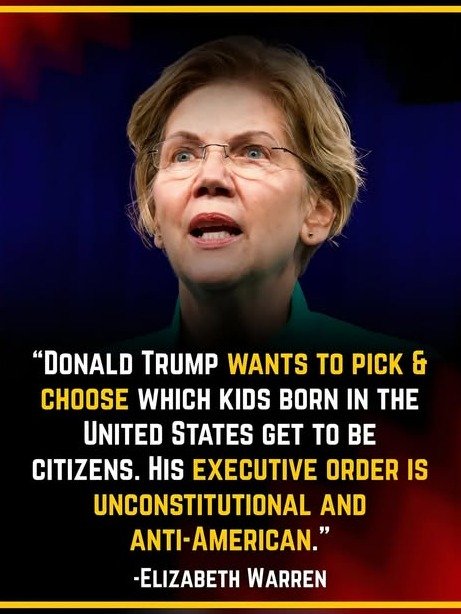
Senator Elizabeth Warren has sounded the alarm, echoing concerns from legal scholars and civil rights advocates across the nation. Her recent comments highlight the profound legal and constitutional challenges such a move would unleash, threatening to plunge the nation into an unprecedented crisis over who truly belongs. The stakes couldn’t be higher: a foundational principle of American identity hangs in the balance, and what happens next could redefine the very fabric of our society.
The 14th Amendment: A Pillar Under Scrutiny
At the heart of this explosive debate lies the 14th Amendment to the U.S. Constitution, ratified in 1868. Specifically, the first sentence of Section One states:
“All persons born or naturalized in the United States, and subject to the jurisdiction thereof, are citizens of the United States and of the State wherein they reside.”
This seemingly straightforward language has been the bedrock of birthright citizenship, meaning anyone born on American soil is automatically a citizen, regardless of their parents’ immigration status.
This amendment was primarily intended to grant citizenship to formerly enslaved people after the Civil War, ensuring their rights and preventing states from denying them legal status. For generations, its interpretation has been largely undisputed, reaffirmed by the Supreme Court in the landmark 1898 case of United States v. Wong Kim Ark, which affirmed birthright citizenship for the U.S.-born child of Chinese immigrants.
Donald Trump’s Bold Proposal: A Constitutional Showdown?
Former President Donald Trump has repeatedly vowed to end birthright citizenship, arguing that it creates a perverse incentive for undocumented immigration, often referring to children born to non-citizens as “anchor babies.” His proposed method is particularly controversial: he suggests he could do it through an executive order, bypassing Congress and the lengthy process of amending the Constitution.
Trump’s argument hinges on a reinterpretation of the phrase “subject to the jurisdiction thereof.” Proponents of his view argue that this phrase was never intended to apply to children of individuals who are not legally present in the country, suggesting it implies full allegiance to the U.S. and excludes those whose parents owe allegiance to another nation. This interpretation, however, stands in stark contrast to over a century of legal precedent and scholarly consensus.
Senator Warren’s Urgent Warning: A Constitutional Crisis Looms
Senator Elizabeth Warren has been unequivocal in her criticism of Trump’s proposal, warning that such a move would not only be unconstitutional but would also ignite a profound legal and societal crisis. She emphasizes that the 14th Amendment is clear and has been consistently interpreted by courts for over a century. To unilaterally change it via executive order would be an unprecedented overreach of presidential power.
“The 14th Amendment is crystal clear on birthright citizenship,” Senator Warren stated, underscoring the legal consensus. “To try and strip it away by executive order isn’t just wrong; it’s an attack on the Constitution itself and would throw our country into chaos.”
Her concerns are rooted in the fundamental principles of American democracy and the rule of law, suggesting that such an action would undermine the very foundation of our legal system.
The Legal Labyrinth: Executive Order vs. Constitutional Amendment
The notion that a president could end birthright citizenship with a stroke of a pen is met with near-universal skepticism from constitutional law experts. Amending the Constitution is an arduous process, requiring either a two-thirds vote in both the House and Senate and ratification by three-fourths of the states, or a constitutional convention called for by two-thirds of state legislatures. Neither scenario is remotely feasible for such a divisive issue.
Legal scholars argue that an executive order attempting to redefine the 14th Amendment would be immediately challenged in court and swiftly struck down. The Supreme Court has consistently upheld the principle that the executive branch cannot unilaterally alter the Constitution. Such an attempt would not only fail legally but would also set a dangerous precedent, blurring the lines between presidential authority and constitutional law.
The Argument for Preserving Birthright Citizenship
- Historical Intent: The 14th Amendment was explicitly designed to grant citizenship to all persons born on U.S. soil, regardless of parentage, primarily to ensure the citizenship of formerly enslaved people.
- Supreme Court Precedent: The 1898 Wong Kim Ark case cemented this interpretation, applying it even to children of non-citizens.
- Preventing Statelessness: Ending birthright citizenship would create a class of people born in the U.S. but without citizenship anywhere, leading to immense social and humanitarian problems.
- Administrative Nightmare: Determining citizenship based on parental status would be an enormous logistical and bureaucratic challenge, potentially leading to racial profiling and discrimination.
- National Identity: Birthright citizenship is seen by many as a core tenet of American exceptionalism and a symbol of its immigrant heritage.
These arguments highlight the deeply embedded nature of birthright citizenship within American legal and cultural frameworks. Critics of Trump’s proposal emphasize that this is not merely a policy debate but a fundamental question of constitutional fidelity and national values.
The Practical Consequences of Ending Birthright Citizenship
Should an executive order somehow survive legal challenges – an unlikely scenario – the practical implications would be catastrophic. Millions of individuals currently considered U.S. citizens would suddenly have their status questioned, creating a massive population of stateless persons within the country. This would lead to:
- Increased Social Instability: A large, marginalized population without legal rights or access to essential services.
- Economic Disruption: Uncertainty over legal status would impact employment, taxes, and social programs.
- Administrative Chaos: A new, complex system would be needed to determine citizenship, likely leading to widespread discrimination and inconsistent application.
- Human Rights Concerns: The creation of a stateless class would violate international human rights norms.
The ramifications extend far beyond legal theory, touching every aspect of American life, from social cohesion to economic stability. The potential for widespread confusion, fear, and injustice is immense, painting a grim picture of a nation grappling with its own identity.
A Deeper Look at the “Subject to the Jurisdiction Thereof” Clause
While opponents of birthright citizenship often seize upon the phrase “subject to the jurisdiction thereof” as a loophole, legal scholars largely agree on its original meaning. It was intended to exclude individuals who were not fully subject to U.S. law, such as foreign diplomats and invading armies. It was not meant to exclude children of non-citizens residing in the U.S. and obeying its laws.
The consensus among constitutional historians is that the framers of the 14th Amendment, particularly Senator Jacob Howard, specifically intended to include all persons born on U.S. soil, irrespective of their parents’ origin or status, with only those narrow exceptions. To argue otherwise requires a significant rewriting of historical intent and established legal interpretation.
Political Motivations and the Road Ahead
The recurring debate over birthright citizenship is deeply entwined with broader immigration policy discussions and political motivations. For some, ending birthright citizenship is seen as a crucial step to deter illegal immigration and assert national sovereignty. For others, it is a dangerous nativist attack on fundamental rights and a distraction from comprehensive immigration reform.
As the 2024 election cycle heats up, this issue is likely to remain a potent talking point, energizing different segments of the electorate. While a presidential executive order to end birthright citizenship faces insurmountable legal hurdles, the mere proposal fuels intense debate and highlights the deep divisions within American society regarding immigration and national identity. The future of birthright citizenship may be constitutionally secure, but the political battle surrounding it is far from over.
Conclusion: Defending a Constitutional Cornerstone
Senator Elizabeth Warren’s forceful comments serve as a critical reminder of the fragility of even long-established constitutional principles when they become political targets. Trump’s proposal to end birthright citizenship via executive order isn’t just a policy suggestion; it’s a direct challenge to the 14th Amendment and the very concept of American citizenship as we know it.
The legal community largely agrees: such an action would be unconstitutional, unlawful, and would undoubtedly be struck down by the courts. However, the ongoing debate underscores the vital importance of understanding our Constitution and protecting its foundational tenets. The battle for birthright citizenship is, in essence, a battle for the soul of American identity and the enduring power of its founding documents.
As this debate continues to unfold, the nation watches to see if a cornerstone of American law will remain steadfast or if a new interpretation, with far-reaching consequences, will attempt to redefine who gets to be called an American.
The stakes are incredibly high, and the outcome will shape the future of millions and the very essence of what it means to be a citizen of the United States.
The Bottom Line: Don’t Miss Out on Understanding This Critical Debate
The discussion around birthright citizenship isn’t just legal jargon; it’s about real people, real rights, and the future of America. Stay informed, engage with the facts, and understand why figures like Senator Warren are so passionately defending a principle that has defined our nation for generations. Your understanding of this issue is more critical now than ever before.
About the Author




