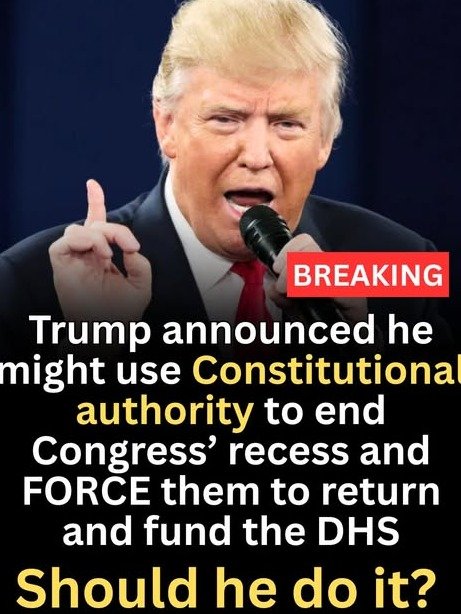
Imagine a scenario where Congress is on a much-anticipated break, only for the President to suddenly demand their immediate return to Washington, D.C. Sound like a plot from a high-stakes political thriller? It’s not. This isn’t just a hypothetical question; it’s a very real power President Trump reportedly considered wielding, sparking a constitutional debate that shook the nation.
For weeks, whispers circulated through the halls of power: President Trump was reportedly weighing his constitutional authority under Article II, Section 3, to cut short the current Senate and House recess. The aim? To force lawmakers back to the Capitol, ostensibly to address pressing national issues and push through stalled nominations. This potential move brought a rarely invoked presidential power into the spotlight, raising questions about the balance of power between the executive and legislative branches.
The President’s Powerful Prerogative: Article II, Section 3 Unpacked
At the heart of this discussion lies Article II, Section 3 of the U.S. Constitution. This crucial clause outlines several presidential duties and powers, including the President’s ability to engage with Congress. Specifically, it states that the President “shall from time to time give to the Congress Information of the State of the Union, and recommend to their Consideration such Measures as he shall judge necessary and expedient; he may, on extraordinary Occasions, convene both Houses, or either of them, and in Case of Disagreement between them, with Respect to the Time of Adjournment, he may adjourn them to such Time as he shall think proper.”
This single sentence contains two distinct, yet often conflated, presidential powers regarding Congress’s schedule. The first, and more commonly understood, is the power to “convene both Houses, or either of them, on extraordinary Occasions.” This allows the President to call Congress into special session outside of its regular schedule.
Convening Congress: A Historical Tool for Crisis
The power to convene Congress for “extraordinary Occasions” has been used by many presidents throughout history. These special sessions are typically called during times of national crisis, war, or when urgent legislation requires immediate attention. For instance, President Franklin D. Roosevelt convened Congress shortly after the attack on Pearl Harbor, and numerous presidents have called special sessions for war declarations or economic emergencies.
This power is generally well-accepted and understood. It ensures that the President can rally the legislative branch to address unforeseen challenges that arise when Congress is not in session. However, President Trump’s reported consideration went a step further, touching upon the far more contentious and rarely invoked second part of the clause.
The Adjournment Disagreement Clause: A Constitutional Tightrope Walk
The second, and far more controversial, part of Article II, Section 3 grants the President the power to “adjourn them to such Time as he shall think proper” in “Case of Disagreement between them, with Respect to the Time of Adjournment.” This specific power is what truly captured national attention and ignited a fierce constitutional debate.
This clause suggests that if the House and Senate cannot agree on when to adjourn their session, the President can step in and dictate the adjournment time. It’s a power designed to prevent legislative gridlock over the congressional calendar itself, ensuring that Congress doesn’t simply remain in a perpetual state of disagreement without resolving its schedule.
Recess vs. Adjournment: A Critical Distinction
Understanding the nuance between a “recess” and an “adjournment” is crucial here. An “adjournment” typically refers to the formal ending of a legislative session, or a longer break between sessions. A “recess,” on the other hand, is generally understood as a shorter break within a single legislative session, such as a holiday break or a district work period.
President Trump’s reported interest was in cutting short a *recess*. While the “convene” power clearly applies to bringing Congress back from *any* break for an “extraordinary Occasion,” the “adjourn” power is specifically tied to a “disagreement… with Respect to the Time of Adjournment.” This distinction is not merely semantic; it’s central to the legal arguments surrounding the President’s authority.
Why President Trump Reportedly Considered This Bold Move
During the period when this consideration was reported, several factors likely motivated President Trump. One significant driver was the backlog of presidential nominations. A substantial number of individuals nominated for federal judgeships and various executive branch positions were awaiting Senate confirmation. With the Senate in recess, these confirmations were stalled.
Another major factor was the legislative agenda, particularly during times of national crisis or economic uncertainty. If critical legislation, such as economic relief packages or emergency funding, was stalled due to Congress being out of session, the President might see recalling them as essential. The optics of Congress being on break while major national issues lingered could also have played a role, allowing the President to frame the move as forcing action.
“The President’s power to adjourn Congress is perhaps the most untested and legally ambiguous power granted to the executive branch in the Constitution. Its application would undoubtedly spark a major constitutional showdown.” – Constitutional Scholar
The Lack of Precedent: A Constitutional Minefield
While presidents have frequently used the power to “convene” Congress, the power to “adjourn” Congress due to disagreement is extraordinarily rare, if not entirely unprecedented in practice. No president has ever successfully invoked this specific power to adjourn both houses of Congress when they disagreed on their adjournment time.
There have been instances where presidents *threatened* to use this power. President Andrew Johnson, for example, considered it during the contentious post-Civil War era. More recently, President Barack Obama threatened to use it to make recess appointments during a period when the Senate was holding pro forma sessions to prevent such appointments. However, the Supreme Court’s ruling in *NLRB v. Noel Canning* (2014) complicated the definition of a “recess” for the purpose of recess appointments, though it didn’t directly rule on the President’s adjournment power itself.
Defining “Disagreement”: The Legal Quagmire
A central legal challenge to using the adjournment disagreement clause lies in defining what constitutes a “disagreement.” Does a simple failure of the two houses to pass a joint resolution setting an adjournment date qualify? Or does it require a more explicit, formal disagreement between the House and Senate leadership?
Legal scholars and constitutional experts are deeply divided on this interpretation. Some argue that if the two chambers simply fail to agree, the President can step in. Others contend that such a broad interpretation would fundamentally undermine the separation of powers, effectively giving the President undue control over the legislative calendar. They argue that “disagreement” implies an active, stated conflict over the adjournment time, not just a passive lack of consensus.
Potential Constitutional Crisis and Political Fallout
If President Trump had decided to invoke the adjournment disagreement power, it would have undoubtedly plunged the nation into a constitutional crisis. Congress would likely have challenged the move in court, setting up an unprecedented legal battle over the boundaries of executive power.
- Legal Challenges: The Supreme Court would be asked to interpret Article II, Section 3, in a way it has never fully done before.
- Separation of Powers: Critics would argue it’s an overreach that infringes on Congress’s inherent right to manage its own schedule.
- Political Backlash: Such a move would almost certainly escalate tensions between the executive and legislative branches, further polarizing an already divided political landscape.
- Public Opinion: The public reaction would be mixed, with supporters hailing it as decisive action and opponents decrying it as an authoritarian power grab.
Beyond the Headlines: The Stakes of Presidential Power
The mere consideration of using this obscure constitutional power highlights the immense stakes involved in the interpretation of presidential authority. While the Constitution grants the President significant powers, these are balanced by the checks and balances inherent in the American system of government. Any expansion or reinterpretation of these powers has profound implications for the future of the republic.
The debate over Article II, Section 3 serves as a powerful reminder of the delicate equilibrium between the branches of government. It underscores the importance of constitutional literacy and the ongoing need for vigilance in upholding the principles of democratic governance.
Conclusion: A Power Rarely Seen, But Always Looming
President Trump’s reported contemplation of using Article II, Section 3 to cut short a congressional recess was a moment that brought a rarely discussed constitutional power to the forefront of national discourse. While the power to convene Congress on “extraordinary Occasions” is a well-established tool, the power to adjourn Congress due to disagreement remains an untested and highly controversial authority.
The implications of such a move, both legal and political, would be immense, potentially reshaping the balance of power in Washington. Though ultimately not invoked in this instance, the mere threat of its use served as a stark reminder of the vast, and sometimes ambiguous, powers vested in the American presidency, and the continuous need to interpret and defend the foundational document of our nation.
About the Author




