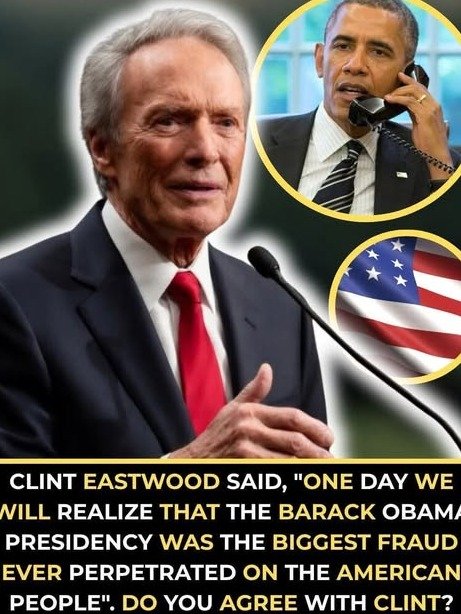
Imagine a packed political convention, the air thick with anticipation, ready for a serious endorsement from a revered Hollywood legend. Then, something entirely unexpected happens. In 2012, at the Republican National Convention in Tampa, Florida, Clint Eastwood — the iconic actor and director known for his stoic demeanor — delivered a speech that wasn’t just unconventional; it was a cultural phenomenon. He spoke to an empty chair, engaging in a bizarre, unscripted dialogue with an invisible President Barack Obama, and the world collectively gasped, laughed, and debated.
This wasn’t merely a political gaffe. It was a moment that transcended the political arena, instantly becoming a viral sensation, a meme generator, and a talking point dominating news cycles for weeks. What truly possessed one of America’s most respected figures to engage in such an act? And what was the lasting impact of this unforgettable performance on the political landscape and his own storied legacy?
The High Stakes of the 2012 Election Cycle
To fully grasp the magnitude of Eastwood’s address, recall the fervent political climate of 2012. President Barack Obama was campaigning for re-election amidst a challenging economic recovery and intense partisan gridlock. His opponent, former Massachusetts Governor Mitt Romney, aimed to unseat him, promising a distinct new direction. The Republican National Convention served as a crucial platform for Romney to energize his base and appeal to undecided voters.
Celebrity endorsements are a common, strategic element of political conventions, designed to add glamour, broaden appeal, and lend credibility. When it was announced that Clint Eastwood, a revered figure known for his conservative leanings but largely private political stance, would speak, expectations soared. Many anticipated a powerful, traditional endorsement underscoring Romney’s ability to connect with a wide spectrum of voters.
A Hollywood Icon’s Unexpected Appearance
Clint Eastwood, a name synonymous with American grit and cinematic excellence, had supported Republican causes privately for years, but his public political appearances were rare and measured. His decision to address the RNC was therefore seen as a significant win for the Romney campaign, signaling broader appeal. Organizers likely envisioned a strong, concise speech highlighting Romney’s leadership qualities, contrasting them with the incumbent administration’s policies.
However, what transpired on that August night was anything but conventional. Eastwood, then 82 years old, emerged onto the stage to a thunderous ovation. Dressed in a dark suit, his signature squint and deliberate cadence were instantly recognizable. The energy in the hall was palpable—a mixture of excitement and deep reverence for the “Dirty Harry” star.
The Unscripted Monologue: An Empty Chair and an Invisible President
Then came the moment etched into political and cultural history. Instead of a prepared speech, Eastwood began addressing an empty chair next to the podium. He declared this chair represented President Barack Obama, who, in Eastwood’s narrative, was failing to deliver on promises and needed replacement.
For the next twelve minutes, Eastwood engaged in a surreal, one-sided conversation with his invisible interlocutor. He chastised “Obama” for various policy decisions, questioned his leadership, and even mimicked the President’s responses with a dismissive wave. The dialogue was rambling, at times disjointed, and deeply personal, touching on issues from the war in Afghanistan to corporate outsourcing.
The audience reacted with a striking mixture of confusion, laughter, and uncomfortable silence. Some delegates cheered wildly, appreciating the actor’s perceived boldness and anti-establishment stance. Others looked on, bewildered, unsure if this was a planned comedic act, a profound political statement, or a spontaneous outburst. The cameras kept rolling, capturing every bewildering second for a global audience.
“When somebody does not do the job, you’ve got to let ’em go.” – Clint Eastwood, addressing the empty chair.
The Social Media Explosion: #EmptyChair Goes Viral
In the burgeoning age of instant communication, the “empty chair” speech exploded across social media platforms. Twitter, then a powerful force in political discourse, became an immediate battleground. Within minutes, #Eastwooding and #EmptyChair were trending worldwide, as millions weighed in, expressing shock, amusement, outrage, or solidarity.
Memes featuring empty chairs in various absurd contexts flooded the internet. Pictures of famous figures talking to empty chairs, or just images of empty chairs with political captions, became an overnight sensation. The moment quickly transcended its political origins, morphing into a pop culture touchstone that exemplified the power of viral content and the unpredictable nature of live television.
Political Fallout: A Divided Response
The political establishment was equally divided. Republicans, particularly those involved with the Romney campaign, were initially caught off guard. Some praised Eastwood’s authenticity, viewing it as a raw, unfiltered expression of frustration with the Obama administration. They argued it resonated with an electorate tired of overly polished political rhetoric.
However, many within the Republican party and conservative media expressed significant discomfort. They worried the speech had overshadowed Mitt Romney’s message, making the convention appear disorganized or farcical. Critics argued it presented an image of the party as out of touch or disrespectful, given the customary solemnity of presidential conventions.
Democrats, predictably, seized upon the opportunity. They mocked the speech relentlessly, portraying it as clear evidence of the Republican party’s desperation and perceived lack of serious policy proposals. President Obama himself, through his campaign, posted a picture of himself in the Oval Office with the caption, “This seat’s taken,” a subtle but highly effective jab that further fueled the burgeoning meme culture.
Eastwood’s Intentions: Unscripted Reality or Calculated Chaos?
In the days and weeks that followed, Eastwood offered crucial insights into his motivations. He confirmed the speech was entirely unscripted. “My only message was to say that I think the country is at a point where we need to think about things, and if you’re not happy with what’s going on, do something about it,” he told reporters. He maintained he was simply conveying his feelings in his own unique way, much like he would approach a scene in a film.
He later elaborated, stating he had a planned skit involving Romney, but it was scrapped. He then improvised, drawing inspiration from a similar routine by legendary comedian Bob Newhart. Eastwood consistently maintained his core intention was to inject reality and humor into what he perceived as overly formal political proceedings, and to express his genuine dissatisfaction with the then-current administration.
A Lasting Cultural and Political Legacy
Despite the initial controversy and mixed reactions, the “empty chair” speech firmly cemented its place in American political lore. It swiftly became shorthand for awkward celebrity political endorsements, a potent symbol of unconventional protest, and a prime example of how quickly a single moment can become a global meme. It also starkly highlighted the undeniable power of social media to amplify and dissect political events in real-time.
Years later, the vivid image of Clint Eastwood talking intently to an empty chair remains instantly recognizable and frequently referenced in popular culture. It serves as a potent reminder of a time when a single, unscripted act by a beloved cultural figure could momentarily overshadow an entire political convention and spark a nationwide, if bizarre, conversation.
Analyzing the Impact: Masterstroke or Misstep?
The question of whether Eastwood’s speech was ultimately a political success or a resounding failure continues to be debated. From a purely traditional campaign perspective, it was arguably a significant misstep. It undeniably diverted crucial attention from Mitt Romney’s message, generated negative headlines, and provided abundant fodder for the opposing campaign. It certainly did not appear to swing any undecided voters towards Romney’s side.
However, from a more unconventional angle, one could argue it was a stroke of genius. It undeniably showcased Eastwood’s raw, unvarnished authenticity, which deeply resonated with some voters who felt similarly frustrated and unheard. It certainly generated unprecedented buzz, ensuring the RNC dominated national conversations, even if not always as intended. It was memorable, for better or worse, and in the crowded media landscape, memorability can indeed be a powerful form of success.
Ultimately, the “empty chair” speech stands as an enduring testament to the unpredictable nature of live political theater and the enduring power of celebrity influence. It vividly demonstrated that even the most meticulously choreographed events can be dramatically upended by an individual’s spontaneous expression, leaving a lasting, indelible mark on popular culture and political history.
Clint Eastwood’s empty chair moment at the 2012 Republican National Convention was far more than just a speech; it was a cultural flashpoint. It sparked a global conversation, launched a thousand memes, and forced everyone to grapple with the often-blurry line between political theater and genuine personal expression. Whether you found it profound, perplexing, or downright hilarious, one thing is undeniably true: it was a moment that no one who witnessed it will ever forget, solidifying its place as one of the most unexpected and talked-about political appearances of the 21st century.
About the Author




