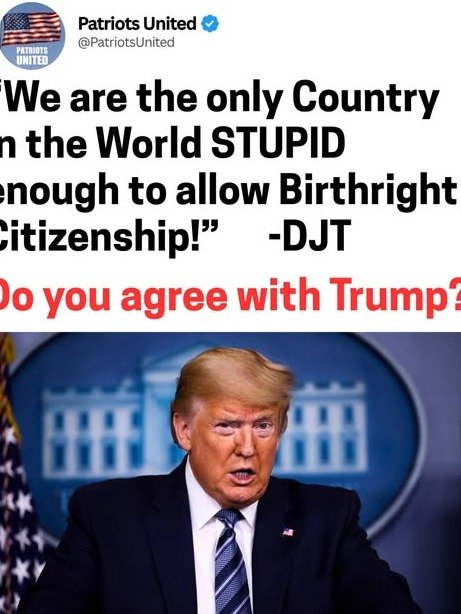
Imagine a world where being born on American soil doesn’t automatically grant you the rights and privileges of U.S. citizenship. This isn’t a hypothetical scenario from a dystopian novel, but a deeply rooted constitutional debate that former President Donald Trump has consistently brought to the forefront, challenging one of the most fundamental tenets of American law: birthright citizenship.
The issue recently reignited public discourse, with President Trump emphatically reiterating his long-standing position after what he framed as ongoing legal discussions surrounding his administration’s early policy ambitions. He ‘fired back,’ stating,
“We are the only Country in the World STUPID enough to have birthright citizenship, where a person comes in, has a baby, and the baby is a citizen of the United States… with all of the benefits.”
This powerful statement underscores a belief held by many conservatives: that the current interpretation of the 14th Amendment is outdated and detrimental to national sovereignty and security.
Unpacking the 14th Amendment: The Cornerstone of the Debate
At the heart of this contentious debate lies the 14th Amendment to the U.S. Constitution, ratified in 1868 in the aftermath of the Civil War. Its first sentence, known as the Citizenship Clause, declares:
“All persons born or naturalized in the United States and subject to the jurisdiction thereof, are citizens of the United States and of the State wherein they reside.”
This clause was primarily intended to grant citizenship to formerly enslaved African Americans, overturning the Supreme Court’s infamous 1857 Dred Scott decision.
For over a century, this clause has been widely interpreted to mean that nearly anyone born on U.S. soil is a citizen, regardless of their parents’ immigration status. This principle, known as jus soli (right of the soil), has shaped American society and its approach to immigration for generations. It implies an expansive view of who belongs to the American family, fostering a sense of inclusion and opportunity.
The ‘Subject to the Jurisdiction Thereof’ Controversy
However, the seemingly straightforward language of the 14th Amendment contains a crucial phrase that fuels the current controversy: ‘subject to the jurisdiction thereof.’ Critics of the traditional interpretation, including former President Trump, argue that this phrase was never intended to apply to children born to parents who are not legal residents or citizens, particularly those who have entered the country unlawfully.
They contend that ‘subject to the jurisdiction thereof’ implies full allegiance to the United States, which undocumented immigrants or temporary visitors may not hold. Therefore, their children, while physically born on U.S. soil, should not automatically be granted citizenship. This argument posits that the original intent of the framers would have excluded such individuals, focusing instead on those who owe full legal and political allegiance to the U.S.
Trump’s ‘Day One’ Vision and Consistent Stance
From the earliest days of his political career and throughout his presidency, Donald Trump made it abundantly clear that altering or ending birthright citizenship was a top policy priority. While a specific ‘Day One executive order’ directly revoking birthright citizenship via presidential fiat was legally complex and never fully implemented in that exact form, his administration consistently explored avenues to challenge or redefine its application.
His public statements and policy discussions from the start of his term, often framed as ‘Day One’ ambitions, signaled a clear intent to tackle what he viewed as a loophole. This consistent focus highlighted his belief that the current system encourages illegal immigration, creating what he and his supporters often refer to as ‘anchor babies’ – children who, by virtue of their citizenship, could potentially facilitate their parents’ ability to remain in the U.S.
A Global Anomaly? Comparing Citizenship Laws
President Trump’s assertion that the U.S. is ‘the only country in the world STUPID enough’ to have birthright citizenship is a powerful rhetorical device, but how accurate is it? While many developed nations, particularly in Europe, adhere to jus sanguinis (right of blood), where citizenship is derived from one’s parents, the U.S. is not alone in its application of jus soli.
- Jus Soli Nations: Many countries in the Western Hemisphere, including Canada, Mexico, Brazil, and Argentina, also grant unconditional birthright citizenship. This practice is rooted in their histories of immigration and settlement.
- Modified Jus Soli: Some countries, like Australia and the UK, have moved to a modified jus soli system, requiring at least one parent to be a citizen or legal resident for a child born on their soil to automatically gain citizenship.
- Jus Sanguinis Nations: Most European and Asian nations primarily follow jus sanguinis, emphasizing ancestral ties over birthplace.
The U.S. system, while not unique globally, is certainly an outlier among developed nations outside of the Americas. This distinction is often highlighted by those advocating for a change, arguing that aligning with European models would reduce incentives for illegal immigration.
The Legal Road Ahead: Executive Action vs. Constitutional Amendment
Can a president unilaterally end birthright citizenship through an executive order? Legal scholars are largely in agreement that such an action would face immediate and significant legal challenges, with many arguing it would be unconstitutional. The prevailing view is that the 14th Amendment’s meaning can only be altered through a constitutional amendment or a definitive Supreme Court ruling that reinterprets its core clause.
An executive order could potentially direct federal agencies to interpret the ‘subject to the jurisdiction thereof’ clause more narrowly, for instance, by denying citizenship to children of undocumented immigrants. However, such an interpretation would almost certainly be challenged in federal courts, likely culminating in a Supreme Court showdown. The Court would then be forced to issue a landmark ruling, either affirming the long-held interpretation or establishing a new precedent.
The Stakes: Identity, Immigration, and the Future of America
The debate over birthright citizenship is far more than a legal technicality; it touches upon fundamental questions about American identity, the nation’s immigration policies, and its place in the world. Proponents of birthright citizenship argue that it:
- Prevents Statelessness: Ensures that children born on U.S. soil are not left without citizenship in any country.
- Promotes Assimilation: Integrates children of immigrants fully into American society, fostering loyalty and participation.
- Reflects American Values: Embodies the nation’s historical commitment to opportunity and inclusion for all born within its borders.
Conversely, those who advocate for its reinterpretation or abolition argue that the current system:
- Incentivizes Illegal Immigration: Encourages individuals to cross borders unlawfully to secure citizenship for their children.
- Undermines Sovereignty: Allows foreign nationals to indirectly determine who becomes an American citizen.
- Burden on Taxpayers: Creates a strain on social services and public resources.
The outcome of this debate, whether through legislative action, a constitutional amendment, or a pivotal Supreme Court decision, would have profound and lasting implications for millions of individuals and for the very fabric of American society. It would redefine who is considered a citizen, altering immigration patterns, demographic trends, and the nation’s self-perception for generations to come.
The Ongoing Constitutional Tug-of-War
President Trump’s consistent ‘firing back’ against the current interpretation of birthright citizenship ensures that this issue remains a flashpoint in national discourse. While specific Supreme Court oral arguments on a ‘Day One executive order’ limiting birthright citizenship might not have occurred in the exact manner suggested by the original statement, the former president’s rhetoric reflects a deep engagement with the legal and political landscape surrounding this issue.
His outspoken challenges serve as a powerful reminder that the foundational principles of American citizenship are not immune to scrutiny and debate. As the nation grapples with complex questions of identity and immigration, the 14th Amendment’s Citizenship Clause continues to be a central battleground, with potentially transformative consequences for what it means to be ‘born in the U.S.A.’
About the Author




