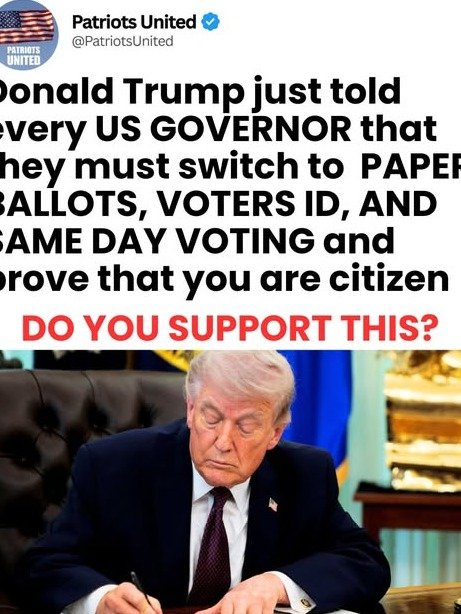
Imagine a scenario where every single vote cast in America is backed by an undeniable paper trail, verified by strict identification, and cast by a proven citizen. This isn’t a futuristic fantasy; it’s the urgent vision former President Donald Trump is now pressing upon every U.S. governor, demanding an immediate overhaul of the nation’s election infrastructure.
In a move that has sent ripples across the political landscape, President Trump is directly urging state leaders to adopt a suite of reforms he believes are critical to restoring faith and integrity in American elections. His call is not merely a suggestion but an emphatic plea for swift, decisive action on issues that have long fueled intense debate and partisan division.
The Core Demands: A Deep Dive into Trump’s Vision
At the heart of President Trump’s urgent message are four key pillars designed to fundamentally reshape how Americans cast their ballots. These proposals, while not new to political discourse, gain renewed prominence and urgency through his direct appeal to state governors, who hold significant power over election administration.
His vision begins with the universal adoption of paper ballots. This seemingly simple measure is championed as a critical safeguard against potential electronic vulnerabilities. Proponents argue that paper ballots provide an auditable, physical record of every vote cast, making it easier to verify results and detect discrepancies, unlike purely electronic systems which can be perceived as black boxes.
Next on the agenda is the implementation of strict voter ID requirements. This demand calls for voters to present a government-issued photo identification at the polls, a measure widely supported by those who believe it prevents impersonation and ensures that only eligible, registered individuals cast a ballot. The debate around voter ID is often fierce, with supporters emphasizing security and opponents raising concerns about potential disenfranchisement.
President Trump also advocates for a return to same-day voting, which in this context, implies a focused election day experience, potentially limiting extended early voting periods or widespread no-excuse absentee balloting. This approach aims to consolidate the voting process, making Election Day itself the primary, singular event for casting ballots, reducing the logistical complexities and alleged vulnerabilities associated with prolonged voting windows. While ‘same-day voting’ can sometimes refer to same-day registration, in the context of ‘strict’ measures, it points towards a simpler, more controlled election calendar.
Finally, and perhaps most controversially, is the requirement for proof of citizenship to vote. This measure seeks to ensure that only U.S. citizens participate in federal, state, and local elections. While citizenship is already a prerequisite for voting, establishing stringent, verifiable proof at the point of registration or voting is seen by some as an essential step to prevent non-citizens from influencing election outcomes.
Why Now? The Driving Force Behind the Push
President Trump’s renewed push for these specific reforms comes amidst ongoing national conversations about election integrity, particularly in the wake of recent presidential elections. His consistent message has been that public faith in the electoral system is paramount, and that current systems harbor vulnerabilities that erode that trust.
For years, concerns about election security, ranging from foreign interference to domestic fraud, have been a recurring theme in American politics. Trump’s advocacy amplifies these concerns, framing his proposals as necessary steps to safeguard the democratic process and ensure that every legal vote counts, and only legal votes count.
“Our elections must be fair, transparent, and beyond reproach. The future of our republic depends on it,” President Trump has often stated, reflecting the urgency he places on these reforms. “We need to make it easy to vote, but impossible to cheat.”
<
The Case For: Supporters’ Arguments
Those who champion these proposed reforms often highlight several key benefits they believe would strengthen American democracy:
- Enhanced Security: Paper ballots offer a tangible audit trail, making it harder for electronic tampering to go undetected. Strict voter ID and proof of citizenship act as deterrents to illegal voting, such as impersonation or non-citizen participation.
- Increased Public Confidence: By implementing clear, verifiable safeguards, supporters argue that the public’s faith in election results would significantly improve. Transparency in the voting process is seen as crucial for a healthy democracy.
- Fraud Prevention: The core argument is that these measures directly combat various forms of voter fraud, from ballot harvesting to ineligible individuals casting votes. They aim to close perceived loopholes in existing systems.
- Clarity and Simplicity: A consolidated, single Election Day experience, coupled with clear identification requirements, could simplify the voting process for administrators and voters alike, reducing confusion over extended voting periods and varied rules.
Supporters often point to other countries with similar stringent requirements, such as Canada or many European nations, which mandate voter ID and have high public confidence in their election results. They argue that these are not radical ideas but common-sense measures for securing a fundamental civic duty.
The Case Against: Opponents’ Concerns
However, President Trump’s proposals are not without significant opposition. Critics raise serious concerns about the potential negative impacts of these reforms, arguing they could undermine democratic participation and create undue burdens for legitimate voters.
A primary concern revolves around voter suppression. Opponents argue that strict voter ID laws disproportionately affect minority groups, the elderly, students, and low-income individuals who may not possess the required forms of identification or face challenges in obtaining them. They contend that the alleged problem of in-person voter impersonation, which strict ID laws primarily address, is exceedingly rare.
The demand for proof of citizenship also draws heavy criticism. While preventing non-citizen voting is a stated goal, opponents argue that requiring new, stringent proof could create significant barriers for naturalized citizens, those with older documents, or those who have simply never needed to prove citizenship for voting before. Current systems generally rely on attestation under penalty of perjury and matching against existing databases.
Limiting voting to primarily same-day voting, by reducing early voting or no-excuse absentee options, is also seen as a step backward by many. Extended voting periods are often championed as ways to increase voter access, reduce lines on Election Day, and accommodate people with busy schedules, disabilities, or travel commitments. Restricting these options could lead to lower turnout, according to critics.
- Logistical Hurdles and Costs: Implementing a nationwide switch to paper ballots, new ID verification systems, and citizenship proof mechanisms would be an enormous logistical undertaking, potentially costing billions of dollars and requiring significant training and infrastructure changes at the state and local levels.
- Disenfranchisement: Critics fear that the cumulative effect of these strict measures would be to make voting harder for millions of eligible citizens, rather than to catch a small number of fraudulent votes.
- Partisan Motivations: Opponents often view these proposals as politically motivated attempts to suppress votes from demographics that tend to lean against the party advocating for such changes, rather than genuine efforts to combat widespread fraud.
The Role of States: Governors on the Front Lines
It is crucial to understand that election administration in the United States is largely decentralized, falling under the purview of individual states and, by extension, their governors and state legislatures. This is precisely why President Trump’s appeal is directed at these state leaders.
Each state currently has its own unique set of election laws, covering everything from voter registration to ballot counting. This patchwork system means that a nationwide overhaul, as envisioned by Trump, would require a concerted effort by dozens of state governments, each navigating its own political landscape and legislative processes.
Governors will face immense pressure from both sides of the aisle. Those aligned with President Trump’s views may see this as an opportunity to enact reforms they believe are necessary, while others will likely resist, citing the potential for voter disenfranchisement and the practical challenges of implementation. The debate is not just about policy; it’s deeply ingrained in partisan politics and differing philosophies about access versus security.
Looking Ahead: The Future of American Elections
President Trump’s urgent call to governors underscores the ongoing, fervent debate surrounding election integrity in America. While the practical implementation of all these reforms nationwide would be a monumental task, his direct appeal signals a continued push to make these issues central to the political discourse.
The impact of such changes, if adopted, could be profound. A shift to universal paper ballots might increase auditing capabilities, but at a significant cost. Strict voter ID and proof of citizenship could redefine who casts a ballot, potentially altering the electorate, while same-day voting could reshape how and when Americans participate.
Ultimately, the discussion around these reforms is a fundamental one about the balance between election security, voter access, and the foundational trust in democratic institutions. As governors and state legislatures grapple with these demands, the future landscape of American elections hangs in the balance, promising continued debate and, potentially, significant transformation.
The coming months will reveal how many states heed President Trump’s call and how these proposals continue to shape the national conversation about the very mechanisms of American democracy. For every voter, understanding these proposed changes is key to engaging in this vital debate.
About the Author




