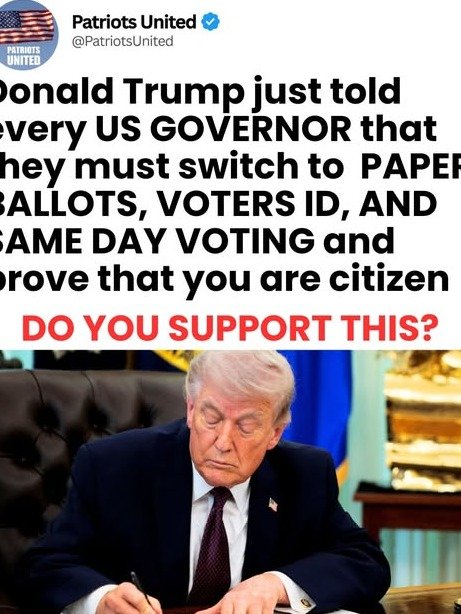
A seismic shift in America’s voting landscape could be on the horizon, as former President Donald Trump issues a direct and urgent call to every U.S. governor. His message is clear: overhaul election systems immediately with a set of stringent reforms he believes are vital for restoring faith and integrity in our democratic process.
This isn’t just a suggestion; it’s a powerful directive aimed at fundamentally changing how millions of Americans will cast their ballots in future elections. Trump’s proposals are designed to address long-standing concerns about election security, aiming to create a system he argues will be impervious to fraud and instill undeniable confidence in every outcome.
The Core of Trump’s Election Integrity Push
At the heart of President Trump’s appeal are four critical pillars, each intended to fortify the electoral system against perceived vulnerabilities. These measures, if adopted nationwide, would represent one of the most significant overhauls of American election procedures in decades.
- Mandatory Paper Ballots: Shifting away from purely electronic systems to ensure a verifiable paper trail for every single vote cast.
- Strict Voter ID Requirements: Implementing rigorous identification checks at the polls to confirm the identity of every voter.
- Same-Day Voting: Concentrating the voting process to a single election day, streamlining operations and potentially reducing the window for various challenges.
- Proof of Citizenship: Requiring explicit documentation to verify that only eligible U.S. citizens are participating in federal, state, and local elections.
Each of these points carries significant implications, sparking intense debate among lawmakers, election officials, and citizens alike. Understanding the rationale behind each proposal, as well as the arguments for and against them, is crucial for anyone invested in the future of American democracy.
The Call for Universal Paper Ballots: A Verifiable Record
One of the most foundational demands from former President Trump is the universal adoption of paper ballots. For years, election security experts and advocates across the political spectrum have championed paper ballots as a crucial safeguard against potential tampering or errors in electronic voting machines.
The argument is straightforward: a physical paper trail provides an auditable record that can be recounted or verified independently. In an era where trust in digital systems can be fragile, a tangible ballot offers a concrete piece of evidence for every vote cast, making audits transparent and results more defensible against claims of manipulation.
“Every vote must be verifiable. Paper ballots are the bedrock of election integrity, allowing for recounts and audits that leave no doubt,” Trump has emphasized, underscoring the importance of this measure for public confidence.
While many states already utilize paper ballots, either exclusively or as a verifiable backup to electronic systems, Trump’s call pushes for a nationwide mandate. This would mean a significant investment in new machinery and infrastructure for jurisdictions still relying solely on electronic voting, but proponents argue the long-term benefits of enhanced security and trust far outweigh the initial costs.
Strict Voter ID: Ensuring Legitimate Participation
Perhaps the most contentious of Trump’s demands is the implementation of strict voter ID laws across all states. This measure requires voters to present a government-issued photo identification, such as a driver’s license or passport, before casting their ballot.
Advocates for strict voter ID argue that it is a fundamental step to prevent in-person voter fraud and ensure that only eligible, registered individuals participate in elections. They often liken it to requiring ID for everyday activities like boarding an airplane, purchasing alcohol, or opening a bank account.
The core belief is that if you need an ID for so many aspects of daily life, you should certainly need one to exercise the most fundamental right of citizenship. This, they contend, reinforces the sanctity of the vote and prevents illegal ballots from diluting the power of legitimate ones.
However, critics express serious concerns, arguing that strict voter ID laws disproportionately disenfranchise eligible voters, particularly minorities, the elderly, students, and low-income individuals who may not have easy access to the required forms of identification or the means to obtain them. They argue that the instances of in-person voter fraud are exceedingly rare, and that such laws are a solution in search of a problem, potentially suppressing legitimate turnout.
Revisiting Same-Day Voting: Focus on Election Day Integrity
The term ‘same-day voting’ can sometimes be ambiguous, but in the context of calls for stricter election integrity, President Trump’s emphasis likely points towards consolidating the voting process around a single Election Day, or ensuring that all necessary checks for voter eligibility are meticulously conducted on the day a ballot is cast. This contrasts with extended early voting periods and some forms of same-day registration.
The push for ‘same-day voting’ in this context is about reinforcing the integrity of the voting event itself. It implies a system where the act of voting, along with all associated verification (like ID checks), happens efficiently and securely within a defined timeframe, typically on Election Day. This approach seeks to limit the window for potential issues and ensures a focused, secure electoral event.
Some proponents argue that a single, secure Election Day makes it easier for poll workers to manage and verify voters, reducing the complexity of multi-week voting periods. It also aligns with the traditional view of Election Day as a civic holiday, encouraging community-wide participation on a specific date.
Conversely, those who advocate for broader access to voting often prefer extended early voting periods and same-day voter registration, arguing that these measures increase participation and accommodate diverse schedules. They worry that restricting voting to a single day, or making same-day processes more stringent, could create logistical hurdles for many eligible citizens.
Proof of Citizenship: A High Bar for Eligibility
Perhaps the most far-reaching and potentially transformative of Trump’s demands is the requirement for explicit proof of citizenship before an individual can register to vote or cast a ballot. This measure aims to ensure that only U.S. citizens are participating in American elections, a principle that is legally enshrined but debated in its practical application.
Currently, federal law requires states to verify citizenship for voter registration, often through databases like state motor vehicle records or federal immigration records. However, some states allow individuals to self-attest to their citizenship under penalty of perjury.
Trump’s call for ‘proof of citizenship’ goes further, advocating for a more rigorous, upfront documentation requirement – such as a birth certificate, passport, or naturalization papers – as a prerequisite for voter registration or voting. The argument is that this would definitively prevent non-citizens from registering or voting, thereby protecting the sanctity of the ballot box.
“Our elections are for citizens, and citizens alone. Requiring proof of citizenship is not just a good idea, it’s a fundamental necessity to secure our borders and our ballots,” President Trump has stated, emphasizing the link between national sovereignty and electoral integrity.
Opponents, however, raise significant constitutional and practical objections. They argue that such requirements could create substantial barriers for millions of eligible citizens, particularly those born at home without birth certificates, older citizens whose records may be difficult to obtain, or those from marginalized communities. They also point to the 1993 National Voter Registration Act (NVRA), which generally prohibits states from requiring documentary proof of citizenship for federal elections, though some states have tried to implement stricter measures for state-level elections.
The Broader Context: Why Now?
President Trump’s urgent appeal to governors comes amidst a continued national conversation about election integrity, especially in the wake of the 2020 and 2022 elections. His supporters often point to perceived irregularities and a lack of public trust in the current system as reasons for these proposed reforms.
For many, the measures are seen as essential steps to restore confidence in electoral outcomes and prevent future disputes. They believe that a secure, transparent, and auditable system is paramount for the health of a democracy, and that these reforms address fundamental weaknesses.
The push also aligns with a broader movement among conservative lawmakers and organizations to tighten voting rules, often citing the need to combat potential fraud and ensure legitimate outcomes. This effort has led to numerous legislative battles in statehouses across the country, with varying degrees of success.
The Path Forward: A Divisive Debate
The implementation of these reforms would face significant political and legal hurdles. State legislatures and governors would have to navigate complex debates, potential lawsuits, and public outcry from both sides of the political spectrum.
- Political Will: Gaining consensus among diverse political factions within state governments will be challenging, especially given the partisan nature of election reform debates.
- Legal Challenges: Any significant changes to voting laws are almost guaranteed to face legal scrutiny, with advocacy groups ready to challenge measures they believe restrict voter access or are unconstitutional.
- Logistical Hurdles: Implementing new systems, training poll workers, and educating voters about new requirements would demand substantial resources and careful planning from state and local election officials.
The call for paper ballots, strict voter ID, same-day voting (in its secure interpretation), and proof of citizenship represents a bold vision for America’s electoral future. It’s a vision rooted in a deep concern for election integrity, but one that also ignites passionate debate about access, fairness, and the very nature of democratic participation.
What This Means for You
Regardless of your political affiliation, these proposals have the potential to directly impact how you and your community engage with the electoral process. The debate is far from over, and the outcome will shape the future of American democracy for generations to come.
As governors deliberate and states consider these sweeping changes, staying informed and engaged will be more important than ever. The conversation around election integrity is not just about rules and procedures; it’s about the fundamental trust citizens place in their government and the bedrock principles of a free and fair society.
The former President’s urgent appeal serves as a powerful catalyst, ensuring that election reform remains at the forefront of national discourse. The question now is, how will America’s governors respond, and what will that mean for your next vote?
About the Author




