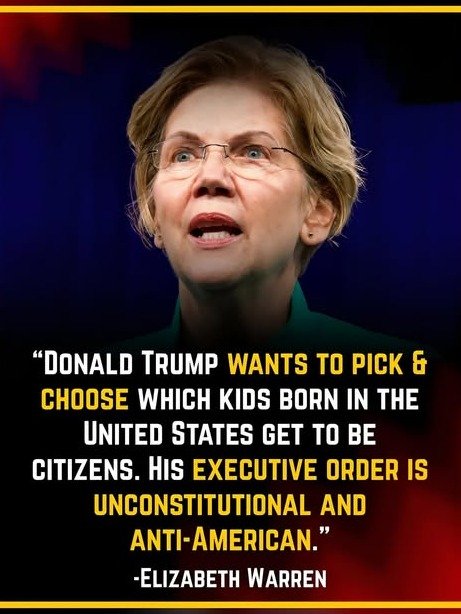
Imagine waking up one day to find the very foundation of American citizenship under threat. It sounds like a plot from a political thriller, but it’s a very real debate currently unfolding at the highest echelons of U.S. power, sparked by a contentious proposal from Donald Trump and a forceful rebuttal from Senator Elizabeth Warren.
This isn’t just another political squabble; it’s a profound challenge to a constitutional principle that has defined American identity for over a century. When Senator Elizabeth Warren recently weighed in on Donald Trump’s controversial ideas regarding birthright citizenship, she didn’t mince words, immediately highlighting the severe legal and constitutional concerns such a move would unleash.
The Core of the Controversy: Trump’s Proposal
At its heart, Donald Trump’s proposal aims to challenge the long-held interpretation of the 14th Amendment, specifically the clause that grants citizenship to anyone born on U.S. soil. His argument posits that this amendment was never intended to apply to the children of undocumented immigrants, often referring to them as “anchor babies” and suggesting that the current system incentivizes illegal immigration.
Trump has indicated a desire to end birthright citizenship, exploring various avenues to achieve this, including executive action or legislative changes. This stance is a cornerstone of his immigration policy platform, appealing to a segment of voters who believe the current system is flawed and easily exploited.
Senator Warren’s Forceful Rebuttal
Senator Elizabeth Warren, a former Harvard Law professor and a prominent voice in the Democratic party, wasted no time in articulating her strong opposition. Drawing on her extensive legal background, Warren emphasized that birthright citizenship is a well-established constitutional principle, deeply embedded in American law and history.
She framed Trump’s proposal not merely as a policy disagreement, but as a direct assault on the Constitution itself. Her comments underscore a crucial point: altering birthright citizenship would require a monumental shift in legal interpretation or a highly unlikely constitutional amendment, far beyond the scope of a presidential executive order.
Understanding the 14th Amendment’s Bedrock
To truly grasp the gravity of this debate, one must look closely at the 14th Amendment of the U.S. Constitution, ratified in 1868 in the aftermath of the Civil War. Section 1 explicitly states:
“All persons born or naturalized in the United States, and subject to the jurisdiction thereof, are citizens of the United States and of the State wherein they reside.”
This language was primarily intended to grant citizenship to newly freed slaves, ensuring their rights and preventing states from denying them. However, its broad wording has been interpreted for over a century to mean that nearly everyone born within U.S. borders is a U.S. citizen, regardless of their parents’ immigration status.
The phrase “subject to the jurisdiction thereof” is often the focal point of debate. Critics of birthright citizenship argue that undocumented immigrants are not fully “subject to the jurisdiction” of the U.S. because they owe allegiance to another country. However, legal scholars and courts have consistently interpreted this phrase to exclude only foreign diplomats and enemy combatants, not those merely residing within the country’s borders.
The Landmark Precedent: United States v. Wong Kim Ark
The legal foundation of birthright citizenship was decisively affirmed by the Supreme Court in the 1898 case of United States v. Wong Kim Ark. Wong Kim Ark was born in San Francisco to Chinese immigrant parents who were not U.S. citizens and could not become naturalized citizens under the discriminatory laws of the time. After a trip to China, he was denied re-entry to the U.S. on the grounds that he was not a citizen.
The Supreme Court ruled overwhelmingly that Wong Kim Ark was, indeed, a U.S. citizen by virtue of his birth on American soil. This landmark decision solidified the interpretation of the 14th Amendment, establishing a clear precedent that has stood for over 120 years. Any attempt to alter birthright citizenship would necessitate either overturning this Supreme Court precedent or amending the Constitution itself.
Legal Hurdles and Executive Overreach
Senator Warren’s concerns are rooted in the immense legal hurdles any attempt to unilaterally end birthright citizenship would face. An executive order, while powerful, cannot override the Constitution. Such an order would immediately be challenged in federal courts, and legal experts widely agree it would likely be struck down as unconstitutional.
Similarly, a simple act of Congress attempting to legislate an end to birthright citizenship would face the same fate, as it would directly contradict the 14th Amendment and established Supreme Court precedent. The only constitutionally sound way to change birthright citizenship would be through a constitutional amendment, a process deliberately made difficult to ensure the stability of the nation’s foundational laws.
The Difficult Path of Constitutional Amendment
Amending the U.S. Constitution is an extraordinarily arduous process, requiring widespread consensus. It demands a two-thirds vote in both the House of Representatives and the Senate, followed by ratification by three-fourths of the states (currently 38 states). Given the deep partisan divisions in the country, achieving such supermajorities for an issue as contentious as birthright citizenship is highly improbable.
This is why Senator Warren and other legal scholars view Trump’s proposals as either legally unsound or politically unrealistic. They argue that floating such ideas without acknowledging the constitutional realities is misleading and potentially dangerous, setting a precedent for executive overreach that could undermine the rule of law.
Potential Ramifications and Societal Impact
Beyond the legal arguments, the implications of ending birthright citizenship are profound and far-reaching. Imagine the administrative nightmare of determining citizenship status for millions of individuals born in the U.S. whose parents were not citizens at the time of their birth. It would create a class of stateless individuals, children born in America but belonging to no nation, leading to immense social and humanitarian challenges.
Such a change could also create a two-tiered society, where individuals born on U.S. soil are treated differently based on their parents’ origins, fundamentally altering the American promise of equality. It could destabilize families, communities, and the very fabric of national identity, leading to widespread legal chaos and social unrest.
A Defining Political and Ideological Battle
The debate over birthright citizenship is more than just a legal discussion; it’s a defining battleground in the ongoing ideological struggle over immigration and national identity. For proponents of ending birthright citizenship, it represents a necessary step to secure borders and discourage illegal immigration. For opponents like Senator Warren, it’s a defense of core constitutional principles and the inclusive spirit of American citizenship.
This issue will undoubtedly remain a potent talking point in future political campaigns, mobilizing voters on both sides of the spectrum. It forces a national conversation about who we are as a country, what our founding documents truly mean, and what future we envision for American society.
What Lies Ahead?
As this debate continues to unfold, the legal and political landscape remains highly charged. While the immediate threat of birthright citizenship being overturned by executive fiat or simple legislation is low due to constitutional protections and judicial precedent, the discussion itself highlights the fragility of established norms when challenged by powerful political figures.
Senator Warren’s outspoken stance serves as a critical reminder that fundamental constitutional rights are not immutable and require vigilant defense. The battle over birthright citizenship is a stark illustration of how deeply entrenched legal principles can become central to modern political discourse, urging every American to understand the stakes involved in this vital constitutional debate.
The Call for Vigilance
Ultimately, the discussion ignited by Donald Trump’s proposals and Senator Warren’s strong opposition underscores the importance of an informed citizenry. Understanding the 14th Amendment, its history, and its legal precedents is crucial for engaging meaningfully with this debate. The future of birthright citizenship, and by extension, the definition of American identity, hangs in the balance, making this an issue that no one can afford to ignore.
About the Author




