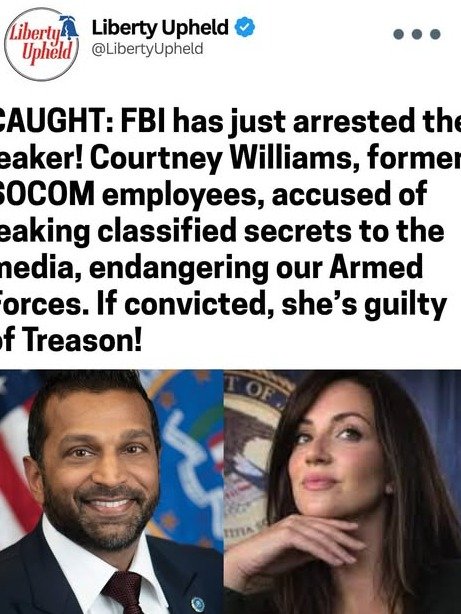
A chilling announcement from the FBI has sent shockwaves through the national security community, igniting urgent questions about the integrity of America’s most sensitive defense secrets. The agency has confirmed the arrest of Courtney Williams, a former staffer with the U.S. Special Operations Command (SOCOM), on grave allegations of leaking classified military intelligence.
This isn’t just about sensitive documents falling into the wrong hands; it’s about the very lives of American service members being placed in immediate, undeniable peril. The charges suggest a profound breach of trust, potentially compromising operations, intelligence sources, and the safety protocols designed to protect our brave men and women overseas.
The Shocking Allegations: Breach of Trust
Courtney Williams, whose role at SOCOM would have granted her access to highly sensitive information, now stands accused of a betrayal that could have catastrophic consequences. While details surrounding the specific classified materials allegedly leaked remain under wraps due to the ongoing investigation, the FBI’s statement underscores the severity of the intelligence compromised.
The allegations point to a deliberate act of sharing vital military secrets with media outlets. This isn’t merely a procedural error; it speaks to a conscious decision to disseminate information that, in the wrong hands, could directly undermine national security and put American troops in harm’s way.
Who Is Courtney Williams and What Was Her Role?
While the public record on Courtney Williams is limited, her former affiliation with SOCOM provides critical context. The U.S. Special Operations Command is a unified combatant command of the U.S. Department of Defense, responsible for overseeing the various special operations components of the Army, Marine Corps, Navy, and Air Force.
Individuals working within SOCOM are entrusted with some of the nation’s most sensitive intelligence, including details on covert operations, advanced military technologies, troop movements, and counter-terrorism strategies. Access to such information comes with immense responsibility and a stringent requirement for discretion and loyalty.
The Peril to American Troops: A Direct Threat
The FBI’s statement specifically highlighted that the alleged leaks directly jeopardized American troops. This isn’t hyperbole; it’s a stark warning. Classified information often includes critical details like operational plans, troop deployment schedules, intelligence-gathering methodologies, and the identities of key personnel or assets.
When such details are exposed, adversaries can exploit them to anticipate movements, compromise missions, or target specific individuals. The lives of soldiers, sailors, airmen, and marines on the ground are quite literally at stake when the shroud of secrecy protecting their operations is lifted without authorization.
Understanding SOCOM’s Mission and Information Security
SOCOM’s mission is inherently clandestine and high-stakes. Its operators conduct some of the most dangerous and sensitive missions globally, often operating in environments where the smallest piece of leaked information can mean the difference between success and catastrophic failure.
Therefore, the security protocols surrounding SOCOM’s information are among the most robust in the entire U.S. government. Every individual with access is subject to extensive background checks, security clearances, and continuous monitoring. The alleged breach by Williams represents a fundamental failure within these layers of protection, or a deliberate circumvention of them.
The Gravity of Leaking Classified Information
Leaking classified information is not just a violation of policy; it is a federal crime, often prosecuted under the Espionage Act. Depending on the nature and sensitivity of the information, and the intent behind its disclosure, penalties can range from significant prison sentences to life imprisonment or even the death penalty in extreme cases of treason.
The legal framework is designed to deter such acts because the consequences for national security and human lives are so profound. The arrest of Williams underscores the government’s unwavering commitment to prosecuting those who compromise the nation’s secrets, regardless of their past affiliations or motivations.
The Ongoing Investigation: Unraveling the Details
The FBI’s investigation into Courtney Williams is likely extensive and far-reaching. Investigators will be working to determine the full scope of the leaks: what specific documents or intelligence were compromised, when these disclosures occurred, to whom they were provided, and what the potential impact on ongoing military operations or intelligence assets might be.
This process often involves digital forensics, interviews with colleagues and contacts, and a meticulous reconstruction of the individual’s activities and communications. The goal is not only to secure a conviction but also to mitigate any further damage caused by the unauthorized disclosures.
A Broader Concern: Insider Threats and National Security
This incident, while specific to Courtney Williams, also highlights the persistent challenge of insider threats to national security. Even with the most advanced cybersecurity and physical security measures, the human element remains a vulnerable point.
Government agencies constantly grapple with the balance between granting necessary access to information for employees to do their jobs and preventing malicious or negligent disclosures. The alleged actions of a former SOCOM staffer serve as a sobering reminder that vigilance against insider threats must be continuous and evolving.
Protecting the Protectors: The Imperative of Secrecy
The very fabric of national security relies on the ability to conduct sensitive operations and gather intelligence in confidence. When that confidence is shattered by leaks, it not only endangers those directly involved but also erodes trust among international partners and within the intelligence community itself.
The imperative to protect classified information is paramount, not for the sake of secrecy itself, but for the safety of our personnel, the effectiveness of our defense, and the stability of global security. The arrest of Courtney Williams is a stark reminder of the immense responsibility carried by those entrusted with America’s most guarded secrets.
What Happens Next?
As the legal process unfolds, more details about the alleged leaks and their potential impact may emerge. Courtney Williams will face the full weight of federal law, and the case will undoubtedly be watched closely by national security experts, military families, and the public.
This incident serves as a critical moment for reflection on the mechanisms designed to protect classified information and the unwavering commitment required from every individual who takes an oath to defend the nation. The safety of American troops depends on it.
About the Author




