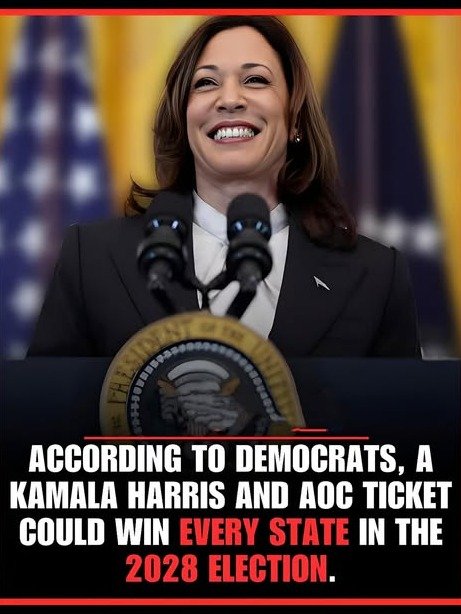
Imagine a political landscape forever changed. Whispers are growing louder within Democratic circles, painting a picture of a potential 2028 presidential ticket so audacious, so groundbreaking, it could either redefine the party’s future or spark an unprecedented internal battle.
This isn’t just idle speculation; it’s a bold idea gaining traction among certain factions of the Democratic Party: a potential pairing of Vice President Kamala Harris and Representative Alexandria Ocasio-Cortez for the 2028 presidential election. Such a ticket would represent a significant shift, combining established experience with a powerful progressive voice.
The Genesis of a ‘Dream Ticket’ Idea
The notion of a Harris-Ocasio-Cortez ticket has emerged from a desire within the Democratic Party to consolidate its diverse base. Supporters envision a ticket that could bridge the gap between the party’s pragmatic center and its energized progressive wing, offering a compelling vision for the future.
This pairing is seen by some as a strategic move to unite different generations and ideologies under a common banner. It promises to deliver a ticket that is not only historically significant but also deeply representative of the party’s evolving demographics and policy priorities.
Kamala Harris: The Experienced Standard-Bearer
Kamala Harris brings a wealth of experience to any potential presidential bid. As the current Vice President, she has served at the highest levels of government, gaining invaluable insight into national and international policy. Her tenure has provided her with direct exposure to the complexities of the executive branch and a platform to articulate the Biden-Harris administration’s vision.
Prior to her vice presidency, Harris served as a U.S. Senator for California and as the state’s Attorney General. This extensive background in both legislative and executive roles, at both state and federal levels, positions her as a seasoned politician ready to lead. Her policy positions often reflect a more centrist approach, appealing to moderate Democrats and independent voters.
Alexandria Ocasio-Cortez: The Progressive Firebrand
On the other side of this intriguing equation is Alexandria Ocasio-Cortez, a figure who has rapidly ascended to national prominence since her election to Congress in 2018. She represents the vibrant, progressive wing of the Democratic Party, advocating for bold policies on climate change, economic inequality, and social justice.
Ocasio-Cortez’s appeal lies in her authenticity, her powerful communication skills, and her ability to mobilize a passionate base, particularly among younger voters and progressives. She has become a leading voice for a new generation of political activists, unafraid to challenge the status quo and push for transformative change.
A Study in Complementary Strengths
The allure of a Harris-Ocasio-Cortez ticket lies in its potential for complementary strengths. Harris offers gravitas, executive experience, and a connection to the party’s establishment. Ocasio-Cortez brings youthful energy, a strong progressive platform, and an undeniable ability to galvanize grassroots support.
This combination could theoretically create a formidable electoral force. Harris could reassure more cautious voters and institutional donors, while Ocasio-Cortez could ignite enthusiasm among the party’s base, drawing in new voters and volunteers who might otherwise feel disengaged.
Bridging the Ideological Divide
One of the primary arguments for this ticket is its potential to bridge the ideological chasm within the Democratic Party. For years, the party has grappled with the tension between its moderate and progressive factions. A Harris-Ocasio-Cortez ticket could symbolize a unified front, demonstrating that both wings can work together towards common goals.
This unity could be crucial in a general election, where maximizing voter turnout across the entire spectrum of Democratic voters is paramount. The ticket would send a powerful message that the party is broad enough to encompass diverse viewpoints while remaining focused on shared values.
Potential Challenges and Criticisms
However, the idea is not without its significant challenges and criticisms. A major concern revolves around the ideological differences between the two women. While both are Democrats, their policy approaches and political styles often diverge. Harris has a more pragmatic, incremental approach, while Ocasio-Cortez advocates for more radical, systemic change.
Can these differences be effectively reconciled on a single ticket, or would they lead to internal friction and confusion among voters? Critics might argue that such a pairing could appear inconsistent, failing to offer a clear, unified vision for the country.
Electability in a General Election
Another pressing question is the electability of such a ticket in a general election. While a Harris-Ocasio-Cortez pairing might energize the Democratic base, some strategists worry that it could be perceived as ‘too progressive’ by swing voters in crucial battleground states. The Republican opposition would undoubtedly attempt to paint the ticket as extreme, focusing on Ocasio-Cortez’s more left-leaning positions.
Winning a national election requires appealing to a broad coalition of voters, including independents and disaffected Republicans. The challenge for this ticket would be to maintain its progressive appeal while also demonstrating a capacity for mainstream governance and broad electability.
Age and Experience Dynamics
While Kamala Harris has extensive experience, Ocasio-Cortez, despite her impact, is still relatively new to national politics in the context of a presidential ticket. Concerns might arise about the perceived lack of traditional executive experience for a Vice Presidential nominee, especially from those who prefer a more seasoned hand in government.
However, supporters counter that Ocasio-Cortez’s grassroots organizing skills and ability to connect directly with voters represent a different, equally valuable form of political experience, essential for modern campaigning and governance.
Identity and Representation
Both Harris and Ocasio-Cortez are women of color, representing a significant demographic shift in American politics. A ticket featuring two women of color would be historically unprecedented and could inspire millions. It would send a powerful message about inclusion and opportunity.
Yet, some political observers caution against over-reliance on identity politics, suggesting that while representation is vital, a ticket’s ultimate success hinges on its policy platform and perceived ability to govern effectively for all Americans, regardless of background.
Fundraising and Coalition Building
Effective fundraising is crucial for any presidential campaign. Both Harris and Ocasio-Cortez have demonstrated significant fundraising capabilities within their respective political spheres. Harris can tap into established party networks and corporate donors, while Ocasio-Cortez excels at small-dollar, grassroots fundraising.
The question becomes whether their fundraising machines can seamlessly integrate and amplify each other. A successful collaboration could lead to an incredibly well-funded campaign, capable of competing with any opponent.
The Future of the Democratic Party
The very discussion of a Harris-Ocasio-Cortez ticket reflects a broader introspection within the Democratic Party about its future direction. As older leaders eventually step aside, there is an urgent need to cultivate and elevate the next generation of leadership.
This potential pairing symbolizes a bold attempt to define what the Democratic Party stands for in the 21st century: a party that values both experience and innovation, stability and progress, and aims to represent the full diversity of the American populace.
Public Reception and Media Buzz
The mere circulation of this idea has already generated significant media buzz and public debate. Social media platforms are alight with discussions, polls, and predictions about the viability and implications of such a ticket. It captures the imagination precisely because it challenges conventional political wisdom.
Whether this idea moves beyond the realm of speculation into concrete action remains to be seen. However, its current prominence underscores a deep desire within the Democratic base for a ticket that is both inspiring and capable of winning.
Conclusion: A Bold Vision, A High-Stakes Gamble
A potential Kamala Harris and Alexandria Ocasio-Cortez 2028 presidential ticket is undeniably a bold vision for the Democratic Party’s future. It offers the tantalizing prospect of uniting diverse factions, energizing the base, and presenting a historically significant and representative ticket to the American people.
However, it also represents a high-stakes gamble, fraught with challenges related to ideological alignment, electability, and the delicate balance between experience and fresh perspectives. As 2028 draws closer, the debate around this audacious pairing will only intensify, shaping the conversation about who will lead the Democrats – and potentially the nation – into the next decade.
About the Author




