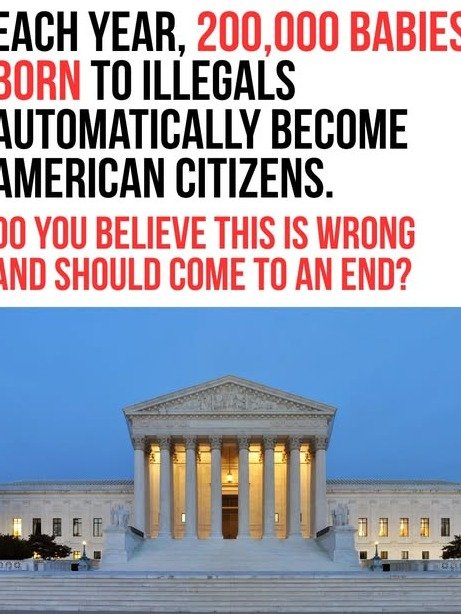
For over 150 years, a simple, powerful truth has defined American identity: if you’re born on U.S. soil, you are an American citizen. It’s a principle so deeply ingrained, most of us never question it. But what if this bedrock of our nation is under siege, its future hanging precariously in the balance?
The battle over birthright citizenship, once a niche legal debate, has exploded into a full-blown national crisis. It’s no longer just about a constitutional clause; it’s a profound argument about who we are as a nation, how we secure our borders, and the very essence of American identity. This isn’t just a political skirmish; it’s a quiet war with implications for every single person who calls this country home.
The Bedrock of Citizenship: Understanding the 14th Amendment
At the heart of this contentious debate lies the 14th Amendment to the U.S. Constitution, ratified in 1868 in the aftermath of the Civil War. Its primary purpose was to grant citizenship and equal protection under the law to formerly enslaved people. The key phrase, often cited, states:
“All persons born or naturalized in the United States and subject to the jurisdiction thereof, are citizens of the United States and of the State wherein they reside.”
For generations, this clause has been broadly interpreted to mean that virtually anyone born within U.S. borders is automatically a citizen, regardless of their parents’ immigration status. This principle, known as jus soli (right of the soil), is a cornerstone of American law and a distinct feature compared to many other nations that primarily follow jus sanguinis (right of blood), where citizenship is inherited from parents.
A Clause Under Scrutiny: “Subject to the Jurisdiction Thereof”
While the intent to grant citizenship to freed slaves is clear, the specific wording, particularly the phrase “subject to the jurisdiction thereof,” has become the focal point of modern legal and political challenges. Proponents of a reinterpretation argue that this phrase was not intended to apply to children born to parents who are not lawful residents or who do not owe full allegiance to the United States.
They contend that “subject to the jurisdiction thereof” implies a complete and exclusive political allegiance, which undocumented immigrants, and by extension, their children, do not fully possess. This nuanced reading suggests that the framers never intended for the amendment to grant automatic citizenship to the children of foreign nationals who might be temporarily or illegally present in the country.
The “Anchor Baby” Debate: A Modern Flashpoint
The term “anchor baby,” though highly controversial and often deemed derogatory, reflects a core concern among those advocating for change. The argument is that birthright citizenship incentivizes illegal immigration, as parents may seek to enter the U.S. specifically to have children who will then be granted citizenship, potentially enabling their families to remain in the country through future sponsorship.
Critics argue that this creates a loophole in immigration law, undermining border security and national sovereignty. They point to the perceived strain on social services, schools, and healthcare systems in communities along the border and beyond, attributing some of these pressures to the current interpretation of birthright citizenship.
Defending Birthright: Arguments for the Status Quo
Despite the growing opposition, strong arguments exist for maintaining the current interpretation of birthright citizenship. Supporters emphasize the plain text reading of the 14th Amendment, arguing that its language is unambiguous and historically affirmed by Supreme Court precedent, particularly the 1898 case of United States v. Wong Kim Ark.
Furthermore, advocates highlight the practical and moral implications of changing the law:
- Preventing a Stateless Underclass: Without birthright citizenship, children born in the U.S. to non-citizen parents could become stateless, lacking legal recognition or rights in any country. This could create a permanent underclass, vulnerable to exploitation and social instability.
- Administrative Simplicity: The current system is straightforward and avoids complex investigations into parents’ legal status at the time of birth, which would be a bureaucratic nightmare.
- Promoting Assimilation: Children granted citizenship at birth are more likely to integrate fully into American society, contributing economically and culturally, rather than living in the shadows.
- Historical Precedent: The principle has stood for over a century and a half, becoming a fundamental aspect of American identity and the rule of law.
Challenging Birthright: Arguments for Reinterpretation or Change
Those who advocate for reinterpreting or changing birthright citizenship often cite concerns about national sovereignty and border control. They argue that the U.S. is one of only a handful of developed nations that still grants unconditional birthright citizenship, while many others, including most of Europe, have moved towards more restrictive models.
Their arguments often include:
- Sovereignty and Control: A nation should have the right to determine who its citizens are, rather than having it be an automatic consequence of physical presence, especially if that presence is unlawful.
- Deterring Illegal Immigration: Changing the policy could remove a significant incentive for individuals to cross the border without authorization.
- Aligning with Global Norms: Moving away from unconditional jus soli would bring the U.S. more in line with the citizenship laws of many other developed countries.
- Original Intent: A belief that the framers of the 14th Amendment never intended for it to apply to the children of foreign nationals not subject to the full political jurisdiction of the U.S.
Beyond the Law: Birthright Citizenship and National Security
The debate over birthright citizenship extends far beyond legal texts; it’s deeply intertwined with discussions about border security and national safety. Opponents of the current system argue that unchecked birthright citizenship complicates efforts to control national borders and track populations, potentially posing security risks.
They suggest that the ability for individuals to gain citizenship simply by being born on U.S. soil, regardless of parental background or allegiance, undermines the integrity of the nation’s immigration system. This perspective often highlights the challenges faced by border patrol and immigration enforcement agencies in managing large-scale migration and ensuring national security.
Redefining “American”: The Identity Crisis
Perhaps the most profound aspect of this battle is its impact on national identity. What does it truly mean to be an American? Is it simply a matter of geography, or does it require a deeper connection to the nation’s laws, values, and culture? The debate forces us to confront these fundamental questions.
For many, birthright citizenship embodies the American ideal of opportunity and inclusion, a testament to a nation built by immigrants. For others, it represents a dilution of national identity, a system that grants citizenship without requiring a reciprocal commitment or understanding of American principles. This clash of visions speaks to a broader cultural divide about the future direction of the United States.
The Constitutional Crossroads: Originalism vs. Living Constitution
The legal arguments surrounding the 14th Amendment often pivot on contrasting philosophies of constitutional law. Advocates for reinterpretation frequently employ an originalist approach, asserting that the Constitution should be interpreted based on the original intent of its framers.
Conversely, defenders of the current system often lean on a living constitution philosophy, arguing that the Constitution is a dynamic document whose principles should be applied in light of contemporary societal values and evolving circumstances. This philosophical divide makes any resolution incredibly challenging, as both sides believe they are upholding the true spirit of the Constitution.
Paths Forward: Executive Action, Legislation, or Amendment?
Given the entrenched positions, how might this debate be resolved? Several pathways have been proposed, each fraught with its own complexities:
- Executive Order: Some argue that a president could issue an executive order to clarify or reinterpret the “subject to the jurisdiction thereof” clause. However, the legal authority for such an order would be immediately challenged in courts.
- Legislative Action: Congress could pass a law to define the scope of birthright citizenship more narrowly. This would undoubtedly face a presidential veto or be challenged in the Supreme Court for potentially violating the 14th Amendment.
- Constitutional Amendment: The most definitive, but also the most difficult, path would be to propose and ratify a new constitutional amendment to explicitly redefine birthright citizenship. This process requires a two-thirds vote in both houses of Congress and ratification by three-fourths of the states, making it an extremely high bar.
Each of these options would ignite an even fiercer legal and political firestorm, highlighting the profound difficulty in altering such a foundational aspect of American law.
Conclusion: The Stakes of a Nation Divided
The fight over birthright citizenship is far more than a legal squabble; it’s a defining moment for America. It encapsulates our deepest anxieties about borders, our evolving sense of national identity, and the very interpretation of our foundational document. The outcome of this battle will not only shape immigration policy but will fundamentally alter the fabric of American society for generations to come.
As the debate rages, every American is called to consider what citizenship truly means, what kind of nation we aspire to be, and how we will uphold the principles that define us. The future of the 14th Amendment, and with it, the future of American identity, hangs in the balance, demanding our urgent attention and thoughtful consideration.
About the Author




