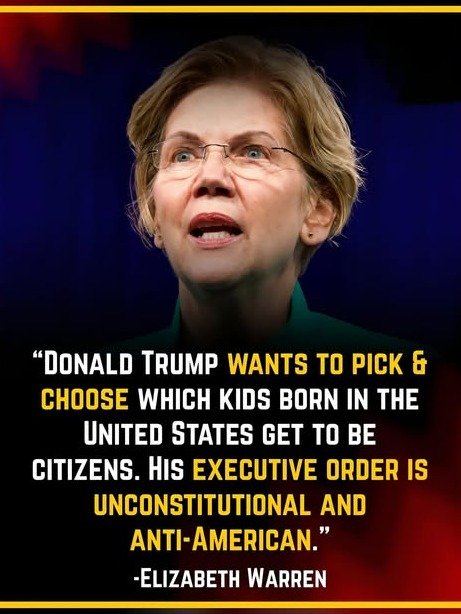
Imagine a world where your very citizenship, simply by being born on American soil, is suddenly up for debate. This isn’t a dystopian novel; it’s the heart of a heated constitutional battle currently unfolding in American politics. A significant proposal by former President Donald Trump to end birthright citizenship has ignited a firestorm, drawing immediate and forceful condemnation from prominent figures like Senator Elizabeth Warren.
This isn’t just another political squabble; it’s a fundamental challenge to a cornerstone of American law and identity. Senator Warren, a former Harvard Law professor and a leading voice on constitutional matters, wasted no time in highlighting the profound legal and constitutional concerns surrounding Trump’s audacious idea. Her comments have brought into sharp focus a debate that could redefine who is, and isn’t, an American citizen.
The Core of the Controversy: Birthright Citizenship and the 14th Amendment
At the very heart of this contentious debate lies the 14th Amendment to the United States Constitution. Ratified in 1868 in the aftermath of the Civil War, its Citizenship Clause explicitly states:
“All persons born or naturalized in the United States and subject to the jurisdiction thereof, are citizens of the United States and of the State wherein they reside.”
This seemingly straightforward sentence has been the bedrock of birthright citizenship for over a century and a half.
This clause was primarily intended to grant citizenship to formerly enslaved people, ensuring they could not be denied their rights. For generations, it has been widely interpreted by legal scholars and courts to mean that nearly anyone born on U.S. soil is automatically a citizen, regardless of their parents’ immigration status. It’s a principle that has provided stability and clarity to millions of Americans.
Trump’s Bold Proposal: Rewriting the Rules?
Former President Donald Trump has long expressed a desire to end birthright citizenship, framing it as an incentive for illegal immigration and a strain on national resources. His recent proposal suggested that he could unilaterally alter this fundamental right through an executive order, bypassing the lengthy and complex process of amending the Constitution.
Trump’s argument often centers on the phrase “subject to the jurisdiction thereof,” contending that children of undocumented immigrants are not truly subject to U.S. jurisdiction in the same way citizens or legal residents are. This interpretation, however, stands in stark contrast to prevailing legal understanding and historical precedent, which views “subject to the jurisdiction” as excluding only foreign diplomats and invading armies, not individuals merely present within U.S. borders.
Senator Warren’s Fiery Rebuttal: A Constitutional Showdown
Senator Elizabeth Warren’s response was swift and unequivocal. Drawing on her extensive background in constitutional law, she emphatically stated that birthright citizenship is unequivocally protected by the 14th Amendment and cannot be undone by presidential fiat. Her comments underscored the gravity of attempting to dismantle such a fundamental constitutional guarantee through executive action.
Warren highlighted that changing the Constitution requires a specific, rigorous process involving both Congress and the states, not merely the stroke of a president’s pen. She argued that any attempt to do so would be a direct assault on the Constitution itself and would be immediately challenged and ultimately struck down by the courts.
“The 14th Amendment is crystal clear,” Warren asserted. “You cannot simply wave a magic wand and make it disappear. This isn’t just bad policy; it’s unconstitutional and an attack on the rule of law.”
Her strong stance reflects a broad consensus among constitutional scholars that an executive order lacks the legal authority to override an amendment to the U.S. Constitution.
The Legal Battleground: Executive Order vs. Constitution
The notion that a president could end birthright citizenship via executive order faces insurmountable legal hurdles. The U.S. Constitution provides two primary methods for amendment: a two-thirds vote in both the House and Senate, followed by ratification by three-fourths of the states; or a constitutional convention called for by two-thirds of the state legislatures. Neither of these avenues involves presidential executive action.
Legal experts across the political spectrum largely agree that an executive order cannot unilaterally modify the Constitution. Such an action would fundamentally undermine the separation of powers and the very framework of American governance. It would set a dangerous precedent, implying that a president could disregard any part of the Constitution they found inconvenient.
A Century of Precedent: United States v. Wong Kim Ark
The legal foundation of birthright citizenship was firmly established by the Supreme Court in the landmark 1898 case, United States v. Wong Kim Ark. In this case, the Court ruled that a child born in the United States to parents who were Chinese immigrants, and who were not citizens themselves, was indeed a U.S. citizen under the 14th Amendment.
This ruling has served as the definitive interpretation of the Citizenship Clause for over 120 years, solidifying the principle that nearly all individuals born within the nation’s borders are citizens. Overturning or circumventing this precedent would require a monumental shift in legal interpretation, most likely by the Supreme Court itself, and certainly not through an executive order.
Why This Matters: The Stability of Citizenship
Birthright citizenship offers several critical advantages that are often overlooked in the heat of political debate. It provides:
- Clarity and Simplicity: It offers a clear, objective rule for citizenship, avoiding complex and potentially discriminatory inquiries into parentage or lineage.
- Prevention of Statelessness: Without birthright citizenship, many children born in the U.S. to non-citizen parents could become stateless, lacking legal recognition or rights in any country.
- Social Cohesion: It promotes integration by ensuring that children raised in the U.S. are fully part of American society, rather than being a perpetual underclass.
- Historical Consistency: It upholds a long-standing tradition that has defined American identity for generations.
Dismantling this principle would introduce immense legal uncertainty, complicate immigration processes, and potentially create a large population of individuals living within the U.S. but without full rights or belonging.
The “Anchor Baby” Argument: A Closer Look
Opponents of birthright citizenship often raise concerns about “anchor babies,” arguing that it incentivizes undocumented immigrants to enter the country solely to have children who can then sponsor family members for legal residency. This term, considered pejorative by many, fuels the argument that birthright citizenship is exploited and contributes to unchecked immigration.
While the debate around immigration policy is complex and multifaceted, many legal and social scientists question the actual impact of birthright citizenship as a primary driver for illegal immigration. They point to economic factors, family reunification, and political instability in home countries as more significant motivators. Furthermore, the legal path for a child to sponsor parents is a long and arduous one, often taking decades, making the “anchor baby” argument less impactful than often portrayed.
Upholding American Values: A Question of Principle
For Senator Warren and other proponents of birthright citizenship, the debate extends beyond legal technicalities to fundamental American values. They argue that the principle of birthright citizenship embodies the nation’s commitment to equality, opportunity, and the idea that all individuals, regardless of their origins, have a chance to build a life here.
Undermining the 14th Amendment would not only be a legal misstep but also a departure from the inclusive ideals that have historically defined America. It would create a two-tiered system of citizenship, potentially leading to discrimination and social instability, and challenging the very notion of what it means to be born an American.
The Road Ahead: What’s Next for This Debate?
The discussion around birthright citizenship is far from over. It remains a potent political issue, frequently resurfacing during election cycles and policy debates. While the legal consensus is strong that birthright citizenship cannot be ended by executive order, the political rhetoric surrounding it continues to resonate with certain segments of the population.
Future challenges to birthright citizenship would likely involve more extensive legal battles, potentially reaching the Supreme Court, or a concerted effort to amend the Constitution itself—a process that is historically rare and incredibly difficult. Until then, the 14th Amendment stands as a formidable guardian of this fundamental right.
As this critical debate continues, it’s essential for citizens to understand the constitutional principles at stake and the profound implications any changes could have on the fabric of American society. Senator Warren’s vocal opposition serves as a powerful reminder that some constitutional rights are not merely suggestions but foundational pillars of our democracy, fiercely defended against any attempts to erode them.
About the Author




