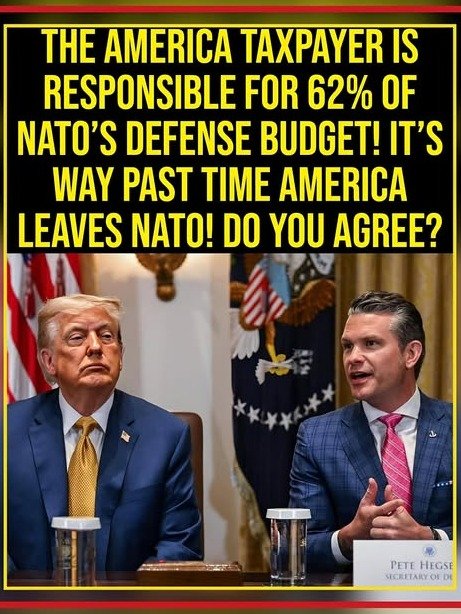
Has the United States been shouldering too much of the world’s defense burden for too long? This burning question has been thrust back into the spotlight, igniting a fierce debate that could redefine global alliances and security. Thanks to recent comments from prominent voices like Pete Hegseth, the long-standing discussion about America’s role in NATO and the equitable sharing of defense responsibilities among member countries is now impossible to ignore.
Hegseth’s remarks have resonated with many who believe it’s time for a significant recalibration of responsibilities within the North Atlantic Treaty Organization. This isn’t just about money; it’s about strategic priorities, national sovereignty, and the very future of collective security. The conversation is complex, touching on historical commitments, evolving geopolitical landscapes, and the economic realities faced by both the U.S. and its allies.
The Enduring Debate: America’s Outsized Role in NATO
For decades, the United States has been the undisputed cornerstone of NATO, a military alliance forged in the crucible of the Cold War to counter Soviet expansion. America’s commitment has been unwavering, providing the lion’s share of military might, technological superiority, and financial backing. This formidable presence has ensured peace and stability across Europe, but it has also fostered a perception among some that European allies have become overly reliant on American protection.
Pete Hegseth’s perspective, echoing sentiments from various political figures, suggests that this imbalance is no longer sustainable or fair. The argument posits that the U.S. is diverting vast resources to defend prosperous European nations, resources that could otherwise be invested domestically or used to address other pressing national interests. This viewpoint challenges the traditional narrative of indispensable American leadership, urging a more equitable distribution of defense costs and capabilities.
The 2% Rule: A Benchmark Often Missed
At the heart of the burden-sharing debate is NATO’s defense spending guideline: member countries are expected to allocate at least 2% of their Gross Domestic Product (GDP) to defense. This target, reaffirmed in 2014, is designed to ensure that all allies contribute adequately to the collective security of the alliance. However, consistently, a significant number of NATO members have fallen short of this benchmark, leading to ongoing frustration in Washington.
Critics point out that while the U.S. consistently exceeds the 3% mark, and often significantly more, many European nations hover well below 2%. This disparity fuels the argument that the U.S. is subsidizing the defense of countries capable of doing more for themselves. The implications extend beyond mere economics; it raises questions about commitment, strategic autonomy, and the long-term viability of the alliance if key members aren’t pulling their weight.
Why the 2% Target Matters (and Why It’s Missed)
Meeting the 2% GDP target is not merely an arbitrary financial goal; it represents a commitment to maintaining robust defense capabilities necessary for collective deterrence and response. Adequate investment in military readiness, modern equipment, and personnel ensures that NATO can effectively address threats ranging from conventional warfare to cyberattacks and terrorism. When allies fail to meet this target, it can create capability gaps and place an increased strain on those who do contribute adequately.
However, the reasons for missing the 2% target are multifaceted. Some European economies have faced periods of slow growth, making increased defense spending a tough political sell when public services like healthcare and education are also demanding resources. Others have historically relied on the sheer scale of U.S. military power, leading to a diminished sense of urgency regarding their own defense investments. Furthermore, differing perceptions of immediate threats among member states can influence national defense priorities.
“The idea that America must forever be the world’s policeman, footing the bill for allies who can afford to do more, is becoming increasingly untenable,” Hegseth has implied through his commentary. “It’s not about abandoning our allies, but about demanding shared responsibility for shared security.”
Arguments for Reducing U.S. Commitment
The push for a reduced U.S. defense commitment within NATO is rooted in several key arguments. Firstly, proponents often cite an “America First” perspective, advocating for a reallocation of resources to domestic challenges such as infrastructure, healthcare, or education. They contend that American taxpayers should not bear the primary financial burden for European security when those nations possess significant economic power themselves.
Secondly, there’s the strategic argument that a more self-reliant Europe would be a stronger, more capable partner, rather than a dependent one. By compelling European allies to invest more in their own defense, the U.S. could encourage the development of robust, independent military capabilities across the continent. This could, in theory, free up U.S. forces to focus on other global hotspots or emerging threats in regions like the Indo-Pacific.
Finally, some argue that the geopolitical landscape has fundamentally shifted since NATO’s inception. While Russia remains a concern, the existential threat of the Cold War era has evolved. They suggest that European nations, with their combined economic might, are more than capable of managing regional security challenges without such a dominant U.S. military presence.
The Counter-Argument: Why NATO Remains Critical
Despite the calls for recalibration, a strong contingent of foreign policy experts and political leaders firmly believes that NATO, with a robust U.S. commitment, remains absolutely vital for both American and global security. They argue that the alliance is not merely a collection of individual defense budgets but a powerful collective security mechanism that deters aggression and promotes stability.
The principle of collective defense, enshrined in Article 5 of the NATO treaty, states that an attack on one member is an attack on all. This mutual defense pact prevents potential adversaries from targeting individual countries, knowing they would face the full force of the alliance. Weakening the U.S. commitment could undermine this deterrence, potentially inviting aggression and destabilizing the European continent, which has historically been a flashpoint for global conflicts.
Furthermore, NATO serves as a critical platform for intelligence sharing, coordinated military exercises, and diplomatic cooperation. These functions are invaluable for addressing transnational threats like terrorism, cyber warfare, and the proliferation of weapons of mass destruction. A diminished U.S. role could fragment these efforts, making it harder to respond effectively to complex global challenges that ultimately impact American interests.
Historical Context and Evolving Threats
NATO’s adaptability has been one of its greatest strengths. Born out of the Cold War to contain the Soviet Union, the alliance successfully navigated the post-Cold War era, expanding its membership and engaging in out-of-area operations in places like Afghanistan. Today, the threats are more diverse and insidious, including hybrid warfare, disinformation campaigns, and the rising assertiveness of revisionist powers.
In this complex environment, the synergy provided by NATO is arguably more crucial than ever. The combined resources, expertise, and political will of its members offer a comprehensive defense against threats that no single nation, not even the United States, could effectively tackle alone. A unified front, backed by U.S. leadership and capabilities, sends a clear message to potential adversaries and reassures allies.
Potential Repercussions of a U.S. Withdrawal/Reduction
The implications of a significant reduction or withdrawal of U.S. involvement in NATO would be profound and far-reaching. Such a move could create a dangerous power vacuum in Europe, potentially leading to increased instability and renewed geopolitical rivalries. European nations might be forced to rapidly rearm and develop independent defense structures, a process that could be costly, divisive, and ultimately less effective than the current collective model.
Moreover, it could severely damage the global network of alliances that the U.S. has carefully built over decades. If allies perceive that America is no longer a reliable partner, it could encourage other nations to distance themselves, weakening democratic solidarity and potentially emboldening authoritarian regimes worldwide. The economic consequences, including disruptions to trade and investment, could also be significant, impacting U.S. prosperity.
Finding a Path Forward: Shared Responsibility
The debate sparked by Pete Hegseth and others is not simply about whether the U.S. should stay or go, but rather how to ensure NATO remains a strong, effective alliance in the 21st century. The path forward likely involves a nuanced approach that emphasizes shared responsibility without undermining collective security. This means continued pressure on allies to meet their 2% defense spending commitments, coupled with open dialogue and strategic planning.
Encouraging European nations to invest more in their own defense, develop specialized capabilities, and take on greater leadership roles within the alliance is crucial. This doesn’t necessitate a complete U.S. withdrawal but rather a rebalancing of contributions and responsibilities. Diplomacy and negotiation, rather than unilateral action, will be key to fostering a stronger, more equitable partnership that benefits all members.
Conclusion: A Debate with Global Stakes
The discussion ignited by Pete Hegseth about America’s role in NATO is more than just political punditry; it’s a critical examination of an alliance that has safeguarded peace for over 70 years. The questions it raises about burden-sharing, strategic priorities, and the future of collective security demand serious consideration from policymakers and citizens alike. While the desire for a more equitable distribution of defense responsibilities is understandable, the potential ramifications of altering such a foundational alliance are immense.
Ultimately, the challenge lies in finding a balance: ensuring that all allies contribute fairly to their common defense while preserving the invaluable strategic advantages and deterrent power that NATO, with a strong U.S. commitment, provides. The stakes are global, and the outcome of this debate will undoubtedly shape the international order for decades to come.
About the Author




