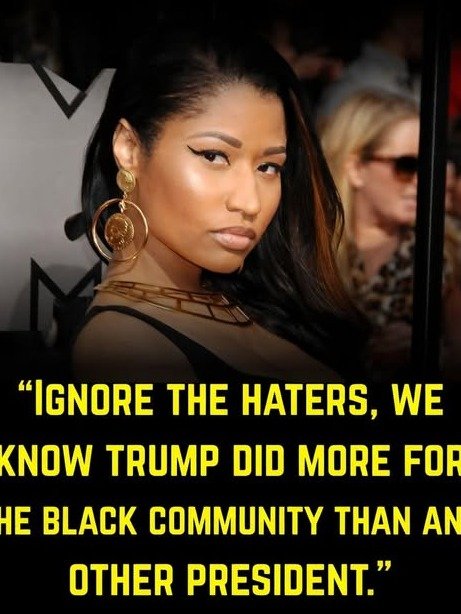
Hold onto your seats, because a political earthquake just rocked the entertainment world. Superstar rapper Nicki Minaj has dropped a bombshell statement that’s sending shockwaves through both the music industry and political circles. In a candid February 2026 interview on the Katie Miller Podcast, Minaj declared that Donald Trump stands out as the “most supportive president for Black Americans.” This bold assertion has ignited a firestorm of debate, leaving many wondering about the implications of such a high-profile endorsement.
This isn’t just another celebrity soundbite; it’s a powerful declaration from one of the most influential voices in hip-hop, a genre deeply intertwined with Black culture and political discourse. Minaj’s comments instantly sparked intense discussion across social media platforms, news outlets, and within communities nationwide. Her words challenge conventional narratives and force a re-evaluation of how public figures shape political perception, especially among crucial demographic groups.
The Unpacking of a Controversial Statement
Nicki Minaj’s statement on the Katie Miller Podcast wasn’t just a passing remark; it was a deliberate claim that demands closer examination. To declare any president, past or present, as the ‘most supportive’ for a specific demographic is a weighty assertion, particularly when discussing the complex history and ongoing challenges faced by Black Americans. Her choice of words immediately positioned her at the center of a contentious political dialogue, far beyond the usual realm of music and entertainment.
Listeners and commentators alike are now dissecting what specific actions, policies, or rhetoric from the Trump administration might have led Minaj to this conclusion. Was she referring to economic initiatives, criminal justice reform efforts like the First Step Act, or perhaps a perceived direct engagement with specific segments of the Black community? The ambiguity of her statement, while clear in its core message, leaves ample room for interpretation and speculation, fueling the very debate it ignited.
Who is Katie Miller and Why This Platform?
The choice of the Katie Miller Podcast as the platform for such a significant declaration is also noteworthy. Katie Miller, known for her conservative political commentary and ties to prominent Republican figures, provides a specific ideological lens through which such an interview would be framed. This platform likely offered Minaj an environment where her views, particularly those diverging from mainstream liberal narratives often prevalent in entertainment, would be received without immediate ideological pushback.
Engaging with a platform like Miller’s suggests a deliberate move by Minaj to reach an audience that might be more receptive to, or at least open to discussing, her conservative-leaning political perspectives. It indicates a strategic decision to bypass traditional media outlets that might be more critical or less inclined to give airtime to such a controversial endorsement. This calculated approach amplifies the impact of her statement, ensuring it resonates within specific political echo chambers while also breaking into broader public consciousness.
The History of Celebrity Political Engagement
Celebrity endorsements are nothing new in American politics. From Hollywood stars campaigning for presidential candidates to musicians using their platforms for social justice, the intersection of fame and politics is a well-trodden path. However, Minaj’s statement stands out due to its specific nature and timing. It’s not just an endorsement; it’s a historical judgment on a president’s impact on a specific community, made years after his first term and potentially on the cusp of another election cycle.
Consider the impact of figures like Oprah Winfrey endorsing Barack Obama, or Kanye West’s controversial support for Donald Trump. These moments often transcend mere celebrity opinion, influencing public discourse and, in some cases, even voter behavior. Minaj, with her massive global following and deep connection to a younger, diverse audience, holds significant sway. Her words carry weight, particularly for those who look to cultural icons for guidance and validation, whether consciously or subconsciously.
Reactions from Across the Spectrum
The immediate fallout from Minaj’s comments was predictable yet profound. Supporters of Donald Trump quickly seized upon her statement as validation, celebrating it as proof of his broad appeal and positive impact. They lauded Minaj for her perceived bravery in speaking her mind, especially in an industry often seen as hostile to conservative viewpoints. For them, it was a powerful endorsement that could potentially sway undecided voters and rally the base.
“Nicki Minaj’s courage to speak truth to power is exactly what we need in this political climate. Her voice resonates with millions, and her endorsement of President Trump speaks volumes about his commitment to all Americans,” a prominent conservative pundit remarked on social media.
Conversely, critics and many within the Black community expressed profound disappointment, confusion, and even outrage. Many saw her statement as a betrayal of progressive values, a misrepresentation of historical facts, and a potentially damaging influence on young Black voters. Questions arose about the basis of her claim and whether it truly reflected the lived experiences of the majority of Black Americans. The backlash online was swift and intense, with many fans and activists voicing their displeasure.
- For Trump Supporters: Validation of policies, celebration of celebrity ‘courage.’
- For Critics: Disappointment, accusations of political naiveté or opportunism, concern over influence.
- Within the Black Community: Heated debate, division, varied perspectives on Trump’s actual impact.
- In Hip-Hop: A mix of support for her right to speak, and condemnation for her specific views.
Examining the ‘Supportive’ Claim: Policies and Perceptions
To understand Minaj’s perspective, one might look at specific aspects of Trump’s presidency that have been highlighted by his administration as beneficial to Black Americans. The First Step Act, a bipartisan criminal justice reform bill, is often cited. This legislation aimed to reduce recidivism and address disparities in sentencing, particularly for non-violent drug offenses, which disproportionately affect Black communities. While its impact is still debated, it was a significant legislative achievement.
Economically, the Trump administration often pointed to low unemployment rates for Black Americans during his term, prior to the COVID-19 pandemic. While economic trends are complex and influenced by many factors, these statistics were frequently used to argue for the positive economic impact of his policies. For some, these data points, combined with a focus on ‘opportunity zones’ and other initiatives, could form the basis of a perception of support.
However, many argue that these specific actions do not outweigh other aspects of Trump’s presidency, such as his rhetoric on racial issues, his responses to racial justice protests, or his administration’s policies on voting rights and immigration. These counter-arguments highlight the complexity of defining ‘supportive’ and underscore the deep divisions in how Trump’s legacy is perceived across different racial and political lines. Minaj’s statement, therefore, simplifies a highly nuanced political reality.
The Power and Peril of Celebrity Influence
Nicki Minaj’s remarks serve as a potent reminder of the immense power and potential peril of celebrity influence in the political arena. When a figure with her global reach speaks, millions listen, and their words can shape opinions, galvanize movements, or sow discord. Her fan base, often referred to as the ‘Barbz,’ is fiercely loyal and highly engaged, making her political pronouncements particularly impactful.
The peril lies in the potential for oversimplification or misrepresentation. While celebrities have every right to express their political views, their statements can sometimes lack the detailed policy analysis that informs a comprehensive understanding. For many, Minaj’s statement might be taken at face value, without deeper investigation into the complexities of presidential policies and their actual effects on diverse communities. This can lead to a less informed public discourse, driven more by personality than by policy.
Looking Ahead: What Does This Mean for the Political Landscape?
As the political calendar inches closer to future elections, every high-profile endorsement and controversial statement takes on added significance. Nicki Minaj’s declaration on the Katie Miller Podcast in February 2026 could very well be a preview of the intensified battle for celebrity influence and voter allegiance. It highlights a growing trend where traditional political lines are blurred, and cultural figures increasingly act as political arbiters, particularly among younger demographics.
Her statement will undoubtedly be used by political campaigns, debated in classrooms, and analyzed by strategists for its potential to shift narratives or mobilize voters. It forces a crucial conversation about how Black Americans perceive their political representation and what criteria they use to define a ‘supportive’ leader. Regardless of individual agreement or disagreement, Minaj’s words have undeniably added a significant, and perhaps irreversible, layer to the ongoing dialogue surrounding race, politics, and power in America.
In the end, Nicki Minaj’s bold assertion is more than just a headline; it’s a cultural flashpoint that reflects the intricate and often contradictory nature of modern political identity. It challenges us all to look beyond simplistic labels and engage with the complex realities that shape our political landscape. Whether her statement ultimately sways public opinion or merely fuels further division, its impact will be felt for a long time to come.
About the Author




