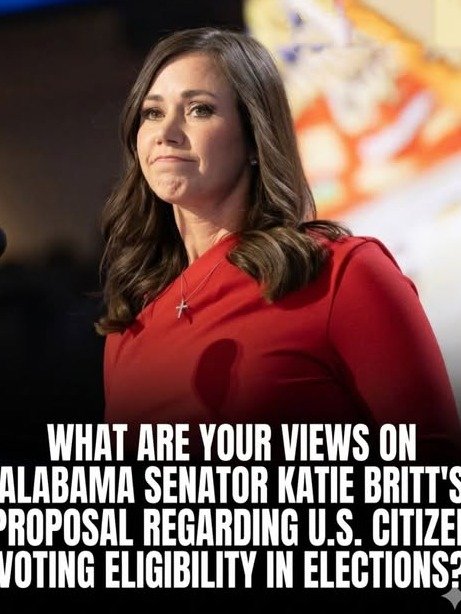
Imagine a scenario where the very foundation of your democracy, the sanctity of your vote, is called into question. A critical debate is sweeping across the nation, challenging the fundamental premise of who is truly eligible to cast a ballot in America’s most important elections. This isn’t just a political skirmish; it’s a vital discussion about national sovereignty and the meaning of citizenship.
At the heart of this escalating conversation is a powerful proposal from Senator Katie Britt, aimed squarely at reinforcing a principle many believe is already etched in stone: that only U.S. citizens should vote in federal elections. But why is this even a debate? And what are the real stakes for every American voter?
The Unwavering Principle: Citizen-Only Voting
For centuries, the right to vote in the United States has been intrinsically linked to citizenship. It’s often viewed as one of the most sacred privileges and responsibilities of being an American. This principle ensures that those who directly elect our leaders and shape our laws are individuals with a vested, long-term interest in the nation’s future, bound by its laws and benefiting from its protections.
Senator Britt’s initiative seeks to cement this understanding at a time when concerns about election integrity are at an all-time high. Her proposal isn’t just about reiterating existing law; it’s about creating a robust, explicit federal standard that leaves no room for ambiguity, ensuring that the voting booth remains exclusively for those who hold U.S. citizenship.
Senator Katie Britt’s Proposal: A Closer Look
The core of Senator Britt’s effort is to proactively safeguard the integrity of federal elections. While current federal law generally restricts voting to U.S. citizens, the senator and her supporters argue that explicit, reinforced legislation is necessary to prevent potential loopholes or future interpretations that could undermine this foundational principle.
The proposal aims to establish a clear, nationwide mandate that voting in all federal elections—for President, Vice President, and members of Congress—is a right reserved solely for citizens. This move is seen by proponents as a crucial step to prevent non-citizens from inadvertently or intentionally participating in the democratic process, thereby protecting the legitimacy of election outcomes.
“The right to vote is the bedrock of our republic, and it must be protected,” Senator Britt has stated. “Ensuring that only American citizens are casting ballots in our federal elections isn’t a partisan issue; it’s a matter of national sovereignty and election security. We must leave no doubt about who has the privilege and responsibility to shape our nation’s future through the ballot box.”
Why Now? Unpacking the Urgency
The timing of Senator Britt’s proposal is no accident. In recent years, public trust in election processes has been a significant point of contention. Debates around voter registration accuracy, ballot access, and election administration have fueled calls for greater clarity and stricter enforcement of voting rules.
While there is no widespread evidence of non-citizens regularly voting in federal elections, instances of non-citizens being registered to vote or even casting ballots, however isolated, tend to generate significant public concern. These incidents, often highlighted by election integrity advocates, underscore the perceived need for stronger federal protections.
Furthermore, discussions around local elections in some jurisdictions, where non-citizens might be permitted to vote in specific municipal contests, sometimes blur the lines for the public. Senator Britt’s proposal seeks to draw a clear distinction, ensuring federal elections remain unequivocally citizen-only.
The Arguments For Reinforcing Citizen-Only Voting
Supporters of Senator Britt’s proposal often cite several key reasons for its necessity:
- Preserving National Sovereignty: The ability to choose national leaders is a defining characteristic of a sovereign nation. Allowing non-citizens to vote could be seen as diluting this sovereignty.
- Protecting Election Integrity: Explicitly barring non-citizens from federal elections adds another layer of security and helps build public confidence in the fairness and accuracy of results.
- Valuing Citizenship: Voting is a fundamental right tied to citizenship. Reinforcing this link upholds the value and responsibilities associated with being a U.S. citizen.
- Preventing Undue Influence: Ensuring that only those with a direct, permanent stake in the nation’s future elect its leaders prevents potential foreign or external influence through non-citizen voting.
- Clarity and Consistency: A clear federal standard would eliminate any potential confusion or discrepancies across different states or localities regarding who is eligible to vote in federal contests.
These arguments emphasize the importance of maintaining a distinct boundary for participation in the nation’s highest-stakes elections, ensuring that the voice of the American citizen remains paramount.
Historical Context of Voting Rights in America
The history of voting rights in the United States is a complex tapestry of expansion and restriction. Initially, voting was largely limited to white male property owners. Over time, the franchise gradually expanded to include:
- All white men (early 19th century)
- African American men (15th Amendment, 1870, though often suppressed until the Voting Rights Act of 1965)
- Women (19th Amendment, 1920)
- Native Americans (Indian Citizenship Act of 1924, though full voting access came later)
- 18-year-olds (26th Amendment, 1971)
Throughout this evolution, the concept of citizenship has remained a constant prerequisite for federal elections. The debates have typically centered on *which* citizens are eligible, not whether non-citizens should be.
Current Legal Framework and Perceived Gaps
Federal law, specifically the National Voter Registration Act of 1993, requires states to ensure that only U.S. citizens are registered to vote. When individuals register, they typically sign an affidavit affirming their citizenship. Falsely claiming citizenship to register or vote is a federal crime.
However, critics argue that the enforcement mechanisms are not always robust enough. They point to cases where non-citizens have been inadvertently registered or have managed to vote, often due to errors in state databases or the honor system inherent in voter registration forms. Senator Britt’s proposal, therefore, seeks to add a legislative layer that explicitly and forcefully reaffirms the citizen-only rule, potentially leading to more stringent verification processes.
Potential Challenges and Broader Implications
While the goal of reinforcing citizen-only voting is widely supported, implementing new federal legislation could present several challenges:
- State vs. Federal Authority: Voting laws are largely administered at the state level. Any federal mandate would need to carefully navigate the balance of power between federal and state governments.
- Verification Processes: How would citizenship be verified more stringently without creating undue burdens for legitimate voters? Concerns about potential voter suppression, particularly for naturalized citizens or those with complex documentation, are often raised.
- Resource Allocation: Implementing new verification measures could require significant resources and administrative changes for state and local election officials.
The broader implications of such a law extend to how states manage their voter rolls, the kind of identification required at polling places, and the overall public perception of election security. It could also reignite debates about the balance between voter access and election integrity measures.
The Path Forward: A National Conversation
Senator Britt’s proposal is more than just a legislative push; it’s a catalyst for a national conversation about the fundamentals of American democracy. It forces us to consider what it means to be a voter, the responsibilities that come with that privilege, and the measures necessary to protect the sanctity of our elections.
As this debate unfolds, it highlights the ongoing tension between ensuring broad access to the ballot box and upholding strict election security. For many, the ability to vote is the ultimate expression of citizenship, and safeguarding that right for citizens alone is paramount to the future health of the republic.
The outcome of this proposal, and the discourse it generates, will undoubtedly shape how Americans view their electoral system for years to come. It’s a reminder that even foundational principles sometimes require explicit reaffirmation in an evolving political landscape.
What This Means for You
For every U.S. citizen, this debate underscores the importance of your participation in the democratic process. It’s a call to understand the laws governing your right to vote and to engage with the discussions shaping election integrity. Your vote is your voice, and ensuring its protection is a shared responsibility.
The efforts to reinforce citizen-only voting are ultimately about fortifying the trust in our elections, ensuring that the results truly reflect the will of the American people – the citizens who call this nation home and are dedicated to its future.
Stay informed, understand the arguments, and recognize the significance of this ongoing dialogue for the future of U.S. elections.
About the Author




