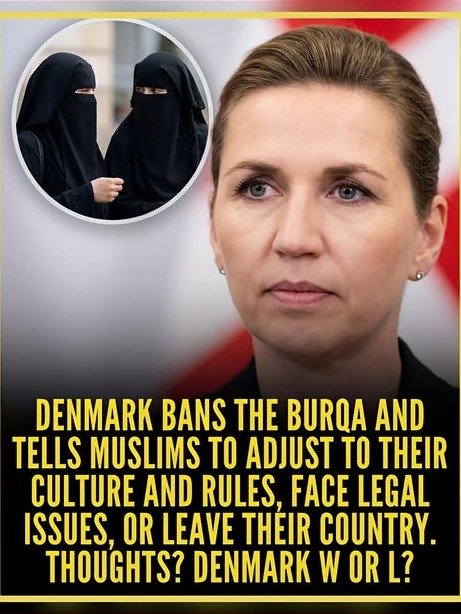
Imagine a country renowned for its progressive values and vibrant democracy, yet one where a simple piece of fabric can land you a fine. This isn’t a dystopian novel; it’s the stark reality in Denmark, where a controversial 2018 law banning face coverings in public spaces has once again ignited a fierce global debate, forcing us to question the very definition of freedom and integration in modern society.
For years, Denmark has been a beacon of social progress, but its stance on specific attire in public has drawn both praise and condemnation. The renewed attention on this policy isn’t just a local squabble; it’s a critical discussion reverberating across continents, highlighting the complex interplay between national identity, religious freedom, and public order.
Denmark’s ‘Burqa Ban’: A Law Born in 2018
The law, often colloquially referred to as the ‘burqa ban,’ officially came into effect on August 1, 2018. It prohibits individuals from wearing garments that cover the entire face in public places, including niqabs, burqas, balaclavas, and even fake beards. While proponents argue it’s a neutral law targeting all face coverings, its primary impact and the subsequent debate have undeniably centered on Muslim women who choose to wear the niqab or burqa as part of their religious practice.
Violators of this law face an initial fine of 1,000 Danish kroner (approximately $150 USD). Repeat offenses can lead to significantly higher penalties, reaching up to 10,000 kroner. This progressive fine structure underscores the government’s determination to enforce the ban, signaling a clear message about what is considered acceptable public dress within Danish society.
The Rationale: Security, Integration, and ‘Danish Values’
The Danish government, along with its supporters, has consistently presented several key arguments for the face covering ban. Chief among these is the concept of public safety and security. Officials argue that full face coverings hinder identification and can pose a risk in certain situations, although specific examples of security threats directly linked to religious face coverings are rarely cited.
Another significant pillar of the argument rests on social integration and communication. Proponents claim that face-to-face communication, where facial expressions are visible, is fundamental to Danish society and essential for successful integration. They suggest that covering the face impedes social interaction and creates barriers between individuals, hindering the process of newcomers becoming part of the broader community.
“It is incompatible with the values of Danish society to have one’s face covered in public space. Respect for the community and the ability to look each other in the eye is a fundamental principle in Danish society,” stated Søren Pape Poulsen, then Minister of Justice, when the law was introduced.
This sentiment reflects a broader focus on what are often termed ‘Danish values’ – an unwritten code of conduct and social norms that the government seeks to uphold. For many, the ban is not just about a piece of clothing but about preserving a perceived cultural identity in the face of increasing diversity.
Voices of Dissent: Human Rights and Religious Freedom at Stake
Unsurprisingly, the law has met with fierce opposition from human rights organizations, religious groups, and civil liberties advocates both within Denmark and internationally. Critics argue that the ban is a direct violation of fundamental human rights, particularly the right to freedom of religion and expression.
Organizations like Amnesty International have condemned the law, stating that it is discriminatory and disproportionate. They emphasize that targeting specific forms of religious dress infringes upon the autonomy of individuals, particularly Muslim women, to practice their faith freely. The argument is that forcing someone to remove a religious garment is as much a violation of religious freedom as forcing them to wear one.
- Discrimination: Critics contend that while the law is framed as ‘neutral,’ its practical application disproportionately affects Muslim women, making it a de facto ban on the niqab and burqa.
- Individual Autonomy: Many argue that adults should have the right to choose what they wear, as long as it doesn’t directly harm others. The state’s role, they believe, should not extend to dictating personal attire.
- Symbolic Gesture: Some see the ban as a largely symbolic act, designed to send a political message rather than address genuine security or integration concerns. They argue it alienates minority communities rather than integrating them.
The debate often highlights the paradox of a liberal society enacting illiberal laws in the name of preserving liberalism. Is a society truly open if it restricts individual expression based on cultural or religious attire?
The Global Echo Chamber: Denmark in Context
Denmark is not an outlier in Europe when it comes to face covering bans. Several other European nations have enacted similar legislation, often sparking comparable controversies. France was the first European country to implement a nationwide ban on full-face veils in public in 2011, followed by Belgium in the same year. Austria, Germany (partial bans), and the Netherlands have also introduced various forms of restrictions.
This pattern suggests a broader European struggle with questions of identity, secularism, and the integration of Muslim minority populations. Each country’s debate, while unique in its local context, contributes to a larger, pan-European discourse on the limits of religious freedom and the nature of public space.
“When you look at Europe, this isn’t an isolated incident. Denmark is part of a trend, and that trend raises serious questions about the future of multiculturalism and human rights on the continent,” noted one international human rights observer.
The renewed global attention on Denmark’s policy often comes when other nations revisit their own similar laws or when new cases of enforcement emerge, creating a cyclical debate that seems far from resolved.
Real-World Impact and Personal Stories
Beyond the legal and political rhetoric, the face covering ban has had tangible impacts on the lives of individuals in Denmark. For Muslim women who wear the niqab or burqa, the law has forced difficult choices: abandon their chosen attire, face fines, or withdraw from public life.
Many women have reported feeling marginalized, targeted, and less free to participate in daily activities such as shopping, using public transport, or attending public events. This sense of exclusion can ironically work against the stated goal of integration, pushing individuals further to the fringes of society rather than drawing them in.
There have been instances of women being fined, leading to public outcry and further polarizing the debate. These personal stories underscore that while the law may be about ‘public order’ on paper, its effects are deeply personal and often painful for those directly impacted.
Navigating Integration and Identity: A Deeper Dive
The core of Denmark’s argument for the ban often revolves around integration. But what does true integration entail? Is it assimilation, where minority groups shed aspects of their cultural or religious identity to conform to the majority, or is it a process of mutual adaptation where diverse identities can coexist harmoniously?
Critics argue that genuine integration is fostered through inclusion, dialogue, and respect for diversity, not through coercive laws that dictate personal appearance. They suggest that the ban can breed resentment and distrust, making true integration more challenging.
- Cultural Clash: The debate highlights a fundamental tension between traditional Danish secularism and the visible expression of religious identity.
- Political Tool: For some, the ban serves as a political tool, allowing parties to appeal to a nationalist sentiment and demonstrate a ‘tough stance’ on immigration and integration issues.
- Societal Cohesion: The long-term impact on societal cohesion remains a key concern. Does the ban bring people closer, or does it create deeper divides within the population?
These questions are not unique to Denmark but are central to the challenges faced by many Western democracies grappling with multiculturalism.
Legal Battlegrounds and Future Prospects
Despite the law being in effect for several years, the legal and ethical questions surrounding it persist. There have been ongoing discussions and calls for its repeal by various groups. While no major legal challenge has overturned the law in Denmark’s highest courts, the European Court of Human Rights has previously upheld similar bans in other countries, though with nuanced judgments that acknowledge the sensitive nature of the issue.
The renewed global attention indicates that this policy is far from settled. As societies evolve and global perspectives shift, the pressure on countries with such bans may intensify. The debate serves as a constant reminder that the balance between individual freedoms and collective societal norms is a delicate one, requiring continuous reassessment and dialogue.
A Complex Future for Freedom and Face Coverings
Denmark’s face covering ban remains a deeply divisive issue, reflecting broader tensions about identity, freedom, and integration in a rapidly changing world. While the government maintains its stance on security and social cohesion, critics continue to highlight the infringement on human rights and religious freedom.
The global community watches, not just to observe Denmark’s internal policies, but to reflect on the universal questions these policies raise. As the debate continues to unfold, one thing is clear: the conversation about what we wear, and why, is far more than just a fashion statement; it’s a profound exploration of who we are as individuals and as a society.
The quest for a truly integrated and free society continues, and Denmark’s policy serves as a powerful case study in the ongoing challenges of achieving that delicate balance.
About the Author




