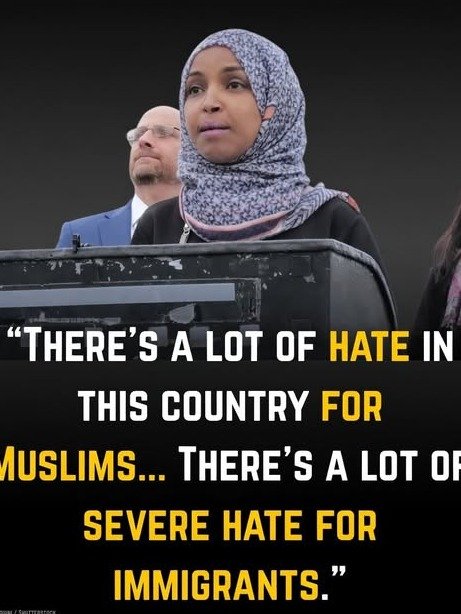
Congresswoman Ilhan Omar recently ignited a firestorm of debate with a stark assertion: that America harbors ‘severe hate’ towards Muslims and immigrants. This isn’t just a casual remark; it’s a powerful indictment that resonates deeply with many, while simultaneously provoking strong disagreement from others.
Her statement forces us to confront uncomfortable questions about national identity, systemic prejudice, and the true nature of American sentiment. But does this sweeping claim truly capture the full, complex picture of a nation as diverse and multifaceted as the United States?
The Heart of the Debate: Omar’s Assertions
Representative Omar’s political discourse frequently highlights what she perceives as deep-seated prejudices within American society. Her arguments often point to systemic issues, discriminatory policies, and rhetoric that she believes fuels animosity towards Muslim communities and immigrant populations.
From travel bans targeting Muslim-majority nations to increased anti-immigrant sentiment, Omar and her supporters argue that these actions are not isolated incidents but symptoms of a pervasive ‘hate’ that needs urgent addressing. They often cite examples of Islamophobia and xenophobia manifesting in various forms, from hate crimes to subtle biases.
This perspective holds that despite America’s founding ideals, a significant undercurrent of prejudice continues to marginalize and threaten these groups. The lived experiences of many Muslims and immigrants, they contend, offer undeniable proof of this societal animosity.
A Closer Look at ‘Severe Hate’ in America
While acknowledging the undeniable challenges of prejudice and discrimination that exist in any diverse society, labeling America as harboring ‘severe hate’ is a claim that demands rigorous scrutiny. The nation’s history is indeed checkered with instances of intolerance, but it is also a story of continuous struggle towards greater inclusion and civil rights.
Millions of immigrants and refugees, including a vibrant and growing Muslim population, have found refuge, opportunity, and built thriving communities within the United States. This reality often stands in stark contrast to the narrative of widespread, intense animosity.
Polls and sociological studies often reveal complex public attitudes, where a segment of the population may hold prejudiced views, but a broad majority expresses tolerance and acceptance. This nuance is critical when discussing such a charged topic.
Unpacking the Trump Administration’s Foreign Policy Shifts
The original post, however, throws a provocative counter-argument into this debate, challenging Omar’s premise by referencing specific actions taken by the Trump administration. It asks: If America truly harbors ‘severe hate’ towards Muslims, then why did President Trump take certain foreign policy steps related to Muslim-majority nations?
This line of questioning pushes us to look beyond domestic rhetoric and examine international actions, particularly those that might appear to contradict a narrative of inherent animosity. Trump’s ‘America First’ doctrine led to significant shifts, often prioritizing national interests as defined by his administration, sometimes in ways that diverged sharply from traditional foreign policy.
The Iran Policy Conundrum: A ’47-Year War’ Ended?
The original post refers to Trump ‘terminating the 47-year Iran war.’ This phrase is a mischaracterization of actual conflict, as the U.S. has not been in a declared war with Iran for nearly five decades. Instead, it likely refers to the long-standing, complex geopolitical tensions, diplomatic standoffs, and proxy conflicts that have characterized U.S.-Iran relations since the 1979 Iranian Revolution.
President Trump’s major policy shift regarding Iran was his withdrawal from the Joint Comprehensive Plan of Action (JCPOA), commonly known as the Iran nuclear deal, in 2018. He argued that the deal was flawed and did not adequately prevent Iran from developing nuclear weapons or address its malign regional activities.
About the Author




