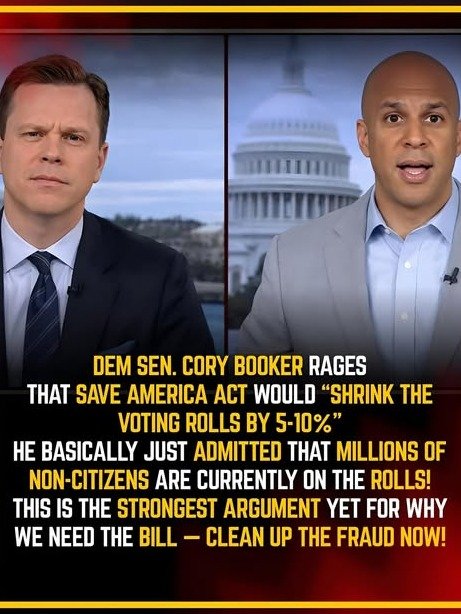
Could a proposed bill fundamentally alter the landscape of American elections, making it harder for millions to cast their ballots? Senator Cory Booker certainly thinks so, and his strong opposition to the proposed SAVE America Act is sending shockwaves through Washington and beyond. This isn’t just another political skirmish; it’s a battle over the very definition of voter access and election integrity, sparking intense debate and drawing the scrutiny of fact-checkers.
At the heart of the controversy lies a seemingly simple requirement: proof of citizenship for voter registration. While proponents argue this measure is crucial for securing elections, critics, including Senator Booker, contend it could disenfranchise legitimate voters and create unnecessary barriers to the ballot box. The stakes are incredibly high, touching upon fundamental questions about who gets to participate in our democracy and how we ensure fair elections for all.
Unpacking the SAVE America Act: What Does It Propose?
The SAVE America Act, a legislative proposal gaining traction among certain political factions, aims to implement a nationwide mandate requiring individuals to provide verifiable proof of U.S. citizenship when registering to vote. This isn’t a minor tweak; it represents a significant shift from current practices in many states, which often rely on sworn affidavits or existing government databases to confirm citizenship.
Proponents of the bill argue that such a requirement is a necessary safeguard against non-citizen voting, which they claim undermines the integrity of American elections. They contend that without explicit proof, the system is vulnerable to exploitation, potentially allowing ineligible individuals to cast ballots and dilute the votes of legal citizens. Their argument often centers on the idea of ensuring that only those constitutionally entitled to vote are able to do so, thereby upholding the sanctity of the electoral process.
Cory Booker’s Vehement Opposition: A Stance for Voter Access
Senator Cory Booker has emerged as a vocal critic of the SAVE America Act, articulating his concerns with passion and clarity. His opposition stems from a fundamental belief that the bill, rather than securing elections, would instead erect significant barriers to voter participation, particularly for marginalized communities and those who may struggle to obtain the specific documentation required.
Booker argues that existing safeguards are already sufficient to prevent widespread non-citizen voting, and that adding a new, stringent requirement would disproportionately impact eligible citizens who lack ready access to birth certificates, passports, or naturalization papers. He emphasizes that many Americans, especially the elderly, low-income individuals, and those in rural areas, might find it challenging and costly to acquire these documents, effectively disenfranchising them.
“This bill is not about protecting our elections; it’s about making it harder for eligible Americans to vote,” Senator Booker has stated, underscoring his deep concern about the potential for voter suppression. “We should be expanding access to the ballot, not creating new hurdles based on unfounded fears.”
His stance aligns with a broader movement advocating for easier voter registration and increased participation, viewing the SAVE America Act as a step backward for democratic inclusion.
The “Misleading or Overstated” Flag: Why the Controversy?
The initial Facebook post regarding Cory Booker’s opposition to the SAVE America Act was notably flagged as “misleading or overstated.” This flag itself highlights the highly contentious nature of the debate surrounding the bill and the claims made by both its supporters and its detractors. It signals that the information presented, or the implications drawn from it, might be disputed by experts or contradict factual evidence.
Such flags often arise when assertions about election fraud or voter suppression lack widespread evidentiary support, or when the potential impacts of a bill are presented in a way that exaggerates their likelihood or severity. In this context, the “misleading” tag could refer to claims about the prevalence of non-citizen voting, the effectiveness of the bill in addressing a genuine threat, or the actual scale of its potential disenfranchising effects.
The Heart of the Debate: Voter Integrity vs. Voter Access
The SAVE America Act and Senator Booker’s opposition to it encapsulate a long-standing tension in American democracy: the balance between ensuring election integrity and maximizing voter access. Both goals are vital, but how they are pursued often leads to conflicting policy proposals.
Arguments for Proof of Citizenship: Election Integrity
- Preventing Non-Citizen Voting: Proponents argue that a proof-of-citizenship requirement is the most direct way to ensure that only U.S. citizens cast ballots, thereby preventing illegal voting that could sway election outcomes.
- Restoring Public Trust: They believe that such measures can bolster public confidence in election results by demonstrating a commitment to secure and verifiable voting processes.
- Fairness and Legality: The argument is often made that voting is a privilege of citizenship, and requiring proof simply upholds this fundamental principle.
Arguments Against Proof of Citizenship: Voter Access and Disenfranchisement
- Voter Suppression: Critics contend that such requirements disproportionately impact eligible voters who may not possess, or cannot easily obtain, the specific documents demanded. This includes elderly citizens born at home, naturalized citizens without accessible naturalization papers, and low-income individuals who face financial and logistical hurdles.
- Lack of Widespread Problem: Opponents often cite studies and data indicating that instances of non-citizen voting are exceedingly rare and statistically insignificant, suggesting that the problem the SAVE America Act aims to solve is largely exaggerated.
- Existing Safeguards: Many states already have mechanisms in place, such as cross-referencing voter rolls with other government databases, to verify eligibility, making a new, more stringent requirement redundant and burdensome.
Legal and Historical Precedents: A Shifting Landscape
The debate over proof of citizenship for voting is not new. It has a rich and complex legal history, marked by various state-level initiatives and federal court challenges. The Supreme Court has weighed in on related issues, often attempting to balance states’ rights to manage elections with federal protections for voting rights.
For example, in cases like Arizona v. Inter Tribal Council of Arizona (2013), the Supreme Court ruled that states could not unilaterally add proof-of-citizenship requirements beyond what was mandated by the National Voter Registration Act (NVRA), which allows for an applicant to attest under penalty of perjury that they are a citizen. However, the ruling left open the possibility for states to *ask* for proof if they could demonstrate that federal forms were insufficient and if the state requirements were not overly burdensome.
This legal landscape means that any federal bill like the SAVE America Act would face intense scrutiny and likely numerous legal challenges, as courts would assess its constitutionality and its impact on established voting rights protections. The tension between federal and state authority over election administration is a recurring theme in these legal battles.
Potential Impact on Different Demographics
Should the SAVE America Act become law, its effects would not be felt equally across the population. Certain demographic groups are predicted to face greater hurdles in complying with a strict proof-of-citizenship mandate:
- Elderly Voters: Many older Americans, especially those born before standardized birth certificates, may lack easy access to official documentation. Retrieving these records can be a significant challenge, involving time, travel, and fees.
- Low-Income Individuals: The cost and effort associated with obtaining certified copies of birth certificates or other documents can be prohibitive for those living paycheck to paycheck.
- Naturalized Citizens: While legally citizens, some naturalized individuals may not always carry or easily access their naturalization certificates, potentially leading to delays or difficulties in registration.
- Students and Mobile Populations: Individuals who frequently move or are new to a state might find it more complex to gather the necessary documentation while navigating new residency requirements.
Critics argue that these disproportionate impacts could lead to a significant chilling effect on voter registration and participation, particularly among communities that already face systemic barriers to political engagement.
The Broader Implications for Democracy
The debate surrounding the SAVE America Act goes beyond the specifics of voter registration; it touches on the fundamental health of American democracy. On one side, there’s a strong desire to ensure the purity and security of the ballot, driven by concerns about potential fraud and the integrity of election outcomes. On the other, there’s an equally fervent commitment to maximizing participation and ensuring that every eligible citizen can exercise their right to vote without undue burden.
Finding a balance between these two crucial objectives is one of the most pressing challenges facing policymakers today. Bills like the SAVE America Act force a critical examination of what we value most in our electoral system and how best to achieve those values in a way that strengthens, rather than weakens, our democratic foundations. The discussion is far from over, and its outcome will undoubtedly shape the future of voting in America.
Conclusion: An Ongoing Battle for the Ballot
Senator Cory Booker’s opposition to the SAVE America Act highlights a deeply entrenched and highly charged debate about the future of voting in the United States. While proponents of the bill advocate for stringent proof-of-citizenship requirements as a means to bolster election integrity, critics like Booker argue that such measures risk disenfranchising millions of eligible Americans and disproportionately impact vulnerable populations.
The “misleading or overstated” flag on initial reports underscores the intense scrutiny and differing interpretations surrounding the bill’s necessity and potential consequences. As this legislative battle continues to unfold, it serves as a powerful reminder of the ongoing struggle to strike a delicate balance between securing our elections and ensuring that every eligible voice can be heard. The conversation around the SAVE America Act is not just about a single piece of legislation; it’s about the very soul of American democracy.
About the Author




