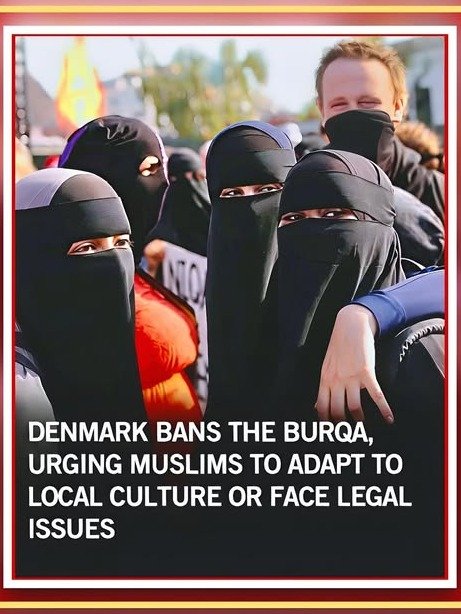
Imagine walking down a street in a democratic nation, only to face a potential fine for what you choose to wear on your face. This isn’t a dystopian fantasy; it’s a very real discussion unfolding right now in Denmark, a nation often lauded for its progressive values and commitment to individual freedoms.
For years, Denmark has been part of a broader European trend grappling with the complex issue of face coverings in public spaces. Now, renewed discussions around these restrictions are igniting fresh debates, with some observers describing the potential policy shifts as an “expansion” of existing bans, stirring both national conversations and international scrutiny.
The Roots of Restriction: Denmark’s 2018 “Burqa Ban”
To fully understand the current fervor, we must look back to 2018, when Denmark enacted its controversial law prohibiting face coverings in public spaces. This legislation, often colloquially referred to as the “burqa ban,” made it illegal to wear garments that cover the face, such as the niqab and burqa, in public. Violators faced fines, starting at 1,000 Danish kroner (approximately $150 USD) for a first offense, escalating for repeat infractions.
The Danish government at the time justified the ban on several grounds. Proponents argued it was crucial for fostering integration, promoting shared societal values, and ensuring public order and safety. The official stance emphasized that open communication and facial recognition are fundamental to Danish society, and full-face coverings impede these essential interactions.
However, from its inception, the law was met with fierce criticism. Human rights organizations, religious groups, and civil liberties advocates condemned it as discriminatory, particularly targeting Muslim women. They argued it infringed upon fundamental rights such as freedom of religion and expression, and that it disproportionately affected a small minority of the population.
What’s Sparking the Renewed Debate and “Expansion”?
Fast forward to today, and the discussion around these restrictions has been reignited, with fresh calls for stricter enforcement or potentially broader interpretations. While no new sweeping legislation has been formally passed to dramatically alter the 2018 law, the public and political discourse has intensified, leading some to perceive an effective “expansion” of its reach and impact.
This renewed focus could stem from a variety of factors. Perhaps it’s a response to evolving societal views on integration, a heightened sense of national identity, or even a reaction to broader geopolitical events influencing domestic policy. Whatever the catalyst, the conversation is no longer just about the legality of the ban, but its practical application and the message it sends about Denmark’s commitment to diversity and individual choice.
Critics suggest that this renewed discussion, even without new legislative text, creates an environment where the existing law is applied with greater rigor, or where its underlying principles are pushed further into public life. This perceived tightening of restrictions raises significant questions about the balance between national identity and individual liberties.
Arguments For the Restrictions: Safety, Integration, and Secularism
Those who advocate for face-covering restrictions often cite a range of deeply held beliefs and practical concerns. A primary argument revolves around public safety and identification. In an increasingly complex world, the ability to identify individuals in public spaces is seen by some as a vital component of national security and crime prevention. Full-face coverings, they argue, hinder this ability, creating potential vulnerabilities.
“Open communication and facial recognition are fundamental to Danish society. We believe that a ban on face coverings makes it easier to interact and engage with each other.” – Statement from a Danish politician during the 2018 debate.
Another significant point is integration and shared societal values. Proponents contend that a society functions best when its members can interact openly and visibly. They believe that face coverings create barriers to communication, foster social segregation, and run counter to Danish norms of openness and equality. From this perspective, the ban is not about targeting any specific group, but about upholding the foundational principles of Danish community life.
Furthermore, some arguments touch upon secularism and gender equality. In countries with strong secular traditions, there is a push to keep religious symbols and practices from dominating public spaces. For some, full-face coverings are seen as symbols of patriarchal oppression, and banning them is framed as a step towards liberating women and promoting gender equality within society. This perspective, however, is often hotly contested by those who see the choice to wear a face covering as an act of personal empowerment and religious devotion.
Arguments Against: Upholding Freedom and Combating Discrimination
On the flip side, opponents of face-covering restrictions raise powerful arguments centered on fundamental human rights and the principles of a liberal democracy. The most prominent concern is the infringement on freedom of religion and expression. For many Muslim women, wearing a niqab or burqa is a deeply personal and spiritual choice, an expression of their religious identity and devotion. Prohibiting this choice in public spaces is seen as a direct violation of their right to practice their faith freely.
Critics also argue that such bans are inherently discriminatory and target specific minority groups. While the law is often framed as “neutral” by referring to “all” face coverings, its practical impact overwhelmingly falls upon Muslim women who wear the niqab or burqa. This selective impact, they contend, amounts to indirect discrimination and stigmatization of an already marginalized community within Danish society.
“This ban is not about freedom. It is about exclusion and making a small group of women feel unwelcome in their own country.” – Amnesty International’s statement on the Danish face covering ban.
Moreover, civil liberties advocates highlight the issue of individual autonomy and the right to choose. They argue that in a free society, individuals should have the right to decide what they wear, as long as it doesn’t directly harm others. State intervention in such personal choices is viewed as an overreach of governmental power and an erosion of personal liberty, setting a dangerous precedent for further restrictions on individual freedoms.
Legal and Human Rights Implications
The Danish face-covering ban, like similar laws in other European countries, has faced significant legal scrutiny and raised serious human rights concerns. Critics argue that the law may violate articles of the European Convention on Human Rights (ECHR), particularly Article 9 (Freedom of Thought, Conscience, and Religion) and Article 14 (Prohibition of Discrimination).
While the European Court of Human Rights has previously upheld similar bans in other countries (like France and Belgium), it has often done so by emphasizing the “living together” argument, suggesting that the requirement for facial visibility in public spaces is a legitimate aim in a democratic society. However, these rulings have not been without dissent and continue to be a source of intense debate among legal scholars and human rights advocates.
For Denmark, the renewed discussion means that the legal and ethical foundations of the 2018 law are once again being put under the microscope, both domestically and internationally. Any perceived “expansion” of its application would undoubtedly face renewed challenges regarding its compatibility with international human rights standards and the principles of a pluralistic society.
Societal Impact and Lived Experiences
Beyond the legal and political debates, the face-covering ban has had tangible and often painful consequences for individuals and communities in Denmark. For women who choose to wear the niqab or burqa, the law has forced them to make difficult choices: either abandon a deeply held religious practice or face isolation, fines, and social stigmatization.
The ban has been reported to lead to increased feelings of alienation and marginalization among some Muslim communities. Rather than promoting integration, critics argue it has pushed some women further out of public life, making them less likely to participate in social, educational, or professional activities for fear of violating the law or facing public harassment. This counterproductive outcome challenges the very premise of the law’s stated goals.
- Increased Isolation: Some women may choose to stay home rather than risk fines or confrontation.
- Social Stigmatization: The law can contribute to negative perceptions and stereotypes about Muslim women.
- Erosion of Trust: It can damage trust between minority communities and state institutions.
- Limited Public Participation: Reduced engagement in civic life, education, and employment.
The societal impact extends beyond those directly affected, potentially fostering a climate of suspicion and division. It raises questions about how a nation balances its desire for social cohesion with the protection of individual freedoms and the rights of its diverse population.
The Broader European Landscape
Denmark is not alone in grappling with these issues. The debate over face coverings is a recurring theme across Europe, with several countries having implemented similar bans:
- France: Was the first European country to implement a full ban on face coverings in public in 2011.
- Belgium: Followed France with its own ban in 2011.
- Austria: Introduced a ban on full-face coverings in 2017.
- Netherlands: Passed a partial ban in 2019, prohibiting face coverings in public transport, schools, hospitals, and government buildings.
These laws reflect a broader European struggle with identity, secularism, and the integration of diverse cultures. Each country’s approach is shaped by its unique history and political context, but the underlying tensions between national values and individual religious freedoms remain a common thread. The renewed discussion in Denmark therefore resonates across the continent, reminding us that these debates are far from settled.
Looking Ahead: Denmark’s Path Forward
The renewed discussion around face-covering restrictions in Denmark indicates that this deeply divisive issue continues to be a live and evolving challenge for the nation. While the precise nature of any “expansion” remains subject to interpretation, the heightened scrutiny undoubtedly signals a period of re-evaluation and potential shifts in how the existing law is perceived and enforced.
The path forward for Denmark will likely involve continued public debate, potential legal challenges, and ongoing efforts to balance competing values. The outcome will not only shape the lives of individuals within Denmark but will also send a powerful message about the kind of society it aspires to be – one that cherishes its shared values while also upholding the fundamental freedoms of all its citizens.
As this debate unfolds, it serves as a crucial reminder for all democratic societies to critically examine how laws designed for “integration” or “safety” truly impact the lives of their most vulnerable citizens. The story of Denmark’s face-covering ban is a microcosm of a much larger global conversation about identity, freedom, and coexistence in an increasingly diverse world.
About the Author




