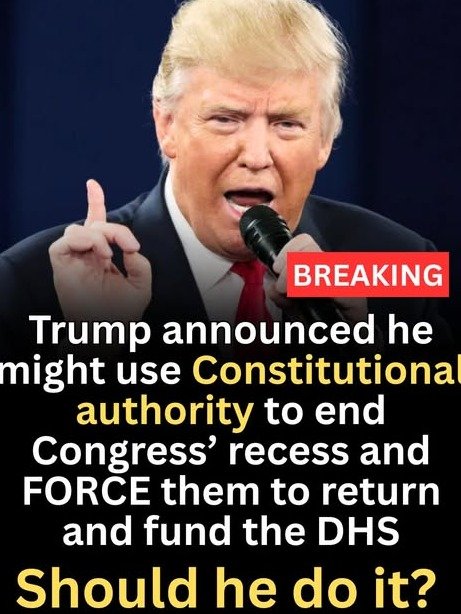
Imagine a President unilaterally ordering Congress to end its recess and return to Washington. Sounds like something out of a political thriller, right? Yet, this extraordinary scenario isn’t just a plot twist from a fictional drama; it’s a very real constitutional power President Trump reportedly weighed during his time in office, a move that could have reshaped the balance of power as we know it.
Reports surfaced during Trump’s presidency indicating that he was exploring the limits of his constitutional authority under Article II, Section 3 of the U.S. Constitution. The target? Cutting short the ongoing Senate and House recess to force lawmakers back to the Capitol. This wasn’t merely a political suggestion; it represented a potential, unprecedented assertion of executive power that sent ripples through Washington and raised critical questions about the separation of powers.
The Forgotten Power: Article II, Section 3 Explained
At the heart of this potential executive maneuver lies a lesser-known, yet immensely powerful, clause within the Constitution. Article II, Section 3 states that the President “shall from time to time give to the Congress Information of the State of the Union, and recommend to their Consideration such Measures as he shall judge necessary and expedient; he may, on extraordinary Occasions, convene both Houses, or either of them, and in Case of Disagreement between them, with Respect to the Time of Adjournment, he may adjourn them to such Time as he shall think proper.”
While the power to “convene” Congress is frequently exercised (e.g., calling special sessions), the power to “adjourn them to such Time as he shall think proper” is the truly contentious part. This specific phrase grants the President authority to set the adjournment date for Congress, but only under a very particular condition: “in Case of Disagreement between them, with Respect to the Time of Adjournment.” This crucial caveat is where the constitutional debate ignites.
A History of Unused Authority: No Precedent for Forceful Recall
Historically, no U.S. President has ever successfully invoked this power to unilaterally force Congress to end an already declared recess or to recall them against their will. The clause has largely been interpreted as a tie-breaking mechanism, intended for situations where the House and Senate cannot agree on a common adjournment date, thereby preventing legislative paralysis.
The framers likely included this provision to ensure that the government could function even in periods of severe inter-chamber disagreement. However, the idea of a President using it to override Congress’s decided recess schedule, or to compel them to return to work when no such disagreement exists, ventures into uncharted and highly controversial territory. It challenges the fundamental understanding of congressional independence.
The Legal Minefield: Interpreting “Disagreement”
The core of the legal debate revolves around the interpretation of “disagreement.” Does it mean a formal, explicit dispute between the House and Senate over when to adjourn? Or could a President argue that congressional inaction or an extended recess, particularly during a perceived national crisis, constitutes a de facto disagreement on the optimal time for legislative activity?
Constitutional scholars are largely in agreement that the power is narrowly defined. They argue that for the President to intervene, there must be an actual, demonstrable inability of the two chambers to agree on an adjournment date. If Congress has already passed a resolution setting its recess schedule, as is typically the case, then a “disagreement” in the constitutional sense would not exist.
“The President’s power to adjourn Congress is extremely limited,” noted one constitutional law expert. “It requires a specific disagreement between the two houses over the time of adjournment. It’s not a general power to recall Congress whenever the President deems it necessary or expedient.”
Why the Consideration? Political Motivations Behind the Move
Why would President Trump reportedly consider such a drastic and constitutionally fraught action? During his term, there were several periods of intense legislative gridlock and pressing national issues that could have fueled such a desire. These included:
- Stalled Nominations: Frustration over the slow pace of Senate confirmations for judicial appointments and executive branch positions.
- Emergency Legislation: The need for rapid action on critical issues like economic stimulus packages (e.g., during the COVID-19 pandemic) or border security funding.
- Legislative Priorities: A desire to push through specific legislative agenda items that were languishing due to congressional recess or opposition.
- Perceived Inaction: A belief that Congress was not acting with the urgency required to address national challenges, prompting the executive to consider extraordinary measures.
For a President eager to project strength and efficiency, the idea of circumventing a perceived legislative slowdown by recalling Congress could have seemed like a direct path to action, despite the immense constitutional hurdles.
The Specter of a Constitutional Crisis
Had President Trump formally attempted to recall Congress from recess using Article II, Section 3, it would have undoubtedly triggered an unprecedented constitutional crisis. The implications would have been profound:
- Legal Challenges: Such an order would almost certainly have been challenged in court, with Congress arguing for its institutional independence. The Supreme Court would likely have been asked to weigh in on the scope of presidential power.
- Congressional Defiance: Members of Congress might have simply refused to return, citing the unconstitutionality of the order, leading to a direct standoff between the executive and legislative branches.
- Political Fallout: The move would have been met with fierce partisan opposition and widespread public debate, further polarizing an already divided nation.
- Erosion of Norms: Even the consideration of such an action tests the unwritten rules and norms that govern the separation of powers, potentially setting a dangerous precedent for future administrations.
The very fabric of the U.S. system of checks and balances would have been put to the ultimate test, with the executive branch potentially asserting a power that fundamentally undermines Congress’s right to manage its own schedule and legislative process.
Checks and Balances: Upholding Congressional Independence
The U.S. Constitution is meticulously designed with a system of checks and balances to prevent any single branch from becoming too powerful. Congress, as the legislative branch, holds significant authority, including the power to set its own calendar, adjourn, and convene. This institutional autonomy is a cornerstone of democratic governance.
Any presidential attempt to unilaterally override a congressional recess schedule would be seen by many as a direct assault on this principle. It would signal an executive overreach, attempting to dictate the operations of a co-equal branch of government. The very essence of legislative independence, crucial for robust debate and deliberation, would be at stake.
Impact on Governance and Future Presidencies
Even though President Trump ultimately did not execute this particular power, the fact that it was reportedly considered highlights the ongoing tension between executive ambition and constitutional limits. It serves as a stark reminder of the constant vigilance required to maintain the delicate balance of power envisioned by the Constitution’s framers.
For future presidencies, the discussion around Article II, Section 3 and the power to recall Congress remains a potent, albeit largely theoretical, weapon. Its consideration by a modern president underscores that constitutional provisions, even those rarely invoked, retain their potential to shape the course of American governance and spark profound debates about the nature of presidential authority.
The Unsettled Question of Power
The reports of President Trump weighing his constitutional authority to cut short a congressional recess under Article II, Section 3 illuminate a fascinating and perilous corner of American constitutional law. It forces us to confront the boundaries of presidential power and the robustness of our system of checks and balances.
While the specific context of Trump’s presidency brought this obscure clause into the spotlight, the underlying questions about executive reach and legislative independence are timeless. Ultimately, the episode serves as a powerful reminder that even the quietest clauses of our founding document hold the potential for dramatic, system-altering interpretations, perpetually challenging the balance of power in Washington.
About the Author




