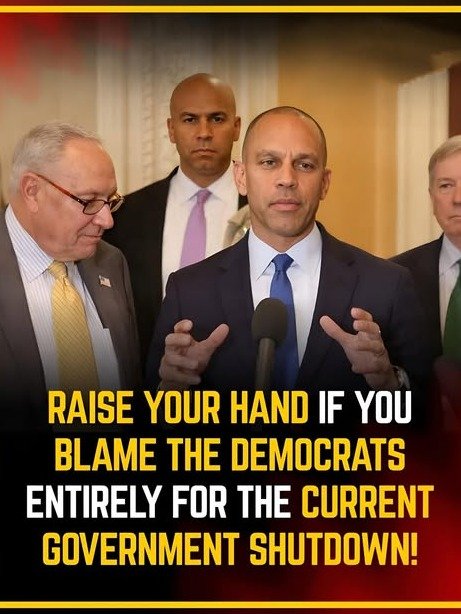
Imagine waking up to find essential government services grinding to a halt, federal employees furloughed without pay, and the national economy teetering on the brink. This isn’t a dystopian novel; it’s the grim reality of a government shutdown, a recurring nightmare in the political landscape. When the gears of government seize up, the immediate question on everyone’s mind is always the same: who is responsible?
The finger-pointing begins almost instantly, a predictable political theater where each side vehemently blames the other. But beyond the partisan rhetoric and the headline-grabbing accusations, lies a complex web of legislative procedures, political ideologies, and strategic maneuvers that truly dictate whether the government remains open or slams shut. Understanding this intricate dance is crucial, not just for political junkies, but for every citizen whose life is impacted.
What Exactly Is a Government Shutdown?
At its core, a government shutdown occurs when Congress fails to pass appropriation bills, or regular funding legislation, for the upcoming fiscal year or a continuing resolution (CR) to temporarily extend funding. Without the legal authority to spend money, non-essential government agencies must cease operations, and hundreds of thousands of federal employees are either furloughed or forced to work without pay.
It’s not just about abstract budget numbers; it’s about real people and vital services. National parks close, passport applications are delayed, scientific research halts, and critical social programs face disruption. The ripple effects extend far beyond Washington D.C., touching communities and industries across the nation, often with devastating personal and economic consequences.
The Roots of the Crisis: A Budgetary Battleground
The United States government operates on a fiscal year that begins on October 1st. Long before this date, Congress is supposed to pass 12 individual appropriation bills to fund various government agencies. This process is designed to be deliberative, allowing for careful consideration of spending priorities and national needs.
However, in an increasingly polarized political environment, these routine budget negotiations often transform into high-stakes battles. Disagreements over spending levels, policy riders (non-fiscal provisions attached to spending bills), or even the national debt ceiling can bring the entire process to a grinding halt. When compromise proves elusive, the deadline looms, and the threat of a shutdown becomes a potent political weapon.
The Human Cost: More Than Just Headlines
While politicians debate on cable news, real people bear the brunt of a shutdown. Federal employees, from TSA agents to scientists at the CDC, face immense financial uncertainty. Many are deemed ‘essential’ and forced to work without pay, while others are furloughed, left scrambling to cover rent, groceries, and childcare with no income.
“A government shutdown isn’t a game; it’s a crisis that plunges families into financial despair and undermines faith in our institutions. The human cost is immeasurable.”
The impact extends to the public as well. Veterans may experience delays in benefits, small businesses seeking loans might find offices closed, and critical health and safety inspections could be postponed. The economy also takes a hit, as consumer confidence wanes and government contracts are put on hold, creating a ripple effect that can slow growth and job creation.
The Blame Game Begins: Who Points Fingers at Whom?
As the clock ticks down to a potential shutdown, the political rhetoric escalates, and the blame game becomes the dominant narrative. Each major player — the President, the House of Representatives, and the Senate — has a distinct role in the budget process, and thus, distinct avenues for both responsibility and deflection.
- The President: The Executive Branch proposes a budget, but Congress holds the “power of the purse.” However, the President can wield significant influence through veto threats, executive orders, and the bully pulpit to shape public opinion and pressure Congress.
- The House of Representatives: As the chamber closest to the people, the House initiates all revenue bills. Its majority party often sets the spending agenda and can be a driving force behind either compromise or confrontation.
- The Senate: The Senate reviews and amends House-passed bills. With its unique rules, including the filibuster, a minority in the Senate can often block legislation, making bipartisan cooperation essential for passage.
The President’s Role: Executive Power and Political Leverage
While the President cannot directly appropriate funds, their leadership and negotiating style are pivotal. A President can propose a budget, but more importantly, they can use the threat of a veto to push Congress towards their preferred spending levels or policy outcomes. Conversely, a President might demand specific concessions, such as funding for a border wall or a particular social program, using the shutdown as leverage.
The Executive branch also controls the messaging. The President and their administration often frame the debate, pointing fingers at congressional intransigence or specific party factions. Their ability to rally public support or condemn opposition tactics can significantly shift the dynamics of the blame game, often painting themselves as the reasonable party seeking compromise.
Congress’s Conundrum: Divided Control and Ideological Standoffs
The legislative branch, particularly a divided Congress, is often the primary stage for shutdown dramas. When one party controls the White House and another controls one or both chambers of Congress, budget negotiations become inherently more difficult. Each party seeks to advance its agenda and appeal to its base, often leading to seemingly intractable ideological standoffs.
Within Congress itself, internal divisions can exacerbate the problem. Moderate members may be willing to compromise, but they often face pressure from more extreme factions within their own party. This internal tug-of-war can make it incredibly difficult for leadership to coalesce around a consensus, leading to paralysis and an eventual shutdown.
Historical Precedents: Learning (or Not Learning) from the Past
Government shutdowns are not a new phenomenon. The modern era of shutdowns largely began in the 1970s, but they became particularly prominent in the mid-1990s, with significant shutdowns occurring under Presidents Clinton, Obama, and Trump. Each instance offered a unique blend of political circumstances, but the pattern of blame-shifting remained remarkably consistent.
In many cases, the party perceived by the public as having initiated the shutdown, or as being less willing to compromise, often suffered a political backlash. However, the exact political fallout can be unpredictable, making the decision to force a shutdown a high-stakes gamble for any political party. The lessons from history often seem to be forgotten in the heat of the moment.
Beyond the Blame: What’s the Real Impact?
While the “who’s responsible” debate dominates headlines, the actual impact on the country is far more significant than political optics. Beyond the immediate disruption and financial hardship, repeated shutdowns erode public trust in government’s ability to function. They create uncertainty for businesses, damage America’s reputation on the global stage, and hinder long-term planning for critical government services.
The focus on blame often distracts from the fundamental issues that lead to these impasses. It shifts attention away from genuine policy disagreements and towards tactical maneuvering, making it harder to find durable solutions that serve the public good rather than partisan interests. The question isn’t just who caused *this* shutdown, but how we can prevent the next one.
Moving Forward: Can We Break the Cycle?
Breaking the cycle of government shutdowns requires more than just assigning blame; it demands a fundamental shift in political culture. It necessitates a renewed commitment to bipartisan negotiation, a willingness to compromise, and a recognition that the functioning of government should not be held hostage to ideological purity or political brinkmanship.
Potential solutions include reforms to the budget process, such as moving to a biennial budget or implementing automatic continuing resolutions to prevent shutdowns. Ultimately, however, it comes down to leadership – leaders in both parties who prioritize governing over political posturing, and who understand that the ultimate responsibility lies with those elected to serve the people, not just their party.
Your Voice Matters: Holding Leaders Accountable
The next time you hear about a looming government shutdown, remember that the blame isn’t a simple equation. It’s a complex interplay of power, politics, and personality. As citizens, our role is to look beyond the headlines, understand the underlying dynamics, and most importantly, hold our elected officials accountable for both their actions and their inactions.
Demand transparency, encourage compromise, and recognize that the true cost of a shutdown is borne by everyone. Only then can we hope to move past the endless blame game and ensure our government consistently serves the people it was designed to protect.
About the Author




