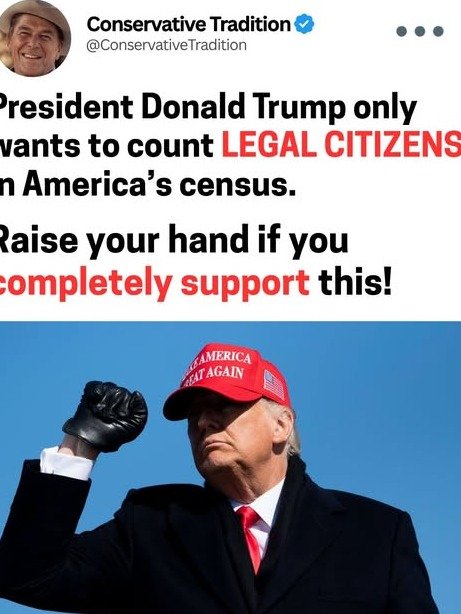
Imagine a scenario where the very foundation of your state’s political power and access to federal resources could be dramatically altered overnight. This isn’t a hypothetical thought experiment; it’s the core of a contentious proposal by former President Donald Trump to fundamentally change how the national census counts its population.
His vision? To retake the national census and count only legal American citizens. Such a shift would send shockwaves through the political landscape, potentially redrawing congressional maps, reallocating billions in federal funding, and sparking a constitutional debate unlike any we’ve seen in generations.
The Census: A Constitutional Cornerstone
For over two centuries, the United States Census has been more than just a headcount; it’s a constitutional mandate. Article I, Section 2 of the U.S. Constitution explicitly requires an ‘actual Enumeration’ of ‘the whole number of persons in each State’ every ten years. This foundational directive has always been interpreted to include every individual residing within U.S. borders, regardless of their legal status or citizenship.
This comprehensive count is crucial for several reasons. Primarily, it dictates the apportionment of seats in the U.S. House of Representatives among the states. States with growing populations gain representation, while those with slower growth or decline may lose it. It’s a direct link between population and political power.
Trump’s Vision: A Paradigm Shift
Former President Trump’s proposal, however, seeks to introduce a radical departure from this long-standing tradition. His stated intention is to conduct a census that specifically excludes non-citizens from the count used for congressional apportionment. This means only individuals who are legal American citizens would be factored into the numbers determining how many representatives each state gets in Washington D.C.
This isn’t a new idea, but it gained significant traction during his previous administration. Proponents argue that counting only legal citizens for apportionment purposes would ensure that political power is truly reflective of the citizen electorate, preventing states with large non-citizen populations from gaining undue influence in Congress.
The Stakes Are Immense: Congressional Power
The most immediate and impactful consequence of such a change would be a dramatic reshuffling of congressional seats. States with significant populations of non-citizens, particularly those along the southern border or with large urban centers, would likely see a substantial reduction in their official population count for apportionment purposes.
Consider states like California, Texas, Florida, and New York, which are home to millions of non-citizens. If these individuals were excluded from the census count, these states could lose multiple congressional seats. Conversely, states with smaller non-citizen populations might see their relative share of representation increase, even if their overall population growth is modest.
“This isn’t merely about numbers; it’s about the very balance of power in our federal government. Every lost seat means less influence on national policy, less of a voice for a state’s unique needs and interests.”
This shift wouldn’t just affect the House of Representatives; it would also indirectly impact the Electoral College. Since each state’s electoral votes are determined by its total number of representatives plus its two senators, a change in House apportionment directly translates to a change in presidential election dynamics.
Billions on the Line: Federal Funding Implications
Beyond political representation, the census data serves as the backbone for distributing over $1.5 trillion in federal funding annually across states and communities. This massive sum supports a vast array of vital programs and services, including:
- Medicaid and Medicare
- Highway planning and construction
- School lunch programs
- Housing assistance
- Emergency services and disaster relief
- Community development block grants
If the census were to count only legal citizens, the official population figures used for these funding formulas would drastically change. States and localities with large non-citizen populations would see their allocated share of federal dollars plummet, even if their actual need for services remains high.
This could create a severe funding crisis for many communities, forcing cuts to essential services, layoffs of public employees, and a general decline in infrastructure and support systems. The economic ripple effect would be profound, impacting everything from local schools to hospitals and public transportation.
The Legal Battleground: Constitutionality and Precedent
Any attempt to exclude non-citizens from the census count for apportionment would undoubtedly face immediate and intense legal challenges. The explicit constitutional language of ‘the whole number of persons’ has been consistently interpreted by courts, including the Supreme Court, to mean all residents, regardless of legal status.
In 2020, the Trump administration attempted to add a citizenship question to the census, leading to a major Supreme Court battle. While the Court did not rule on the constitutionality of a citizenship question itself, it blocked its inclusion, citing insufficient justification from the Commerce Department. The legal arguments against excluding non-citizens from the apportionment base are even stronger, resting on centuries of practice and direct constitutional interpretation.
Opponents argue that such a move would be a clear violation of the 14th Amendment’s Equal Protection Clause and the long-established principle of ‘one person, one vote,’ which applies to all residents, not just citizens. They contend that the framers intended for representation to be based on actual inhabitants, not just the voting eligible population.
Arguments for a Citizen-Only Count
Proponents of a citizen-only count often center their arguments on principles of fairness and national sovereignty. They argue that:
- Fair Representation: Congressional seats should reflect the citizen population that is eligible to vote and participate in the democratic process.
- Preventing Undue Influence: Counting non-citizens, especially undocumented immigrants, grants political power to states based on populations that cannot vote, potentially diluting the voice of citizens in other states.
- Resource Allocation: Federal resources should primarily benefit legal citizens and taxpayers, and funding formulas should reflect this.
They see the existing system as an outdated interpretation that no longer serves the best interests of the citizenry, especially in an era of increased immigration debates.
Arguments Against a Citizen-Only Count
Conversely, those who oppose a citizen-only count raise significant concerns:
- Constitutional Fidelity: The plain language of the Constitution and historical precedent clearly mandate counting ‘persons,’ not ‘citizens,’ for apportionment.
- Practical Challenges: Accurately determining citizenship status for every resident in a nationwide census would be an unprecedented logistical nightmare, fraught with errors and potential for discrimination.
- Undercounting Risk: Efforts to identify and exclude non-citizens could lead to widespread fear and distrust within immigrant communities, causing an undercount of the entire population, including citizens, and thus distorting data for all purposes.
- Economic and Social Disruption: Excluding non-citizens would lead to massive funding cuts for communities where non-citizens live, work, and contribute to the economy, creating a ripple effect that harms everyone.
They emphasize that all residents, regardless of status, use public services, contribute to the economy, and require representation to some degree, and therefore, their presence must be acknowledged in the census.
The Data Dilemma and Future Implications
Beyond the legal and political battles, the practicalities of a citizen-only count present enormous hurdles. How would citizenship status be verified for every person? Would it rely on existing government databases, or would new, intrusive questions be added to the census form? The accuracy and privacy implications of such data collection are vast and largely unresolved.
This debate underscores a fundamental philosophical divide about who constitutes ‘the people’ in America’s democratic framework. While the Constitution has historically cast a wide net, the push for a citizen-only count reflects a desire to narrow that definition, with profound consequences for the future of American governance.
What Lies Ahead?
As the nation looks towards future electoral cycles, the prospect of a census re-evaluation remains a potent and highly charged issue. Should former President Trump return to office, this proposal would undoubtedly be a top priority, igniting a fresh round of legal challenges, political debates, and public discourse.
The outcome could fundamentally alter the balance of power in Washington, reshape the flow of federal dollars to your community, and redefine the very meaning of representation in the United States. It’s a silent revolution brewing, and its impact could be felt by every American, in every state, for decades to come.
About the Author




